|
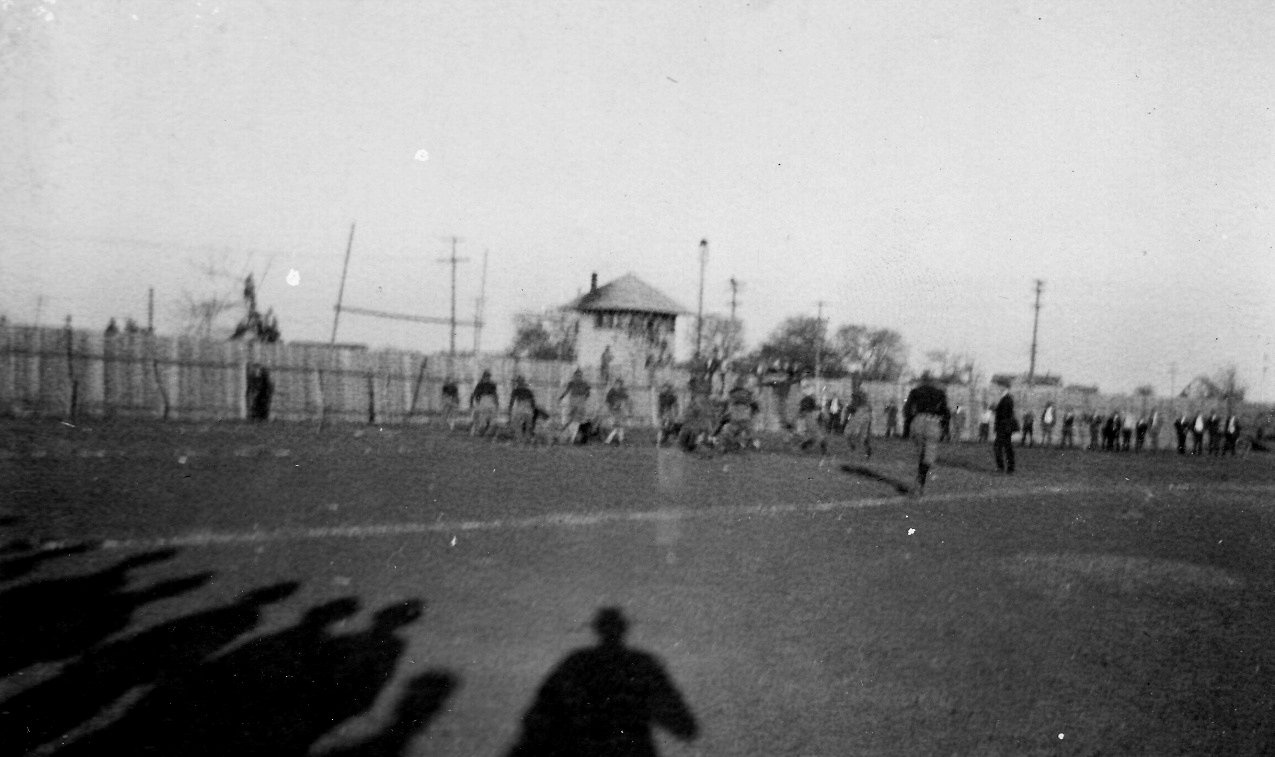
Above: The unidentified photographer that
snapped this photo of a football game in Whitewright in 1924 likely paid
no attention to the railroad structure looming in the background. Tower
101, visible just beyond the fence, sat in the northwest quadrant of a
right-angle crossing of the north / south Missouri, Kansas & Texas
("Katy") Railway and the east / west St. Louis Southwestern (SSW,
"Cotton Belt") Railway. A clear, autumn day with a late afternoon sun low in the
southwest sent the spectators' shadows directly toward the southwest
corner of the tower. The SSW double-track sits
between the fence and the south side of the tower. A signal post with
both semaphores in the down position is visible to the right of the
tower, adjacent to the Katy tracks which pass the east side of the
tower. The poor quality of the photo limits architectural clues as to
which railroad built it. This is the
only image of Tower 101 that has been found (image courtesy of the
Whitewright Public
Library; special thanks to the
library staff for their
assistance.) Right: At full resolution, the blurry image appears to show spectators standing on a staircase on the south side of the tower. Although football is being played, the field is identified on Sanborn Fire Insurance maps of the era as a "Base Ball Park" including a grandstand. A century later, the site remains a baseball facility, but staff at the Whitewright Public Library confirm that it was also used for football until a new stadium was built at Whitewright High School in the 1980s. |
 |
After the Missouri, Kansas & Texas ("Katy") Railway bridged the Red River in late 1872,
it established a base of operations
in the new town of Denison. The Katy was based in
Kansas and had tracks in Missouri and Oklahoma. At Denison, it connected to the
Houston & Texas Central (H&TC) Railway which had completed a lengthy
route between Houston and Denison about the same
time. The H&TC connection worked very well; noted Texas rail historian S. G.
Reed described it as "practically a through line." The Texas
Legislature had passed a law in 1870 to incentivize the Katy to build south
across the Red River by authorizing it to continue building to the Rio Grande
under its Kansas railroad charter. The Katy remained at Denison, choosing to go
no further into Texas
at least in part due to financial difficulties that resulted in a short
receivership. Toward the end of the 1870s, investors saw profitable opportunities
in building rail lines out of Denison to serve as feeder routes for the
Katy. They were encouraged to do so by the Katy, and there was at least a tacit
understanding that the Katy would work cooperatively with finished lines while
considering potential acquisition.
The first such effort was chartered as the
Denison & Southeastern (D&S)
Railway in 1877. The goal of the D&S was to build from Denison to the town of
Greenville fifty miles southeast. Greenville was a good target because
the East Line & Red River (EL&RR) Railroad had arrived there in 1876
with a 120-mile line from Jefferson. Jefferson was Texas'
sixth largest town at the time, a major trading center located on Big Cypress
Bayou near the Louisiana border. Its significant
population was attributable to its riverport, one of the largest inland ports in
the U.S. with water access to New Orleans and
St. Louis. The EL&RR plan was to build to 32 miles farther west to McKinney, a town on the H&TC line south of Denison.
There, it hoped to capture southbound export freight to be
forwarded to Jefferson for delivery by barge or steamship to New Orleans. As the EL&RR paused in Greenville to raise additional capital before
continuing west, the D&S
initiated construction from Denison southeast to Greenville to establish a through route between Denison and
Jefferson.
The D&S Board of Directors consisted almost exclusively of New York
financiers. One of them, William Whitewright, took
advantage of his knowledge of the expected route and bought land in its path,
planning to profit from selling real estate at a new town he would establish. He
founded his namesake community in early 1878 and began preparing for the tracks to
reach Whitewright. When they did, he arranged an excursion train from Denison on April 17, 1878 to bring crowds to Whitewright for an auction of
town lots. The D&S did not build beyond Whitewright for two years, but during
that time, regular trains were operated by the Katy between Denison and
Whitewright. It's doubtful the D&S ever planned to acquire its own rolling
stock. The intention all along was to make the line sufficiently attractive
that the Katy would buy it.
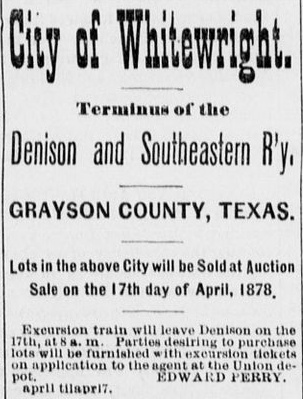 |
Left: Promoters of the new town of Whitewright
placed this advertisement in the Dallas
Daily Herald of April 10, 1878 to announce the excursion
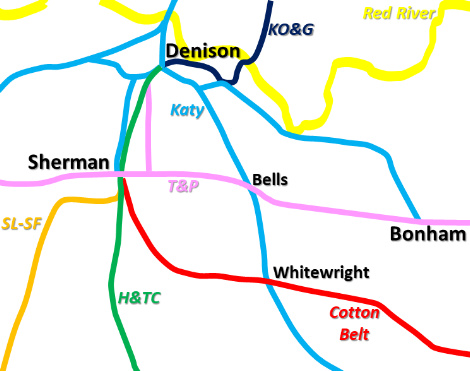
train scheduled for April 17th to serve the town lot auction. Right: area map for railroads in the vicinity of Whitewright c.1904 Railroad Abbreviations: Katy: Missouri, Kansas & Texas Cotton Belt: St. Louis Southwestern T&P: Texas & Pacific H&TC: Houston & Texas Central SL-SF: St. Louis & San Francisco ("the Frisco") KO&G: Kansas, Oklahoma & Gulf |
 |
 |
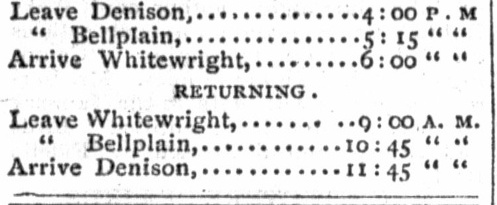 |
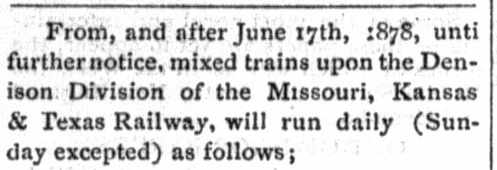
Left: Two months after the excursion train to Whitewright for the town lot auction, the Denison Daily News of June 17, 1878 published this schedule for service by the Denison Division of the Katy from Denison to Bellplain (later named Bells) continuing to Whitewright and return. The D&S did not have its own rolling stock so the Katy operated the line. |
While Whitewright was planning and conducting the sale of town lots, another railroad similar to the D&S, the Denison & Pacific (D&P), was chartered in April, 1878. One of the individuals involved was Ben Munson who could arguably claim to have been the founder of Denison. The D&P built from Denison west to Gainesville, 42 miles west, but by the end of 1879, it had stopped operating. In January, 1880, a newspaper report suggested that the D&S and the D&P had been acquired by a financial group run by stock and bondholders of the Katy, presumably major investors who intended to shore up the value of the railroads to make the combined enterprise attractive for acquisition by the Katy. On March 11, 1880, the D&S acquired the D&P, and twelve days later, the D&S modified its charter to authorize the westward expansion embodied in the D&P. The charter revision also changed the name of the combined enterprise to the Missouri, Kansas & Texas Extension Railway. Under that name, the railroad completed construction from Whitewright to Greenville during the remainder of 1880.
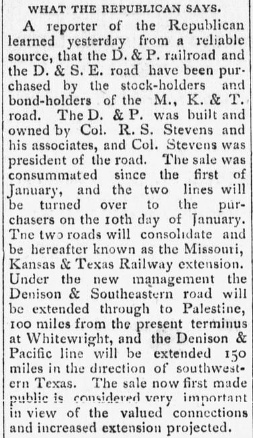 |
Left: The
Denison Daily News of January 8,
1880 repeated a news item from another newspaper ("the Republican",
location unknown) that a group of stock and bondholders of the Katy
had obtained investment capital to buy both the D&S and the
D&P. Supposedly the sale had been consummated during the first week of
January and the lines would be combined into a new railroad, the
"Missouri, Kansas & Texas Railway extension." The railroad would ultimately
be known as the Missouri,
Kansas & Texas Extension Railway. The southeast extension to Palestine
went as
far as Mineola. The southwest extension,
"150 miles" with no specified endpoint, ended up being west-northwest to
Wichita Falls and beyond. The obvious objective was to induce the Katy
to buy the railroad. Right: This article reports a contract let to John Scullin (one of the founders of the D&P) to extend the D&S line from Whitewright to Greenville. The article claims the D&S was "now owned and operated" by the Katy. Operated, yes, but not yet owned. The reporter may have been confused hearing the new name "Missouri, Kansas & Texas Extension Railway." The story conveys the reality that this was a Katy operation all the way, regardless of who owned the tracks or when the legal paperwork might catch up. |
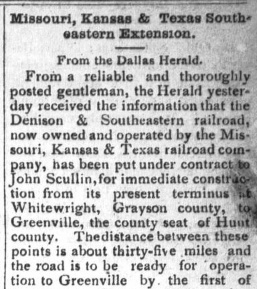
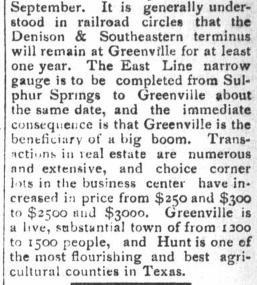 Above: Denison Daily News, April 15, 1880 |
The sudden move by investors to acquire and merge the D&S and D&P, and
change the name, was undoubtedly driven by rail baron Jay Gould. Gould had been
extending his east coast rail empire into the Midwest and had determined that he
needed a Texas railroad -- he chose the Katy -- to provide access to Gulf ports
and Mexico. Gould was a long term planner, and it is obvious that he had
contemplated this migration for many years. The Katy's bridging of the Red River in 1872 motivated Gould to begin infiltrating Katy management with
his henchmen. The Katy's stock was too diluted and insufficiently traded for
Gould to attempt to buy a controlling interest, his usual playbook. His
alternate approach took longer but achieved the same result, culminating in
December, 1879
when his loyalists were able to have him named President of the Katy. A year later, Gould leased the Katy to Missouri Pacific (MP), a
St. Louis-based railroad he controlled
with a major ownership position. The terms of the Katy's lease were
onerous, enabling Gould to siphon Katy profits into MP to his benefit but to the detriment of Katy
stockholders. Gould directed the Katy to acquire the Missouri,
Kansas & Texas Extension Railway and it
did so in November, 1881.
Gould also became tangentially involved with the next railroad at Whitewright, the St.
Louis, Arkansas & Texas (SLA&T, "Cotton Belt") Railway.
It had built a 109-mile branch to
Sherman
in 1887 from its main line at Mt. Pleasant. En route to Sherman, the SLA&T crossed the
Katy at a right angle on the southeast side of Whitewright. Gould saw the Cotton
Belt as a threat to his Texas business, but he also discerned that it was
in financial trouble despite recently coming out of receivership. SLA&T President
Sam Fordyce had told the bankruptcy judge that there were unresolved
operational issues that would impede its growth and profitability, but the judge
insisted that the receivership be terminated using the plan he had developed. Gould
sensed an opportunity and made a secret agreement with Fordyce to cooperate on
traffic through Texarkana where MP and the Cotton
Belt both operated as gateways to St. Louis and the Midwest. Working closely with Fordyce allowed Gould to
make short term loans to the Cotton Belt and buy blocks of its stock privately. This positioned him
to have a major influence on the Cotton Belt's reorganization when it inevitably
went back into receivership, in May, 1889, as Ford had anticipated.
While
working with Fordyce, Gould was also trying to prevent a Katy stockholders'
meeting, resorting to litigation at one point. In May, 1888, the stockholders
were finally able to convene a quorum at a special meeting called for the
purpose of firing Gould for malfeasance regarding the MP lease. New Katy
management immediately sought bankruptcy protection and requested a court order
dissolving the MP lease, which was granted. This was in the midst of greater legal and financial turmoil for
the Gould regime, much of it related to lawsuits filed by the new Texas Attorney
General Jim Hogg elected in November, 1886. Hogg had campaigned on a platform of
suing the railroads for various infractions of their state-issued charters. Hogg
had sued the Katy for unlawfully owning the EL&RR which had been purchased and
transferred to the Katy by Gould in 1881. The Katy was not headquartered in
Texas nor did it have a Texas-based subsidiary, thus it was legally ineligible to own
other railroads in Texas.
In
June, 1891, the property of the SLA&T was
conveyed to the newly chartered St. Louis
Southwestern (SSW) Railway which would become the new "Cotton Belt".
Gould was heavily involved in the reorganization and he arranged for his son
Edwin to be named SSW Vice President. When Fordyce left the company in 1898,
Edwin rose to President and remained in that position until his retirement in
1925. By that time, the Gould family no longer had a financial interest; the SSW
went through ownership changes that ultimately resulted in a controlling
interest owned by Southern Pacific (SP)
in 1932.
When the legal situation with the Katy was finally settled in late 1891, Gould
was able to retain two other Texas railroads in his portfolio, but the Katy was
made
fully independent, owned by its stockholders. It would operate under a new Texas charter law passed in
October, 1891 that established a Texas-based subsidiary to own the Katy's tracks
and the other Texas railroads it was allowed to keep. The EL&RR was not
among those because it had been put
into receivership when the Texas Supreme Court ruled in February, 1890 that the
Katy's ownership of the EL&RR was, in fact, unlawful. The new Katy charter law
was signed by Governor ... Jim Hogg! Hogg had been elected in November, 1890 on
a platform advocating greater state regulation of railroads. This resulted in
the establishment of the Railroad Commission of Texas (RCT) in 1891. Jay Gould
had limited time to react to all of these changes; he died in December, 1892. His eldest son George ascended to the
top of the family rail empire.
Served by two railroads, Whitewright
prospered as the principal supply and shipping center for the agriculture-based
economy in the area. The population peaked at 1,804 in 1900 and remained
relatively stable after that. When RCT was given authority by the Legislature in
1901 to manage grade crossing safety for railroads, RCT proceeded to order swing
gates installed at all such crossings; presumably this was done in Whitewright. RCT did not order
the Whitewright crossing interlocked until January, 1914. Why the delay? Traffic
through Whitewright was not heavy and both depots were relatively close to the
crossing. Trains would typically stop at the depot, hence the added delay of a
brief stop at the crossing was not significant. RCT's limited engineering staff
had to approve designs and inspect installations at every interlocking tower in
Texas, incentivizing RCT to roll out interlocking orders on a manageable basis.
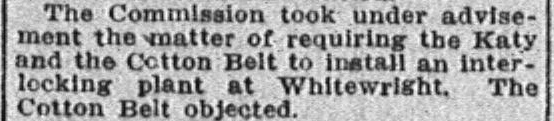 Above: The Austin Statesman of January 14, 1914 briefly noted the outcome of a meeting held by RCT to discuss ordering an interlocker for the crossing at Whitewright. That the Cotton Belt did not want the plant is not surprising. The Sherman line was a Cotton Belt branch with few trains, hence the delay of a complete stop at the crossing was not a significant operating penalty. The Katy track was a main line because it carried named passenger trains between Dallas and the Midwest (Kansas City, St. Louis.) The Katy wanted improved operations for trains that did not need to stop at Whitewright, but these would only have been Katy trains, hence the SSW was not interested in sharing the cost of building and operating a tower. Whether the Katy had requested a tower order is undetermined. 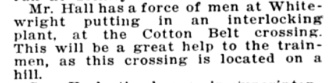 Above: This news item appeared in the Katy's employee magazine in September, 1914. That the Katy was doing interlocker installation work at Whitewright suggests that the tower was a Katy design. |
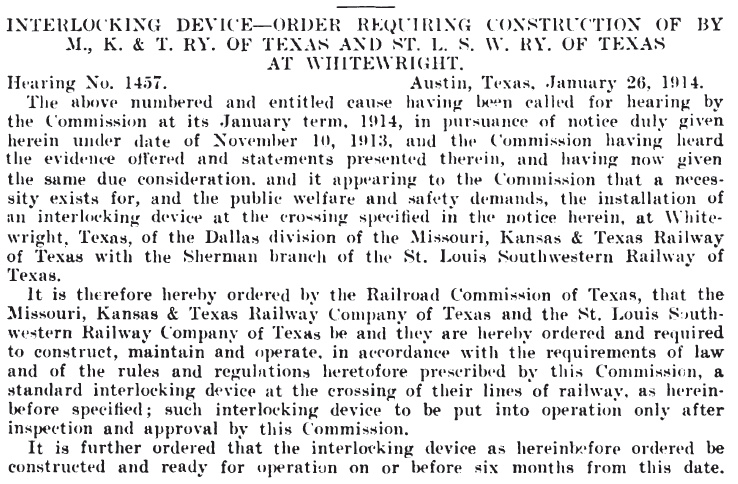 Above: RCT issued an order on January 26, 1914 requiring installation of an interlocking plant at the Whitewright crossing within six months. (RCT 1915 Annual Report.) |
More than ten months after RCT's order, Tower 101 was authorized for operation by RCT on December 1, 1914. It was a 2-story manned tower incorporating a 23-function manual interlocker. A typical minimal interlocking plant had a dozen functions, so the higher function count suggests that there were additional tracks to be controlled by tower operators. The Sanborn maps below show that at least by 1920, both railroads had a main track and a siding adjacent to the tower. The extra interlocking functions when the tower opened in 1914 were almost certainly switches, signals and derails for multiple sidings.
 |
Left:
The 1929 Sanborn Fire Insurance Co. map of Whitewright shows the
crossing of the two railroads four blocks south of downtown. Both
railroads had double tracks at the crossing due to lengthy siding tracks
in town. Below: The depiction of the tower
in 1929 changed from 1920 in the location of the door ('o'). Perhaps the
tower was rebuilt (or substantially modified) between those years. If a
staircase is visible in the 1924 tower
image above, the door seems to be nearer the southwest corner, not the
southeast corner as on the 1920 map. By 1929, the staircase
would not be visible from the football field. Thus if there really was a
door near the southwest corner, then the 1924 image
matches neither map precisely. The Katy often used
concrete as the primary material for its interlocking towers, hence the
cartographer's note of "stucco" on the 1920 map does not help confirm
Katy construction. But the Katy was most likely the builder of the wood towers
erected at Jefferson, Alvarado
and Celeste, all of which preceded Tower 101. |
The Katy is known to have had O&M responsibility for Tower 101 at Whitewright as of 1916 when RCT began reporting that information (the information also shows the Katy with O&M responsibility at Jefferson, Alvarado and Celeste.) In most cases, the railroad that took O&M responsibility was also the one that had designed the tower. The Katy had by far the greater incentive to have Tower 101 properly staffed and maintained to prevent delays through Whitewright whereas the Cotton Belt opposed the erection of an interlocking tower. Given the Katy's greater incentive (main line vs. branch line) plus the Katy employee magazine note and the O&M responsibility, all signs point to Tower 101 as having been designed and built by the Katy.
Right: This c.2008 "birds eye view" image from
Microsoft Visual Earth has been annotated to show the rights-of-way at
the former Tower 101 crossing. The tower's foundation is visible and it
remains intact today. The baseball field is also still in use. The
former Katy tracks remain operational, now belonging to Genesee &
Wyoming, Inc. and operated by two of its subsidiaries: the Texas
Northeastern Railroad and the Dallas, Garland & Northeastern Railroad. Near Right: This 1959 aerial image shows that when lined for football, the field was played parallel to the Katy tracks. By 1959, the Cotton Belt tracks had been abandoned (1953) and removed. The tower was no longer intact, but its foundation is clearly visible in the upper right corner of the image as a white rectangle to the left of the Katy tracks. ((c)historicaerials.com) |
 |
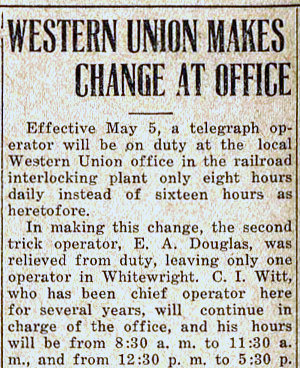
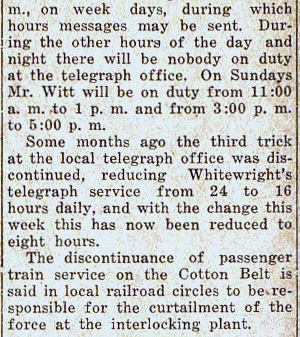
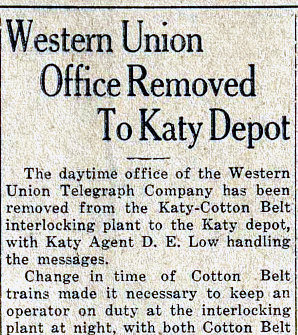
| Right: The Whitewright Sun newspaper of May 5, 1932 detailed that telegraph operations in the "interlocking plant" were becoming daytime only, eight hours per day. The story mentions that months earlier, the service had been cut back from 24 hours to 16 hours. This appears to have resulted from a staffing reduction in the tower that was blamed on the Cotton Belt eliminating passenger service to Whitewright. The story implies that previously, there had been a late night Cotton Belt passenger train that had justified the need for 24/7 staffing in the tower. |
 |
 |
 |
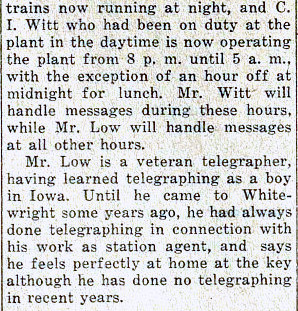 |
Left: A year later, the Whitewright Sun reported on July 13, 1933 that daytime telegraph operations were being moved from the tower to the Katy depot. Apparently, a change to the Cotton Belt's schedule resulted in the need for a tower operator overnight and eliminated the need to staff the tower during the day. The implication is that under the revised schedule, the Cotton Belt ran zero trains through Whitewright during the day, so it was acceptable to line the signals for unrestricted passage on the Katy and leave the tower unmanned. |
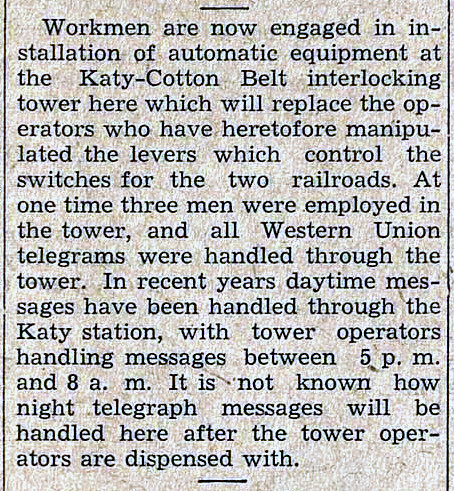  |
Left, Top: The Whitewright Sun
of October 14, 1943 briefly mentioned that the crossing at the "Katy -
Cotton Belt interlocking tower" was in the process of being upgraded
with "automatic equipment" which would eliminate the need to staff the
tower. Although a trackside cabin could have been used for the new
equipment, it seems likely that the new system was installed in the
bottom floor of the tower, which would
remain in place, though unmanned. If so, the tower was probably removed
shortly after the Cotton Belt abandoned its tracks through Whitewright
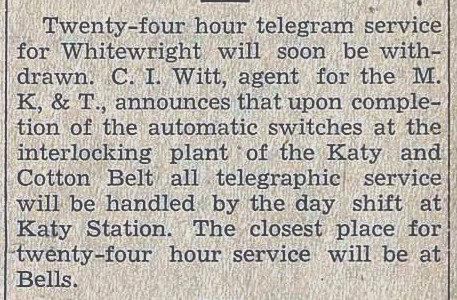
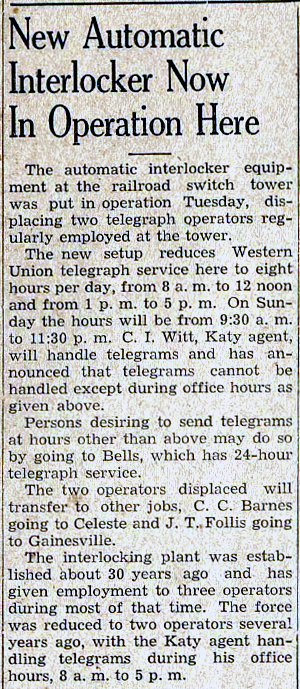
in late 1953 when the interlocking was no longer needed. Left, Bottom: On November 11, 1943 the Sun reported the upcoming impact to telegraph service in Whitewright due to the impending closure of the tower. The town of Bells (~ 8 miles away) was identified as the nearest location with 24-hour telegraph service, presumably at Tower 20. Right: On Thursday, December 9, 1943, the Sun gave the new automatic interlocker a small headline as it announced that the tower was no longer staffed. Significantly, the story identifies C. I. Witt as a Katy agent and states that two other operators are being transferred to Gainesville and Celeste respectively, both of which had towers staffed by the Katy. The major headlines (below) in the same issue of the Sun put the timing of the automatic interlocker upgrade into perspective. 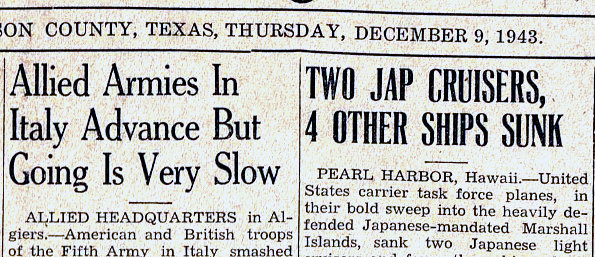 |
 |
 |
Left: The Cotton Belt
issued this notice to affected personnel that the final run
from Commerce to Sherman and back would occur on
September 25-26, 1953. The handwritten annotations were made by C. W. Standifer,
one of the affected employees and the subject of a
book by Ed Cooper. (Ed Cooper collection) Below: The Cotton Belt right-of-way (ROW) between Commerce and Sherman is now mostly occupied by Texas Highway 11. East of Whitewright, the highway deviates south as the ROW continues west toward town on the dirt road (center of image.) The highway rejoins the ROW west of town. (Google Street View, March, 2026) 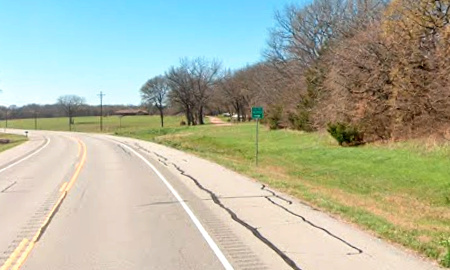 |
|
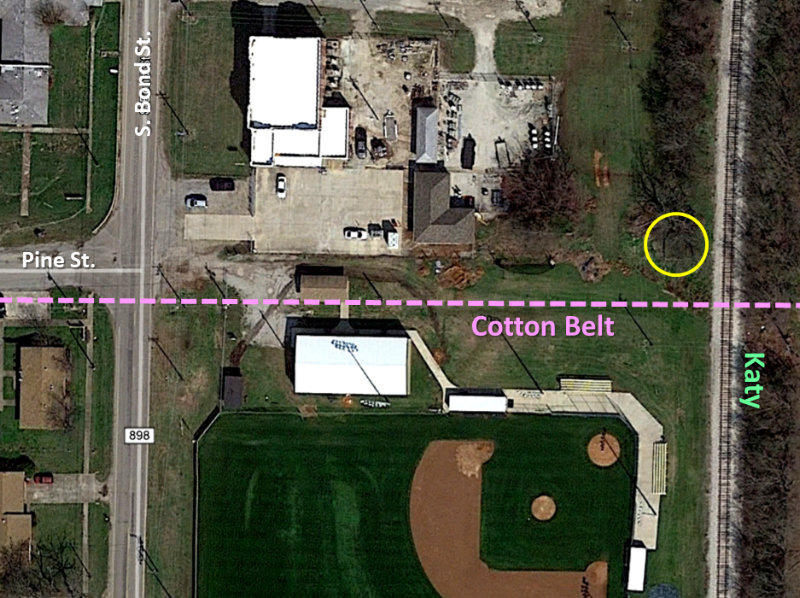
Right: This annotated Google Earth
image shows the location of
the tower foundation (yellow circle.) The nearby industrial facility is a Texas
New Mexico Power Co. substation and office built in 1929. The Katy
supported the construction effort with a spur track for offloading heavy
equipment. The main building's architecture and
the surrounding site appearance is sufficiently interesting that the Texas Film
Commission identifies it as a
location for shooting movie scenes. Below: An image of a 1910 post card (Jan West collection) was reprocessed by AI to create this clear view of the Whitewright Katy depot (which is no longer standing.) 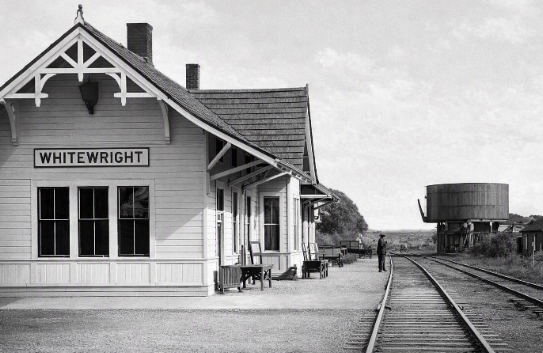 |
 |
