Texas Railroad History - Tower 62 - Mineola
A Crossing of the Texas & Pacific Railway and the Missouri, Kansas
& Texas Railway
 |
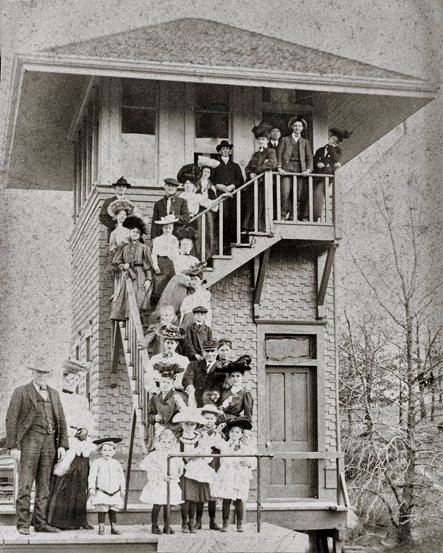
Left: In 1970, Earl
Aldridge painted Tower 62 from a photo, but years later, the photo's whereabouts
were
unknown.
After a town-wide search conducted by Mineola citizens, the photo was located in the archives of the Mineola Area Chamber of Commerce
in 2015.
The painting now resides in the Mineola Public Library.
Right: This is the
photo of the tower which the painting
attempted to duplicate. The date on the painting, December 9, 1887, is too early to
have been the date of the photograph because the tower didn't exist
before 1905. (photo courtesy of Jeanne Johnson May) |
 |
The impetus for the first railroad at Mineola began
with the idea of building across Texas as part of a projected
southern transcontinental line. This was prior to the Civil War, a period when the Legislature
somewhat freely granted state charters to railroads promising to build through
Texas. There were two competing concepts, but the most promising one envisioned rails
connecting Atlanta, Vicksburg and Shreveport -- more or less a straight line -- with
Marshall, Texas, a town near the Louisiana border. From Marshall, the rails
would continue
across the state to El Paso. A Texas railroad charter was granted to the
Vicksburg & El Paso Railroad Co. which the charter law also called the
Texas Western Railroad. This charter changed hands but was eventually
reacquired by the original promoters who then asked the Legislature to change
its name to Southern Pacific Railroad, unrelated to the famous
Southern Pacific that evolved in California in a similar timeframe. The
name change was granted in 1856 by the Legislature, overriding a veto by Texas
Governor Elisha Pease. Work began at Swanson's Landing, a riverport at the south
end of Caddo Lake (near the present day town of Karnak) connected by waterways
to New Orleans. This enabled rails, locomotives and other materials to be
shipped to Texas by barge. A track was completed southwest to the town of
Marshall by the end of 1859. Another was laid to Jonesville in the direction of
Shreveport, intending to connect with a Louisiana railroad at the state line.
During the Civil War, the rails between Swanson's Landing and Jonesville were
taken up to be used to advance a direct rail line between Marshall and
Shreveport.
In July, 1870, the Legislature granted a
charter for a new company, the Southern Transcontinental
Railroad Co., that would be allowed to acquire the assets of the
Southern Pacific. On March 3, 1871, Congress granted a Federal railroad
charter to the Texas Pacific Railroad (renamed Texas & Pacific
Railway -- "T&P" -- a year later) for the purpose of building a
transcontinental rail line from Marshall to San Diego, California. The Texas
Legislature authorized the T&P to acquire the Southern Pacific and the
Southern Transcontinental Railroad Co., and this happened in 1872 on
March 21 and March 30, respectively. By the end of 1873, new construction plus
the acquired assets resulted in the T&P having three track segments, the most
significant being from the Louisiana border through Marshall and Longview to
Dallas. Additional
construction moved the endpoint west to
Fort Worth in 1876.
The Houston & Great Northern (H&GN) Railroad
was chartered in 1866 with plans to build from
Houston to the Red River. Construction was delayed several years as
New York banks were reluctant to lend money to Texas railroads during
post-Civil War Reconstruction. Work finally began in Houston in
December, 1870. While the main line was being built to
Palestine in
1872, the International Railroad reached Palestine as it built
between Longview and
Hearne. The two railroads agreed to merge under the name
International & Great Northern (I&GN) Railroad. While waiting for
the I&GN charter bill to be passed by the Legislature, the companies
established a combined management team in Houston in December, 1872 led
by Herbert Melville "Hub" Hoxie as the General Superintendent of both
railroads.
Hoxie wanted a branch to Denison
where a new rail bridge over the Red River built by the Missouri, Kansas & Texas (MK&T, "Katy") Railway
had just opened. The bridge enabled export commodities from Plains and Midwest states to
move south to Houston through an interchange at Denison with the Houston & Texas Central
(H&TC)
Railway. Construction proceeded with H&GN teams because the
International's teams were deployed to the main line west of Hearne.
The branch departed from the town of of Zavala on the
International main line 36 miles southwest of Longview (the Post Office
changed the name to Troup in 1877.) Zavala was the I&GN's
nearest location to
Tyler, a major east Texas town Hoxie wanted
to serve. Northwest from Tyler on a straight line to Denison, the
anticipated crossing of the T&P would be at the tiny settlement of
Sodom. The T&P was building toward Sodom en
route to Dallas, but the H&GN arrived first, supposedly by 15 minutes,
thus gaining the privilege of renaming the town (since no railroad
wanted Sodom in its timetable.) A new name, Mineola,
was chosen as the combination of two girls' names, Minnie and Ola (was Olaminie an option?) All agree that Minnie Patten was one of the girls, but
two H&GN officials had daughters named Ola, so the ultimate
credit is disputed. Not ready to continue toward Denison, the H&GN interchanged with the T&P at Mineola but
did not cross it.
The I&GN charter delay was due to
an issue regarding the International's claim for construction subsidy
bonds to be issued by the State. Claiming corruption, the Texas
Comptroller had refused to countersign and register the bonds despite
the State engineer's report that the work covered by the bonds was of
high quality and met the requirements of the International's charter. As
legal proceedings moved slowly, a lengthy debate raged in the press
statewide. A compromise was eventually found, and the charter bill
passed in 1875.
Right: As soon as the
line to Mineola was completed, Tyler and Mineola were incorporated into
a regular advertisement by the I&GN. The I&GN would not be an official,
chartered
railroad for another two years. (Houston Daily Mercury,
July 12, 1873) |
 |
The I&GN was on its way to becoming the largest
railroad in Texas, serving Texarkana and Houston,
with construction in progress southwest from Hearne toward
Austin,
San Antonio and Laredo. This attracted the
attention of rail baron Jay Gould who was looking to expand his empire into
Texas. He developed a plan to capture the I&GN, but it first required him
to take over the Katy railroad to gain a foothold in Texas and to control the
Red River bridge. The Katy's stock was so diluted that acquiring a controlling
interest was considered impossible. But in late 1879, Gould was named President of the Katy, the culmination of
a multi-year plan to infiltrate
Katy executive management with his loyalists.
Gould
fully understood that the Katy did not have a Texas
railroad charter -- a State law passed in 1870 had allowed the Katy to build
into Texas under its Kansas charter. As an incentive to to do so, the law
allowed the Katy to build to the Rio Grande. In 1876, however, an amendment to
the Texas Constitution required railroads owning tracks in Texas to be
headquartered in state. Gould knew track ownership was a potential issue, but
his argument was that as long as the 1870 law remained on the books, the Katy
had all the authorization it needed. A Katy subsidiary headquartered in Texas
would be subject to audits by the Texas Attorney General's office
whereas Texas officials had no power to show up at the Katy's headquarters in
Kansas to demand
to see the books. And most of all, everyone wanted more railroads! No one
was likely to challenge the Katy's construction activities.
To benefit from the Katy's
profitability, Gould leased it to the Missouri Pacific (MP) Railroad, a
company based in St. Louis that he controlled with a major ownership stake.
Gould also believed that giving MP control over the Katy through the lease might
protect him to some extent from Katy stockholders. The
lease terms were highly detrimental to those stockholders and Gould knew they
would eventually figure it out. He was vulnerable to collective action by the
stockholders since he owned very little Katy stock. The lease terms were onerous
to the Katy because they allowed Gould to move Katy profits into MP, leaving the Katy
to break even at best. To
the public, it was MP, not the Katy, that had begun expanding into Texas with new MP depots in each
town. Since Gould considered the Katy to be a "Texas railroad" under
the 1870 law (which MP definitely was not) the title to new tracks would be held
by the Katy. Otherwise, Gould had no intention of strengthening the Katy as a
long term Texas railroad. His goal was to use it for convenience, extract
whatever value he could from it, and let it be a silent, very minor partner in
his MP-focused activities.
To execute his plan for capturing the I&GN, Gould also
needed to control the T&P. The T&P was critical to the I&GN (and thus to
Gould) because it provided the route for I&GN traffic between Longview and
Texarkana where the connection to St. Louis was made. The T&P had been stuck in Fort Worth since 1876, unable to
finance its continuation to El Paso. Gould bought the stock of T&P President
Thomas Scott for $3.5 million and made a deal with the T&P Board to build the remainder of
the T&P at his expense, with his equity in the railroad accruing incrementally
with each mile completed. He was immediately the CEO, and he formally became T&P President when his equity reached
controlling interest in April, 1881. Since
Gould also controlled the Katy's Red River bridge, he had boxed-in
the I&GN, with the power to impact its traffic to and from the Midwest. I&GN management sold out to Gould in
June, 1881 in a swap for Katy stock. Fearing that he might run afoul of Texas'
railroad ownership laws, Gould kept the precise ownership of the I&GN murky,
going so far as to place all of the I&GN stock certificates with a close friend
in Fort Worth (a Texas resident, if he ever had to make the case.) Katy
stockholders didn't know they owned the I&GN. Publicly, Gould leased the I&GN to the Katy,
providing cover for the accounting relationship that was moving I&GN profits
into MP via the Katy. The I&GN continued operating
under its own name because it was well-known in Texas.
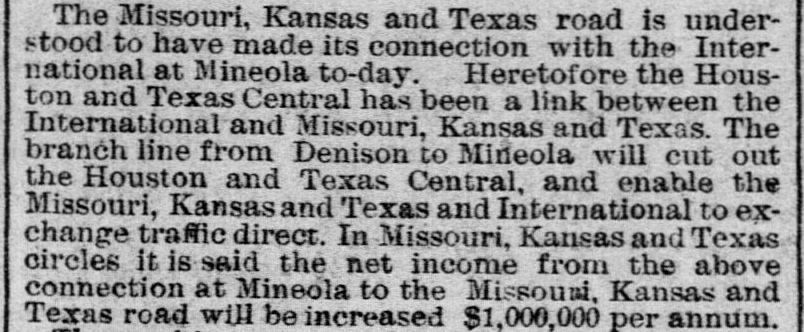 |
Among the new construction on Gould's mind was an extension
of the Katy from Greenville to Mineola. A railroad
chartered by Katy interests had completed a line from Denison southeast to Greenville
in 1880, and it had been acquired by the Katy at Gould's direction. Gould wanted
to complete the Denison-to-Houston route originally envisioned by the I&GN so
that southbound freight at Denison could take "Gould all the way" rather than
the H&TC route. In 1881, Gould directed the Katy to build the 51 miles from
Greenville to Mineola, creating a junction of three Gould railroads and
facilitating the alternate route from Denison to Houston.
Left:
Galveston Daily News, June 24, 1881 |
Under the MP banner (but with the Katy having title)
Gould built south from Denison to Fort Worth,
Waco and Temple,
finally stopping at Taylor in 1882 due to changes
in the political and economic landscape. He resumed building in 1886, but
stopped all construction in late 1887 as financial and legal storm clouds
gathered. In April, 1888, Katy stockholders were able to summon a quorum and
fire Gould for malfeasance associated with the MP lease and for Gould's attempt
to unwind the I&GN lease to the Katy. Gould had discerned that his time with the
Katy would end soon and he had been working on breaking the Katy's lease of the
I&GN. (It is unclear how he planned to claim ownership of the I&GN, but he would
worry about that later.) With Gould evicted, new
Katy management sought bankruptcy protection and asked
the court for an order voiding the MP lease, which was granted and subsequently
confirmed by a
ruling of the Texas Supreme Court.
At the time, Gould was also engaged
with lawsuits filed months earlier by the Texas Attorney General against the
Katy and the I&GN. With some clever legal maneuvering, Gould bought valuable
time to prevent his ouster from the I&GN. Ultimately, to clean up the mess, the Legislature
enacted a new Katy charter in October, 1891, creating a Denison-based subsidiary to
make it all legal. The charter forced the Katy to sell the I&GN, and Gould was
the only bidder. He remained the President of the T&P and MP. Gould didn't have
much time to adjust to the new situation -- he died in December, 1892, and his
eldest son George took
over. The Gould family remained involved with MP, the T&P and the I&GN for
another 25 years.
The I&GN went into bankruptcy in 1908
and again in 1914. Finally independent of the Gould family, it emerged in 1922 as a new corporation, the
International - Great Northern ("I-GN") and immediately became a target for acquisition because of its vast track network
in Texas. MP, no longer subject to Gould family control, tried to buy the I-GN in 1924 but the sale was nixed by the Interstate Commerce
Commission (ICC.) Not to be deterred, MP executed its fallback strategy by helping to
arrange for the New Orleans, Texas & Mexico (NOT&M) Railway to buy the
I-GN, simply to keep it out of the hands of other competitors. The NOT&M had
been one of the Gulf Coast Lines (GCL), a group
of railroads in south Texas and Louisiana formerly owned by the St. Louis & San
Francisco ("Frisco") Railway. During the Frisco's receivership,
the GCL railroads were separated from the Frisco and the NOT&M was then
re-chartered to become the new GCL corporate parent. The sale of the I-GN to the NOT&M was
approved by the ICC in June, 1924. The ICC then allowed MP to buy the entire NOT&M on January 1,
1925, acquiring the target I-GN plus all of the other GCL railroads.
Overnight, MP had a huge presence in Texas.
 |
As a means of introducing interlocker technology into Texas, a 1901
Texas law authorized RCT to issue safety regulations for crossings of
two railroads. State law required all trains to stop completely before proceeding
across a diamond, a rule that did not apply at interlocked crossings.
Stopping wasted time, fuel and water since crossings
were unoccupied most of the time. At Mineola, the H&GN had not built
across
the T&P main line in 1873, hence the Katy crossed it in 1881 to make a
connection with the I&GN. The crossing was interlocked with a manned
two-story tower, Tower 62,
commissioned by the Railroad Commission of Texas (RCT) on December 12, 1905 with a
12-function mechanical interlocking plant. The tower was staffed by the
T&P, but recurring expenses for labor, utilities and maintenance were
split evenly since both railroads used half of the interlocker's
functions. RCT reported Tower 62 seeing an average of 25 movements per
day over the twelve months ending June 30, 1906. |
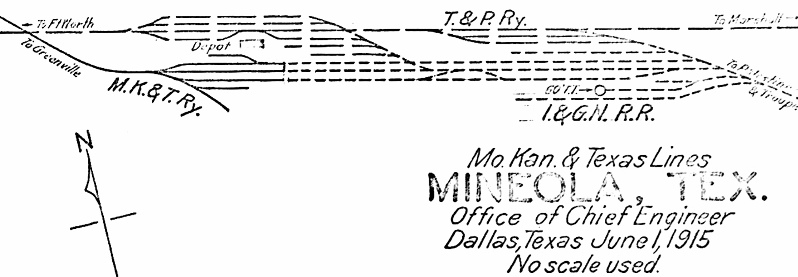
Above: This 1915 Katy Railroad
track chart of Mineola (Ed Chambers collection) shows that the "M.K.& T. Ry."
and the "I.&G.N. R.R." arrived from opposite directions on opposite sides of
town. Tower 62 was
located at the crossing in the upper left corner. The Katy's exchange tracks paralleled the T&P main line
south of the depot and extended far enough east to facilitate
interchange with the I&GN. The "60' T.T." (sixty foot turntable) allowed I&GN
locomotives to turn around for the trip south and might have been used by the
Katy. At some point, the T&P built a
wye west of Tower 62 which could also be used to turn locomotives. The text at upper right says
"To Marshall"; below it reads "To Palestine & Troupe." The
drawing is not to scale; the
distance from the depot to Tower 62 was approximately 0.8 miles while the
distance from the depot to the I&GN connecting track off the T&P was about 0.2 miles.
On September 27, 1915, the Katy went into
receivership. A comprehensive report on the condition of the company and its
options for regaining solvency was commissioned by the Receiver and prepared by
consultant J. W. Kendrick of Chicago. Kendrick's report, delivered in January,
1917, succinctly described the problem that led to the Katy's financial woes.
Simply put, the Katy was "Built originally as a granger
line, with grades conforming...to the general surface of the territory...with
rails of light sections and odd weights, with narrow banks and cuts...wet and
undrained, with bridges much too light...with light engines...of antiquated
design...unwisely purchased...by administrations which utterly failed to
recognize the coming changes in transportation methods... handicapped by
extraordinary interest charges upon...nondescript indebtedness, so large as to
make it necessary to starve the property...maintenance in order to keep it
solvent..." Kendrick noted that the Katy's "...payment of dividends was
commenced in 1906 and continued until 1914, during which time $4,160,000 was
dispensed to stockholders that should have been returned to the property in the
form of well conceived improvements..." In short, the railroad had been
severely mismanaged, leaving it physically and financially non-competitive.
In discussing freight opportunities, Kendrick's report mentioned that
"...lignite, or semi-bituminous coal, is produced in large quantities on the
Mineola Branch..." What Kendrick did not know was that the rapidly
developing petroleum industry, and the expansion of the availability of
electricity as a source of power, led to a sharp recession for Texas lignite
beginning in 1920. Kendrick also mentioned "...manufacture of boxes and
fruit and vegetable containers..." as a business in Mineola that provided
freight to the Katy, but this was hardly enough to keep the line busy. And while
Kendrick's data showed the Katy received more freight from the T&P
than from than any other railroad, it is likely that the vast majority of this
interchange was in Fort Worth and Dallas where both railroads had a sizeable
presence. Kendrick also mentioned that the Katy was paying one-third of the cost
to operate the Mineola passenger station.
In the aftermath of Kendrick's report, the
bankruptcy court continued working to create an arrangement that would
establish long term viability for the Katy. It finally emerged
from bankruptcy in 1923 as a new corporation with a new name, the
Missouri - Kansas - Texas Railway (but everyone still called it
the Katy.)
At Mineola,
the peak period of Katy traffic
across the Tower 62 diamond is undetermined, but the traffic had substantially
declined by the early 1920s. With limited Katy traffic at Tower 62, the
railroads decided to eliminate the manned tower and replace it with a
cabin interlocker which would be much less expensive to operate and
maintain. Cabin interlockers were used in situations where a lightly
used rail line (the Katy) crossed a busy line (the T&P.)
Cabin
interlockers were so named because the controls were typically located
in a trackside hut to be operated by train crews from the lightly used
line (hence there was no staffing expense for operating the
interlocker.) At Mineola, the signals were normally left so that T&P
trains had unrestricted permission to cross the diamond. When a Katy
train approached Mineola, it would stop at the diamond so that a
crewmember could disembark, enter the cabin and set the signals to
grant a PROCEED indication for his train. This
action also signaled any approaching T&P trains to STOP. When the
crossing was completed, the crewmember would reset the controls for
unimpeded movements on the T&P and return to his train.
On
November 26, 1922, the T&P activated a new cabin interlocker to replace
the existing manned tower at Mineola. The manned tower was closed, and
the tower operators who lost their jobs filed a complaint with the
United States Railroad Labor Board. Their argument was that the
railroads had essentially built a new tower (the cabin interlocker) with
the same manual controls as the ones in the old manned tower. But the
controls in the new tower were being operated by train crewmembers
instead of members of the tower operators' union, the Order of Railroad
Telegraphers, as required by their contract with the railroads.
Right: The Katy
line from Greenville to Mineola remained viable as a lightly used branch
for many years. It was finally abandoned in 1956 at which time the Tower 62
cabin interlocker was
retired. Eleven rail miles west of Mineola at Grand Saline, another
cabin interlocker, Tower 130, controlled
the T&P crossing of the Texas Short Line (TSL) Railroad. |
 |
 |
Left:
In 1925, the U.S. Railroad Labor Board published its ruling in the case
brought by the tower operators. This summary preceded the opinion, in
which the Board ruled against the operators. The cabin interlocker at
Mineola remained in service.
Normally, the 2-story tower
might have been razed soon after the ruling was issued, but other
evidence suggests that the original tower remained in place to house the
new interlocker, effectively serving as
the cabin for the cabin interlocker. When Mineola resident
Joyce Alexander Williams interviewed two life long residents for their
recollections of a tower near the Katy / T&P crossing, both Wayne
Collins and Larry Barlow recalled seeing the tower and said it was
located on the south side of the diamond. Wayne Collins was certain that
the tower was removed between 1941 and 1945 because it was there when he
left for World War II military service and it was gone when he returned. |
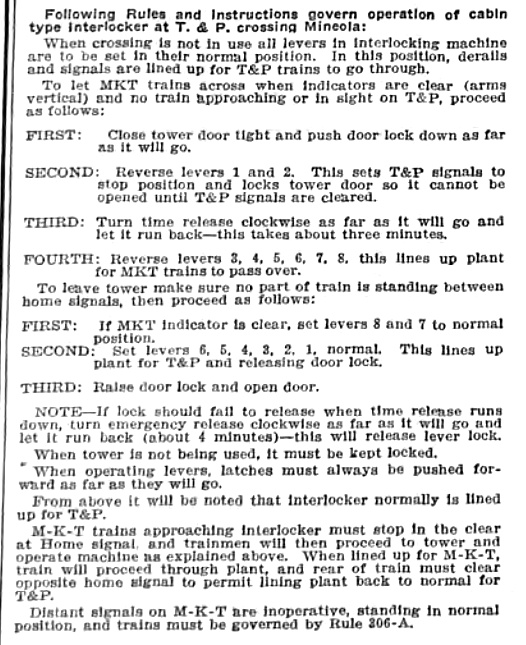
Right: A Katy Employee Timetable published
August 24, 1933 carried these instructions on how to operate the cabin
interlocker at Mineola. The written procedure makes multiple references
to "tower" in the context of the structure, not simply as a generic term
for the interlocking. Phrases such as "To leave tower" and "proceed to
tower" appear in the instructions, and the term "tower door" is used
more than once. This lends credence to the eyewitness recollections that
the Tower 62 building was standing in the 1930s and perhaps early 1940s.
It appears to have been used to host the cabin
interlocker beginning in 1922.
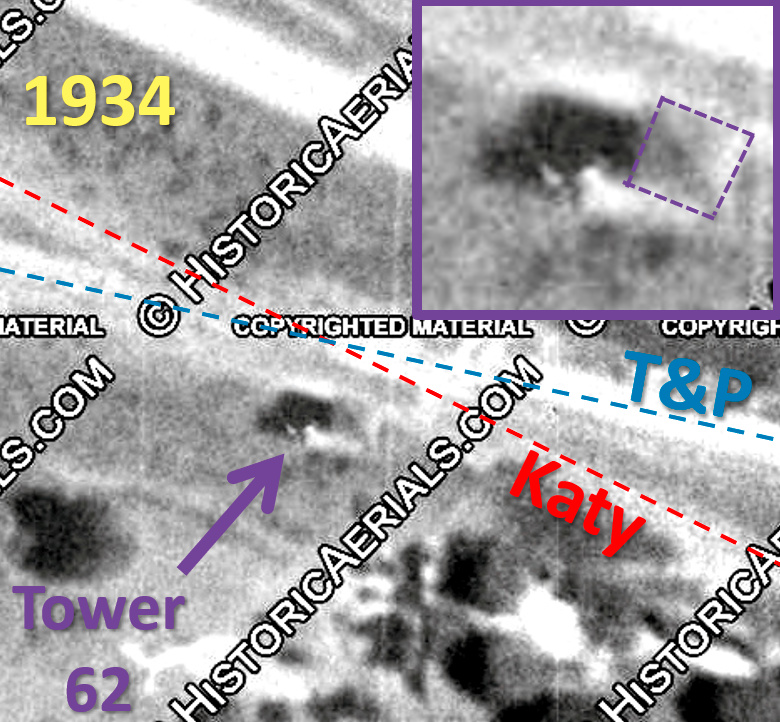
Below: This 1934 aerial image ((c)
historicaerials.com) has been annotated to show Tower 62 at the Katy /
T&P crossing. The inset at upper right is a magnification of the tower
and its immediate vicinity, with the pyramid roof outlined in purple
dashes. The east sun casts a tower shadow to the west and also causes
the east (right) side of the roof to be brighter. At
minimum, this confirms that the tower building remained in place in
1934, a dozen years after the interlocker was converted to a cabin type. The procedure at right suggests that the use of "tower" rather
than "cabin" was intentional, i.e. the tower hosted the "cabin interlocking
plant" and its controls.
 |
 |
In 1956, MP ended a lengthy bankruptcy and merged its various subsidiaries into a consolidated MP corporation.
Along with several others, the I&GN was fully merged and ceased to exist.
The T&P was not a subsidiary of MP although MP had
owned a majority of T&P's stock since the 1930s. MP had never exercised operational
or executive management control over the T&P. Instead, the two railroads collaborated closely on
operations by coordinating schedules and sharing yards and other resources.
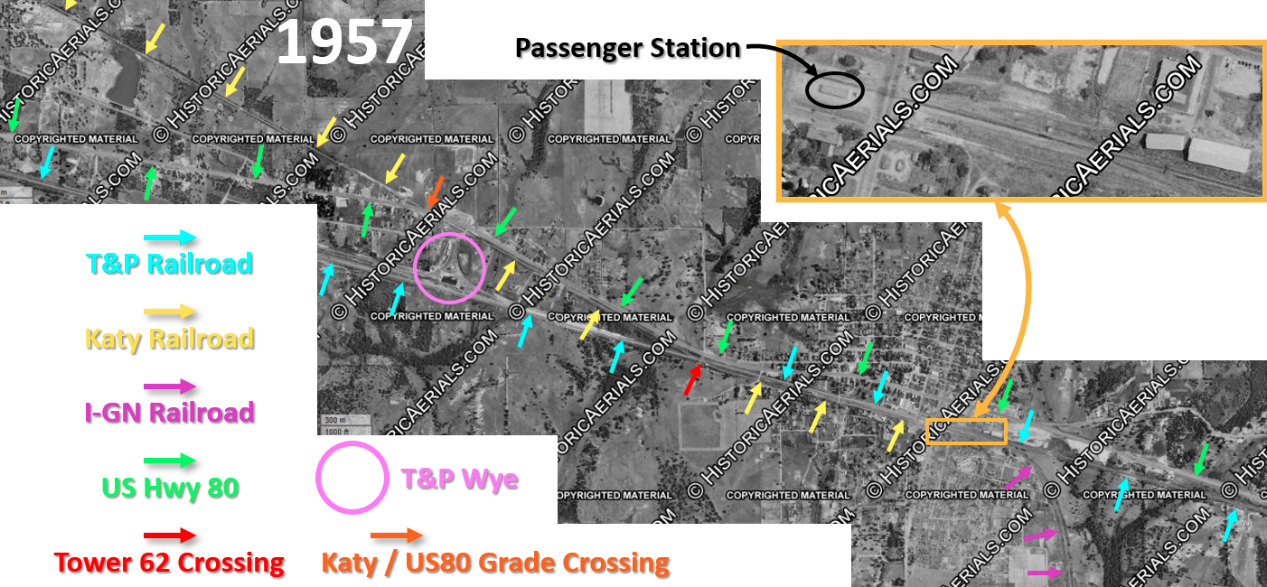
Above:
This composite image from 1957 aerial photography ((c) historicaerials.com)
shows the path of the Katy, T&P and I-GN railroads through Mineola. The Katy had
been abandoned between Mineola and Greenville only a year earlier, hence the
right-of-way remained visible.
  |
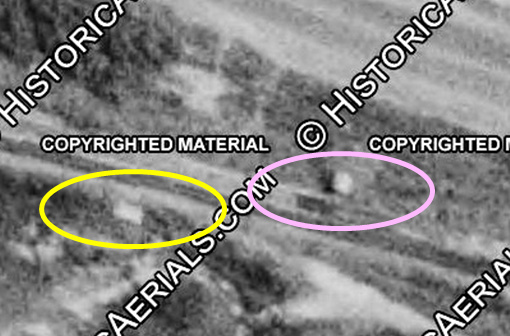
Above: This
magnification ((c)historicaerials.com) from the 1957 composite map shows the
abandoned Tower 62 crossing of the Katy and the T&P. A possible rectangular foundation
(yellow oval) is visible
on the south side of the T&P tracks. The lack of a shadow makes it less
likely to be a structure. On the north side of the T&P tracks, a small
building is
visible (pink oval) casting a shadow to the west. This is the cabin interlocker that
replaced the manned tower, possibly in the early 1940s. The abandoned cabin remained in place to at
least 1995. Railroads sometimes left cabins in place for decades after abandonment (e.g.
Tower 213,
Tower 204 and
Tower 179.) |
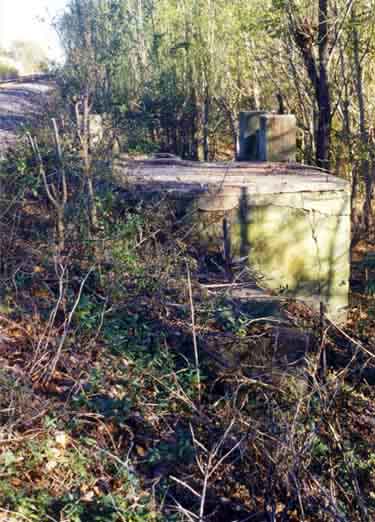
Above Left and Center: What
appears to be the concrete base for the original Tower 62 still exists on the
west edge of Mineola about a quarter mile west of Cheek Street. The photos show
the west face (left) and south face (center) of this foundation. (photos c.2002 by Myron Malone)
In 1968, MP decided to abandon eleven miles of former I-GN track between
Mineola and Lindale, hence the MP / T&P interchange at Mineola was no longer
needed. The two railroads had better locations to exchange traffic e.g.,
Longview, Dallas and Fort Worth. In 1976, MP elected to acquire the remaining
shares of T&P stock
and take executive control, merging it into MP and retiring the T&P name. In 1982, Union Pacific (UP)
acquired MP, but MP continued to operate under its own name. In 1988, UP bought
the Katy and merged it into MP, reuniting the two railroads a century after the
Texas courts had broken MP's lease. The Katy had survived as an independent
railroad all of that time, but another receivership was looming and UP wanted
the Katy's tracks, many of which were complementary to those of MP.
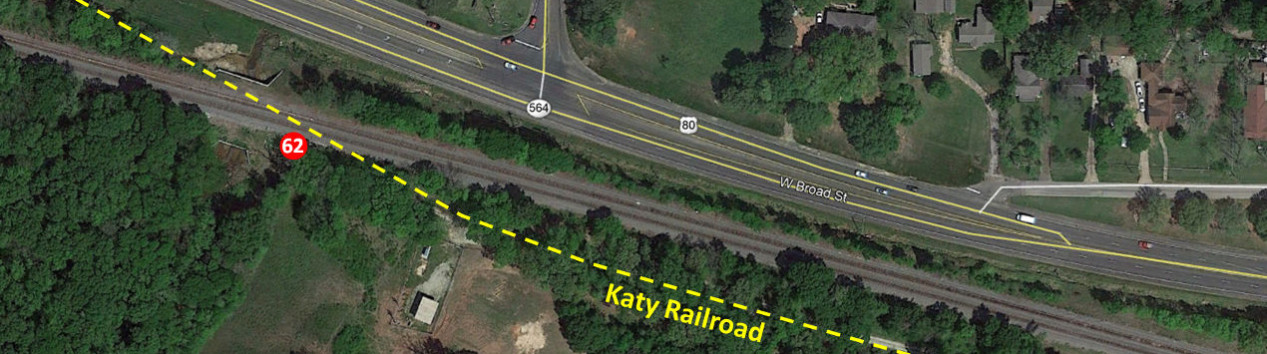
Below: The Tower 62 crossing was at an acute angle. When
the highway was built through Mineola, it paralleled the north side of the Katy
right-of-way (ROW) for a mile west of the diamond before crossing over it. The
highway was following the T&P into Dallas whereas the Katy would curve to the
northwest toward Greenville.


Above Left to Right: Eastbound on US 80 coming into
Mineola, the highway curves where the Katy railroad formerly crossed at grade at
an acute angle, becoming parallel to the roadway. The utility poles in the left
photo are relatively close to the highway, perhaps ten feet from the paved edge
of the shoulder, because the Katy has not yet crossed. In the center photo
farther east, the camera is essentially looking straight down the Katy ROW.
Judging the distance between the pavement and the utility poles, the nearby
utility pole is still relatively close to the pavement but the poles in the
distance are significantly further away. In the right photo farther to the east,
the Katy ROW is probably somewhere to the right of the white stripe. It's
possible that the utility poles, which are now perhaps 30 feet from the edge of
the roadway, sit on the elevated grade, or perhaps the apparent elevation is
merely an artifact of the road construction. The tracks (and certainly the
original telegraph poles) were in place long before any highways were built. Since the Katy's abandonment in 1956, US 80 has been
widened into a
divided highway east of the apex of the curve in this section. This road reconstruction likely encroached on the
edges of the ROW, but it appears that most of the additional real estate required
was taken from the north side of the highway. The Katy ROW real estate was
essentially left intact along the south side, although the grade itself was
obliterated by various improvements
(e.g. drainage.) (Google Street View images)
 |
Left: Northwest of Mineola, a
1919 double-arched masonry culvert carried the Katy tracks. The
Katy was in receivership at this time. Bridge and right-of-way reconstruction
investments were authorized by the Receiver to repair and improve the Katy's
physical infrastructure into a competitive posture. Numerous such culverts were
rebuilt in the vicinity of Mineola. This one is between Mineola and Lake
Holbrook. (Joyce Alexander Williams photo) |

Last Revised: 8/31/2026 JGK - Contact the Texas
Interlocking Towers Page.