Texas Railroad History - Towers 92 (New Braunfels),
205 (Austin) and
206 (San Marcos)
Three Junctions of the International &
Great Northern and the Missouri - Kansas - Texas Railroads Between Austin and New
Braunfels
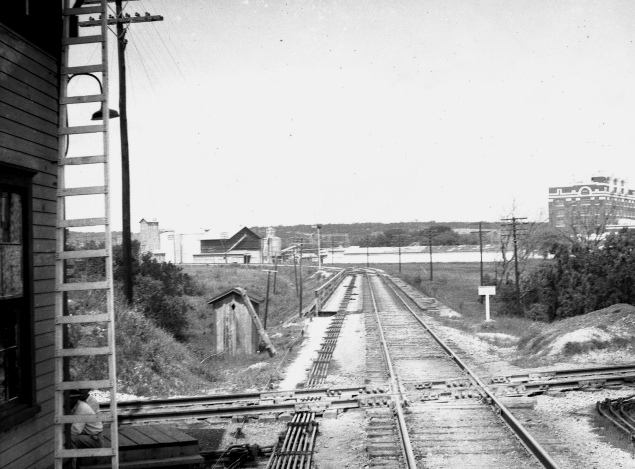
Above Left:
Railroad executive John W. Barriger III took this photo in the 1930s from the
rear platform of his business car when he passed Tower 92 (to his immediate left)
as his train was traveling northbound at New Braunfels. Although Barriger is looking at the
southbound tracks of the International - Great Northern (I-GN) Railroad to San Antonio, his view at the moment is to the northwest
because of two sweeping curves the I-GN makes in New Braunfels resulting in a
generally east / west transition through downtown. The crossing diamond in the
foreground carries the tracks of the Missouri - Kansas - Texas (MKT, "Katy")
Railroad to San Antonio (to the left) and San Marcos (to the right). The white
sign to the right presumably warns pedestrians to stay off the bridge over Dry Comal
Creek. The large building in the distance is the Comal Power
Plant, a lignite-burning facility built in 1925 that has since been
decommissioned and converted to
apartments.
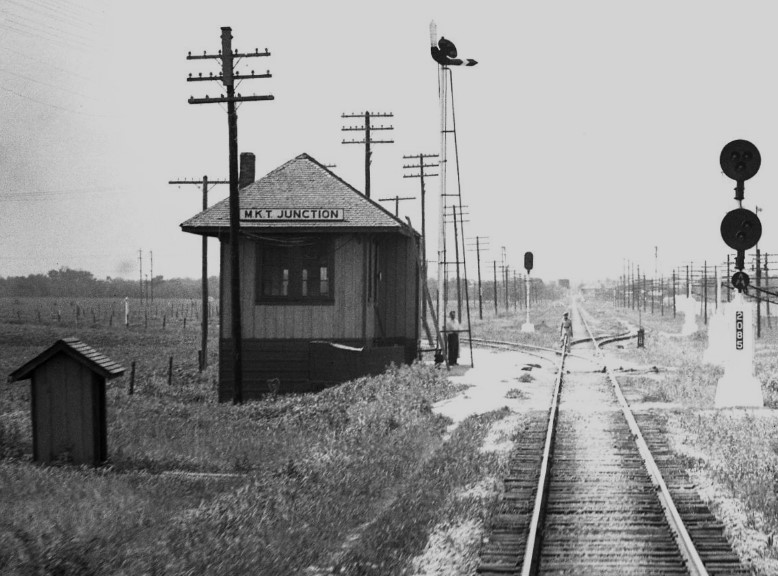
Above
Right: Barriger took this photo facing the "M.K.T. Junction" cabin at San Marcos
from his business car on I-GN tracks. A connector to
Katy rails can be seen branching off to the left, just beyond the south side of
the building. Again, the timeframe is the 1930s and again, Barriger's view is
south toward San Antonio, this time facing geographically southwest. The first cabin at
MKT Junction began operation on August 1, 1912, but whether this structure is
the original cabin is undetermined. Perhaps fifteen to
twenty years after this photo was taken, MKT Junction was interlocked and became
Tower 206 in the Railroad Commission of Texas (RCT) interlocker assignment list.
The two railroads touched at both New Braunfels and San Marcos, and employee timetables
show Towers 92 and 206 being about 18.65
miles apart. It is undetermined whether Barriger's photos were
taken on the same trip. They certainly could have been, and they undoubtedly date from the 1933 - 1941 timeframe
when Barriger served in the
Reconstruction Finance Corporation as the chief
administrator for railroad investments.
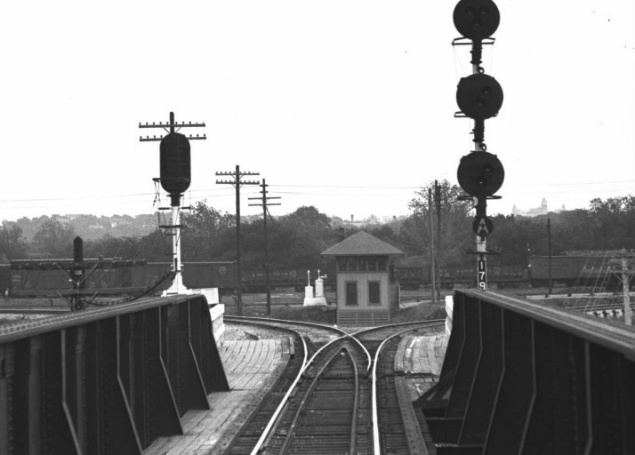
Below Left: On a different
trip, Barriger took this photo of the railroad control tower at the north end of the Colorado River bridge
in Austin as his train was heading south toward San Marcos. This was
at least 25 years prior to 1956 when an RCT-authorized interlocking was
installed and the building became designated as Tower
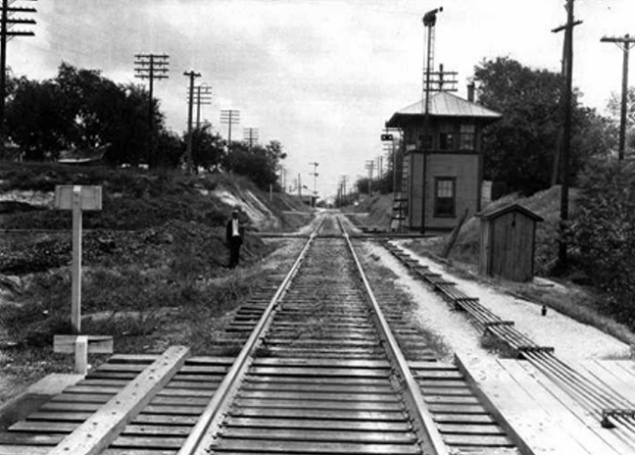
205. Below Right:
Although this image of Tower 92 certainly resembles Barriger's work, the
photographer is undetermined. The camera is facing southeast along the
northbound I-GN tracks toward San Marcos, a few dozen yards west of Tower 92. The tower
sits in the southeast quadrant and the Katy tracks cross the I-GN leading to San Antonio
(to the right) and San Marcos (to the left.) The photographer is on the bridge
over Dry Comal Creek. The back of the sign warning pedestrians to stay
off the bridge is visible at left. (New Braunfels Historic Railroad and Modeler's
Society collection, courtesy Jim Burns)
The
Barriger photos are used courtesy of the
John W. Barriger III
National Railroad Library.
San Antonio and Austin were two important towns in
early Texas history (they still are!) but their inland locations meant that they would not be
among the first to be served by Texas railroads. Rails and ties are
heavy, hence railroad construction was typically limited by cost-effective
transportation options, e.g. existing railroads or river steamboats. Using
the Colorado River to ship materials to Austin was not an option; it was not
navigable by ordinary steamboats due to a huge "timber raft" that blocked the
river six miles above its mouth at Matagorda. Austin's first railroad finally
arrived in 1871, a westward branch from Hempstead off the
Houston & Texas Central (H&TC) Railroad main line out of
Houston. Similarly,
San Antonio's first railroad arrived from the east
in 1877, an extension of the Galveston, Harrisburg & San Antonio (GH&SA) Railway
out of Harrisburg, a river port on Buffalo Bayou.
The need for a north / south rail line to connect Austin and San Antonio seventy-five miles apart was recognized, but this need would not be satisfied for several
years. The H&TC and GH&SA both became controlled by Southern Pacific (SP)
in the early 1880s.
Austin's second railroad arrived in 1876 in the form of the International & Great Northern
(I&GN) Railroad building south with plans to continue to San
Antonio and Laredo. The I&GN was the combination of two unrelated railroads,
the International Railroad and the Houston & Great Northern (H&GN) Railroad. The
earliest of these, the H&GN, was chartered in 1866 by Houston interests with a
plan to build north to the Red River. Construction was delayed for several
years; major New York banks were reluctant to lend money to
a new Texas railroad during the initial Reconstruction period after the Civil
War. Work finally began in Houston in December, 1870, and by May, 1873, the tracks
had reached Palestine, 151 miles north of
Houston.
The H&GN's arrival into Palestine
marked the third construction team to do so in less than a year! Both of the
other two were crews of the International Railroad arriving into Palestine from
opposite directions. The International had been chartered by investors
interested in building a line from Texarkana to
Laredo, many of whom were also investors in the St. Louis, Iron Mountain &
Southern (SLIM&S) Railway. The SLIM&S was building from St. Louis to Texarkana,
and the International was chartered in August, 1870 to be essentially a Texas extension of the SLIM&S
that would run through Austin and San Antonio to
the Rio Grande river. Work commenced at two locations, Hearne
and Longview, in 1871.
Before the H&GN had even reached Palestine, the
management of the International saw the value in a combined railroad that would
eventually serve Houston, Austin, San Antonio and Laredo, with favorable
connections to Galveston and
Texarkana. An agreement was reached in December,
1872, and the railroads began operating under a combined management structure
led by Herbert Melville "Hub" Hoxie as General Superintendent (GS) of both railroads.
The International's offices were moved from Hearne to Houston so that Hoxie could run both railroads while awaiting
legal permission to merge. Two years later in March, 1875, the Legislature
authorized the merger.
That the I&GN would
eventually reach Austin and San Antonio was understood, but the timing thereof
was subject to the vagaries of financing, weather, politics and the national
economy, and that made the citizens of San Antonio no less anxious. Austin had
railroad service, the H&TC from Houston; San Antonio did not -- it was dependent
on stage routes to meet trains in Austin and in Columbus where the GH&SA had
terminated during the Civil War. The GH&SA
led by Thomas Peirce (with the unusual ei spelling) had successfully
petitioned the Legislature to modify the GH&SA charter to permit construction
west to San Antonio instead of northwest along the Colorado River to Austin, the
original plan. By the time the I&GN
had been formalized in March, 1875, the GH&SA had already extended its tracks
from Columbus to Luling, only 58 miles northeast of San Antonio.
As Peirce
was building west, he received an offer of $100,000 from Comal County if he
would route the GH&SA into New Braunfels, the county seat. The
San Antonio Express of November 12, 1875
discussed this offer, concerned that its acceptance would delay or preempt
the arrival of rails into San Antonio while boosting New Braunfels into a
regional trade destination to the detriment of San Antonio. The real concern was
that Comal County's proposal was attractive -- New Braunfels was
only 30
miles due west of Luling, roughly half as far as San Antonio. With the I&GN
known to be headed to Austin and farther south, New Braunfels would
become a thriving railroad junction with the addition of the GH&SA. The extent to which Peirce considered this
offer is undetermined, but his railroad stayed on its planned route, reaching
San Antonio in 1877.
 |
 |
Left:
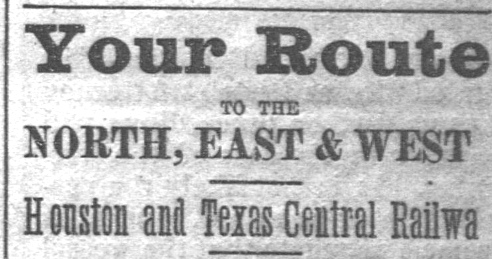
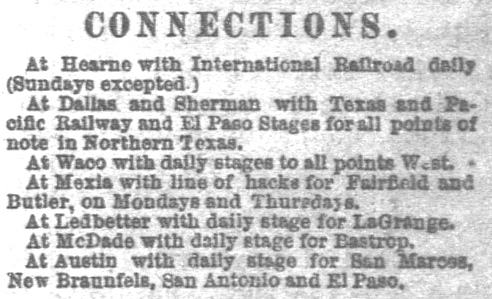
In the early years, San Marcos, New Braunfels and San Antonio were dependent on stagecoach service
to meet trains in Austin (there were also stages from San Antonio to Columbus
for the GH&SA connection.) The Houston Daily
Mercury of January 1, 1874 carried a schedule advertisement for the H&TC
which also listed its
connections at various stops. Some connections were with railroads (at
Dallas,
Sherman and Hearne), some were with stagecoaches (at
Waco, Ledbetter, McDade and Austin),
and then there was Mexia which offered a
connection to a "line of hacks" (horses for rent) two
days per week! |
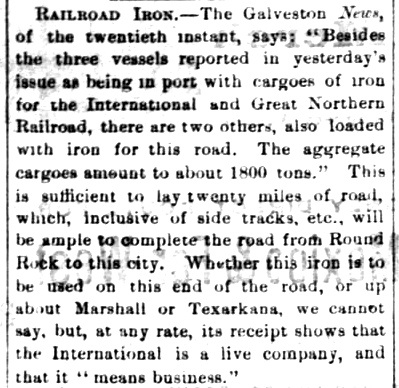 |
Left:
The Austin Weekly Democrat Statesman
carried this news item in its July 27, 1876 edition noting the arrival
at Galveston of 1,800 tons of iron for the I&GN. Speculating that this
would be sufficient to complete the remaining distance for the I&GN to
reach Austin (from Round Rock), the article assures the reader that the
I&GN is a "live company" that "means business." Perhaps rumors of
financial difficulty for the I&GN had already begun to surface.
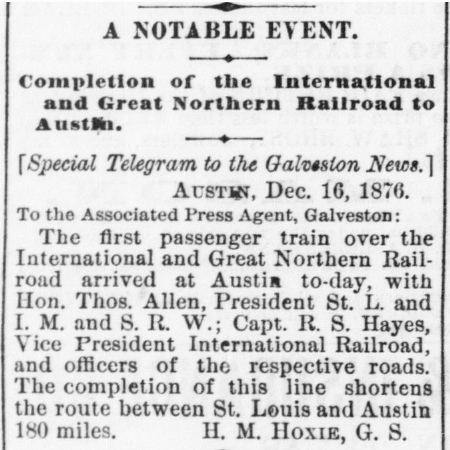
Right: The
Galveston Daily News of December 17, 1876 describes the
arrival of the first I&GN passenger train into Austin the previous
day as "A Notable Event". The telegram was sent by the
aforementioned "Hub" Hoxie of the I&GN. Hoxie had a lengthy career in railroad management with several
railroads. In later years, he was a close associate of rail baron
Jay Gould. Hoxie died in
New York in 1886 at age 55 due to complications from kidney stone surgery. |
 |
The I&GN reached Austin on December 16, 1876 and ...
stayed there. The construction from Hearne to Austin had stretched the company's
finances to the breaking point; it badly needed operating revenue with which to
pay expenses and bond interest. On April 1, 1878, the company was forced into
receivership. After a year and a half in bankruptcy, it was sold at foreclosure
on November 1, 1879 to buyers who formed a new I&GN company under the original
charter and management team. Construction was restarted south from Austin to San
Antonio via San Marcos and New Braunfels with a contract issued to the New
Jersey Contracting Company on May 31, 1880. The contract was successfully
completed at San Antonio on February 16, 1881, and an extension to Laredo was
completed later that year.
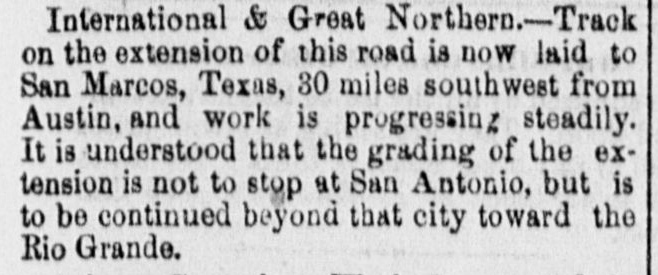 |
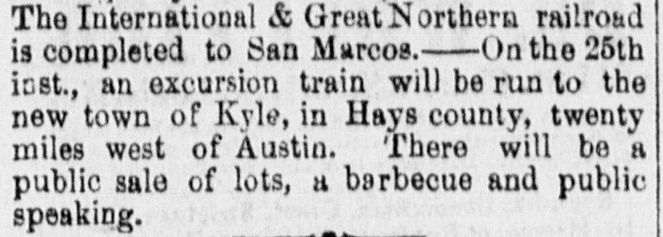
Left: In
September, 1880, the Dallas Daily Herald
carried these items (on the 22nd and 29th, respectively) discussing
the arrival of I&GN tracks into San Marcos.
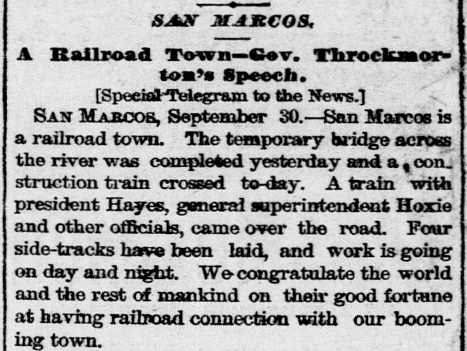
Right: The Galveston Daily News
of October 1, 1880 printed this telegram from San Marcos announcing
passage of the first construction train over the San Marcos River the
previous day, followed shortly by a train with numerous dignitaries. The
telegram congratulated "the rest of mankind" for
having the "good fortune" to have finally begun to reap the
benefits that would instantly flow from the new
connection with the "booming town" of San Marcos. Obviously, San Marcos
didn't need the rail connection; the world
did. Apparently, the presence of U. S. President Rutherford B. Hayes and
Texas Governor James W. Throckmorton in San Marcos was of lesser significance. |
 |
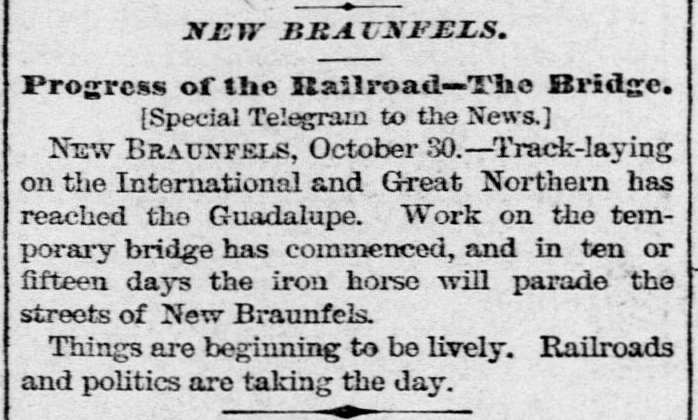 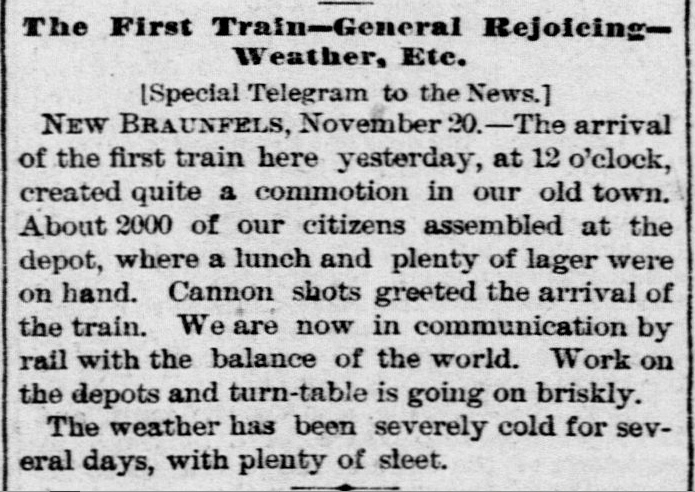
Above Left:
The Galveston Daily News
of October 31, 1880 carried a telegram announcing that I&GN track-laying
had reached the Guadalupe River and that it would arrive in New
Braunfels within the next two weeks. From the north, the I&GN's
construction went to the southeast side of New Braunfels where it made a
sweeping curve to cross the river and turn back to the northwest to enter downtown, about a mile past the bridge.
West
of downtown, the right-of-way then curved back to the southwest to
resume the basic heading toward San Antonio.
Above Right:
The Galveston Daily News
of November 21, 1880 described the celebration in New Braunfels (with "plenty of lager") for the
high noon arrival of the first train into the city. |
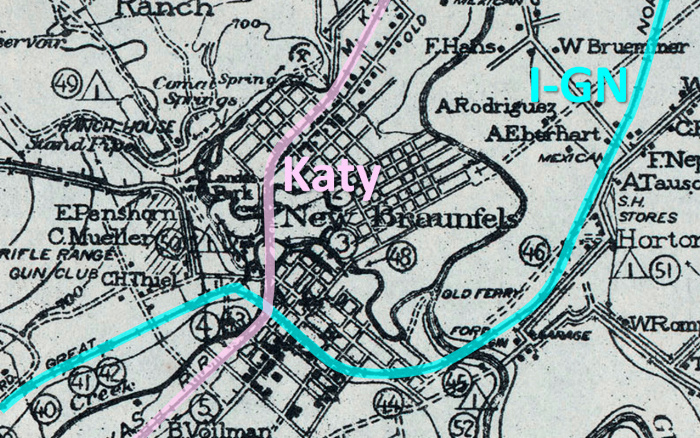
Above: This 1916
military map of New Braunfels has been annotated to highlight the Katy
and I&GN tracks, respectively. Geographically, the two curves on the I&GN
bracketing downtown result in
trains proceeding southeast or
northwest for just under a mile, opposite their general direction of travel. |
In late 1872, the creation of a combined management
structure and the plan to merge the International and the H&GN into a
single railroad had immediately caught the attention of rail baron Jay Gould. Gould
was expanding his east coast rail empire into the Midwest and he
needed an outlet to Mexico and ports on the Gulf to maximize his potential.
The I&GN would be a formidable competitor in Texas, so he set out to capture it.
Gould began by eyeing the Missouri, Kansas & Texas (MK&T, "Katy") Railway as a
potentially valuable property for his efforts in Texas. The Katy's Red River
bridge into Texas was one of only two outlets Texas railroads could use for
efficient access to the Midwest; the other was the rail connection at Texarkana.
By controlling both of them, Gould could severely impact I&GN business if its
management refused to capitulate in a buyout. At the time, he controlled neither
gateway; he had no railroads in Texas at all. Author Wayne Cline in his 2015 book The
Texas Railroad explains that Gould's plan to take over
the Katy quietly began on October 22, 1873 when...
"...he stage-managed the election
of a loyal ally, William Bond, as the road's second vice president. Bond
proceeded to fire key Katy managers and replace them with Gould's henchmen. On
December 21, 1874 Bond was appointed receiver of the MKT, and on March 1, 1876
he became the Katy's general manager. By December, 1879, Bond had brought so
many Gould supporters aboard the MKT that Jay was elected president."
Gould adopted this strategy because buying a
controlling interest in Katy stock was infeasible. The
stock had become so diluted and widely dispersed among so many small
stockholders that there were few large blocks available for private purchase,
and there simply
weren't enough shares circulating on the open market. As a result, Gould had
little ownership interest in the Katy, he was merely its President. Gould leased the Katy in December, 1880 to the
Missouri
Pacific (MP) Railroad, a large Missouri-based railroad that he controlled
with a large ownership position.
Lease accounting and operating policies tilted
heavily toward MP meant that its stockholders (and Gould in particular) would
reap the benefits of Katy profits; Katy stockholders would get nothing. The
Katy's Red River bridge was a gateway to the Midwest and Plains States; Gould
would use it to his
strategic advantage.
To capture the I&GN, Gould needed two other
railroads. The I&GN was dependent on Texas & Pacific (T&P) Railway
tracks between Longview and Texarkana for access to the SLIM&S connection to St. Louis. Gould focused initially on the T&P which was
building west from Texarkana to El Paso on a Federal charter that
authorized construction to San Diego. The T&P had become stalled at Fort Worth, unable to build
farther west for lack of funds. Gould pounced on the opportunity; he
created a construction company and offered to build the T&P line west of Fort
Worth at his own expense in exchange for $20,000 in T&P stock and $20,000 in T&P
bonds for each mile completed. A deal was struck, and as construction proceeded
west from Fort Worth, Gould's ownership and influence
over the T&P increased with each mile. In the summer of 1880 he was
effectively the CEO, and in April, 1881, Gould became President of the T&P.
To capture the SLIM&S, Gould began to use the Katy's line through Oklahoma to carry T&P
and I&GN
traffic bound for St. Louis. Normally, this interchange would be with the SLIM&S
at Texarkana, thus depriving that railroad of critical northbound traffic.
Near St. Louis, Gould bought the terminal railroad that provided the final
connection for the SLIM&S into St. Louis, positioning him to create mischief.
In December, 1880, the SLIM&S ownership gave in and sold a large block of stock to
Gould, giving him about 30% of the company. They did not further resist Gould's control
and he leased the SLIM&S to MP.
By February,
1881, as I&GN construction reached San Antonio and connected with the
GH&SA, Gould had already begun negotiations with the I&GN to buy a
controlling interest. On June 1, 1881, it was announced that Gould had acquired all of
the I&GN common stock in a two-for-one swap for Katy stock. Gould finessed
the actual ownership of the I&GN -- he did not want it known publicly that the
Katy was the legal owner because the Katy was not headquartered in Texas and was
thus ineligible to own a Texas railroad. The Katy had been authorized to build
through Texas toward the Rio Grande using its Kansas charter under a Texas law
passed in 1870 as an incentive for the Katy to build south and bridge the Red
River. The Katy had not, however, complied with an amendment to the Texas
Constitution passed in 1876 that required railroads owning tracks or other
railroads in Texas to be headquartered in Texas. Once Gould had possession of all of the I&GN stock certificates,
he secretly moved them to Fort Worth to be kept there by Gen.
Grenville M. Dodge. Dodge was a friend of Gould's, a famous Army General who had
been the chief engineer for numerous railroads including the eastern portion of
the Transcontinental
Railroad. He was presently the Chief Engineer for the T&P. If Gould was
ever forced to name who owned the I&GN, his answer would have been "Fort Worth resident Gen.
Grenville M. Dodge" who possessed all of the stock certificates. Gould
also announced that the Katy had leased the I&GN for 99 years. This supported the
facade that the I&GN was controlled by the Katy but not owned by it, and
provided an overt mechanism for their financials to become joined.
MP was a "foreign" railroad; it did not own any tracks in Texas -- they were all Katy
tracks under lease. Under Katy ownership, tracks were extended south by MP from
the Katy's Red River crossing near Denison to
Fort Worth (1880), and from there
south to Hillsboro (1881) and farther south to
Waco, Temple and
Taylor (1882). To the press and public, all of this work was associated with MP, not
the Katy; those were MP depots being erected in towns along the route. Gould was aggressively following
the 1870 Texas law that authorized Katy construction (not that he
considered himself bound by it.) Texas officials
wanted more railroads, even if it meant not questioning the
legality of MP's southward expansion of Katy's route network. Neither
railroad was headquartered in Texas and neither had a Texas railroad charter. At
least the Katy could make the argument that its construction was authorized by
the 1870 law even though the Katy wasn't building to the Rio Grande.
 |
Left:
The Galveston Daily News of
April 30, 1881 carried this article from six days earlier out of St.
Louis speculating on a complete merger of MP, the Katy, the T&P and the
I&GN, repeating the rumors that the I&GN had already been sold to Gould.
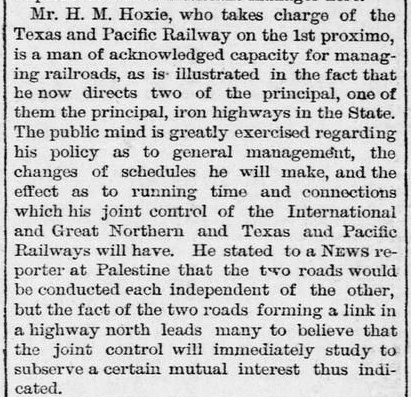
Right:
The same issue of the
Galveston Daily News carried this article discussing H. M.
Hoxie's assignment to be the new GS of the T&P. As noted earlier, Hoxie
had been the GS of the I&GN since the beginning and he had been the
author of the telegram sent to newspapers publicizing the arrival of the
first I&GN train into Austin in December, 1876. So why was Hoxie
suddenly the T&P's GS while remaining GS of the I&GN? Gould had formally
taken over the T&P during its annual stockholders' meeting held in
Philadelphia in April, 1881. By naming Hoxie as the T&P's new GS starting May 1, Gould ensured that the I&GN
would begin coordinating with the T&P (and thus, with all of his
railroads) even though the deal to add the I&GN to the Gould enterprise was
not yet complete. The article reported the belief of "many" that the two
railroads having the same GS would "immediately study to subserve a
certain mutual interest thus indicated" ... whatever that means. |
 |
Reaching Taylor
in 1882 gave MP a Gould connection to Austin, San
Antonio and Laredo via the I&GN, satisfying one of Gould's objectives -
reaching Mexico (more or less) directly from the Red River bridge. MP
planned to complete a
route from Taylor to Houston, but for several years, the southern terminus of
the Katy tracks remained at
Taylor. This was mostly due to the political climate in the Texas Legislature
which in 1882 had repealed the land grant law and lowered authorized passenger
fares while pondering additional railroad regulation. Gould was still planning
for the Katy to reach Houston, so he bought the Galveston, Houston &
Henderson (GH&H) Railroad. It owned only one line, but it was an important
one: the only direct set of tracks between Houston and Galveston. Gould
reorganized the GH&H under its original charter and sold it to the Katy. At this point, the Katy had
only reached Taylor, a long way from Houston, so Gould had the Katy lease the
GH&H to the I&GN. The I&GN and GH&H had interchanged in Houston for many years,
but now those movements would be under a common Gould enterprise.
After four years, MP
resumed construction of Katy tracks out of Taylor by chartering the Bastrop &
Taylor Railway Co. on April 26, 1886. By the time work commenced
in 1887, the name had been changed to the Taylor, Bastrop &
Houston Railway. Regardless, it was a MP / Katy operation all the way. At Elgin, the tracks crossed the
H&TC line to Austin and continued south to Bastrop where a bridge over the
Colorado River was built south of town. Beyond the bridge, the route took a
southeast heading into Smithville and continued to La Grange, planning to follow a route
to Sealy that had been surveyed (but never used) by the
narrow gauge Texas Western Railway. Reaching Sealy would put the Katy only 48 miles out of
downtown Houston. However, eleven miles beyond La Grange, construction stopped
at the end of 1887 at a location the railroad named Boggy Tank. There was no progress beyond
Boggy Tank for several years as the Gould railroads entered a period of financial turmoil.
 The Katy
tracks through Smithville were within 50 miles of the I&GN tracks at San Marcos.
A line from Smithville west to San Marcos would provide benefits to Gould's
railroads by creating a triangle of track alternatives between Taylor, San
Marcos and Smithville that would be valuable in the event of a bridge failure or
other track problem. Most important, however, was that a Smithville - San Marcos
connection would eventually (when the eastward extension to Houston was
finished) create a Gould route between Houston and San Antonio via Smithville
and San Marcos. Such a route could compete with the GH&SA for movements between two of Texas' largest
cities. As an added bonus, the town of Lockhart, worthy of rail service as the seat of Caldwell County, was
midway between Smithville and San Marcos. In 1887, MP initiated construction of
Katy tracks between San Marcos and Smithville via Lockhart. Work began at San
Marcos, and the tracks to Lockhart were completed in 1887. Like
the situation at Boggy Tank, further construction from Lockhart to Smithville was paused
when
financial turmoil hit the Gould enterprise.
The Katy
tracks through Smithville were within 50 miles of the I&GN tracks at San Marcos.
A line from Smithville west to San Marcos would provide benefits to Gould's
railroads by creating a triangle of track alternatives between Taylor, San
Marcos and Smithville that would be valuable in the event of a bridge failure or
other track problem. Most important, however, was that a Smithville - San Marcos
connection would eventually (when the eastward extension to Houston was
finished) create a Gould route between Houston and San Antonio via Smithville
and San Marcos. Such a route could compete with the GH&SA for movements between two of Texas' largest
cities. As an added bonus, the town of Lockhart, worthy of rail service as the seat of Caldwell County, was
midway between Smithville and San Marcos. In 1887, MP initiated construction of
Katy tracks between San Marcos and Smithville via Lockhart. Work began at San
Marcos, and the tracks to Lockhart were completed in 1887. Like
the situation at Boggy Tank, further construction from Lockhart to Smithville was paused
when
financial turmoil hit the Gould enterprise.
Left: The
San Marcos Free Press of May 19,
1887 reported that the construction contract out of San Marcos had been let.
Work stopped before the end of 1887 as Gould faced dark financial clouds primarily
related to the bankruptcy of the Wabash, St. Louis & Pacific Railway
which he had acquired in the early 1880s. The problems spilled over to MP
because Gould had leased the Wabash to the SLIM&S, part of the MP family. The
more immediate problem, however, was the election of James S. Hogg in November,
1886 as Texas Attorney General. Hogg had
been elected on a campaign to go after Texas railroads for poor service, poor
facilities, price-fixing and other violations of state law. Hogg began by suing
the I&GN on December 3, 1887 for neglecting its infrastructure and delivering
poor and unsafe service, in violation of its Texas railroad charter. He also
claimed the I&GN had violated Texas railroad ownership laws by consenting to be
leased (through the Katy) to MP, a "foreign" corporation.
After a 3-day trial, the judge issued a split ruling on June 21, 1888; the I&GN
would not forfeit its charter, but it would no longer benefit from a
charter-based tax exemption. Eighteen months later, the Texas Supreme Court
reversed the ruling on the tax exemption. In the end, Hogg won nothing from this
lawsuit.
Hogg also sued the Katy for unlawful ownership of the East
Line & Red River (EL&RR) Railroad between
Jefferson and McKinney. Early in his tenure as Katy President, Gould had
bought the EL&RR and transferred ownership to the Katy. Hogg had better success
with this lawsuit by attacking the Katy for being a "foreign" railroad
unlawfully owning a Texas railroad. In February, 1890, Hogg won the final appeal
of his lawsuit at the Texas Supreme Court, causing the EL&RR's charter to be
forfeited and forcing it into receivership. The appellate ruling in Hogg's favor
had concluded that the Katy was, indeed, a "foreign" railroad that lacked both a
Texas charter and a Texas headquarters. The Katy could not continue as a viable
railroad in Texas until this situation was resolved, which could only be done by
the Legislature.
The EL&RR wasn't critical to Gould's plans, and
despite the loss, Gould may have temporarily felt safe from the wrath of
Hogg. He was not, however, safe from the wrath of Katy stockholders.
Gould owned very little Katy stock, hence he could be tossed out as
President at an unfavorable stockholders meeting. That is precisely what
happened in May, 1888. It had long been obvious to Katy stockholders
that Gould was extracting every dollar possible out of the Katy and
sending it north to MP where he would benefit from dividends. This led
to a move among the stockholders to get rid of Gould, and they retained
legal counsel for this purpose. Gould had anticipated that his time at
the Katy might be dwindling so he had begun efforts to cancel the I&GN lease
to the Katy. He wanted to ensure that if he was terminated from the
Katy, he would still control the I&GN. Establishing his
ownership of the I&GN would be difficult since he used Katy stock (that
he didn't personally own) to buy it. But Gould's primary purpose in
taking over the Katy had been to facilitate capturing the I&GN
which he had accomplished seven years earlier. He would not give it up
without a fight.
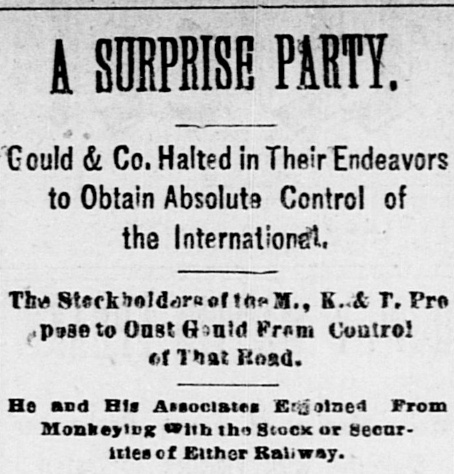
Right:
Fort Worth Daily Gazette, May
11, 1888. As Gould made moves to separate the I&GN from the Katy, an
injunction was obtained by attorneys for Katy stockholders to prevent
Gould from "monkeying" with the stock or securities of the Katy
or the
I&GN.
At a Katy stockholders meeting held May 16, 1888 at
Parsons, Kansas, the quorum
replaced Gould and all of his cronies. Resolutions were passed rejecting the
moves Gould had made to sever the I&GN from the Katy. Shortly
thereafter, the new management team requested
receivership protection from a bankruptcy court while it reorganized. They also
requested the Katy's lease to MP be voided. The court assigned a Receiver and it eventually voided MP's lease of the
Katy. |
 |
The Katy was finally free of Gould, but he would not go quietly; he proceeded to execute a
daring plan to retain the I&GN. He was still the President of the I&GN, at least
temporarily until the corporate officers of the Katy could call a formal I&GN
stockholders meeting and fire him. (...But first, new Katy management would have
to wade through the documents at Katy headquarters they were seeing for the
first time to discover that the Katy actually owned
the I&GN.) Gould needed to buy time; his ploy was to make a short-term personal loan of a half million dollars
to the I&GN. As I&GN President, he then refused to pay it back within the time specified. Gould then
personally sued the I&GN for default
and forced it into involuntary receivership, giving him temporary protection from Katy
management. The Katy intervened in the court proceedings
and agreed that the I&GN should repay the $500,000 to end the matter, after
which they would oust Gould and his henchmen from the I&GN. Gould countered by approaching
his adversary, Attorney General Hogg, to admit privately that the Katy
actually owned the I&GN. Since the Katy was a "foreign" railroad that owned
a bona fide Texas railroad, Hogg was livid and he responded by filing for an
injunction to prevent Katy management from taking any adverse action pertaining
to the I&GN.
Gould's plan worked; Hogg's injunction was upheld by the district court
and the I&GN remained in receivership. It was still owned by the Katy, and
the bankruptcy judge became persuaded to terminate the receivership since the I&GN was
capable of repaying the debt owed to Gould. Hogg tried to prevent termination of the I&GN receivership
and the injunction against Katy management with a final appeal to the Texas Supreme Court --
he lost -- but the additional delay caused by the Supreme Court appeal made a difference. It was now the summer of 1891 and the Texas Legislature was working on the bill to create a Texas railroad
charter for the Katy. At Governor Hogg's urging
(he had been
elected the prior November!) the Legislature had begun to sour on the idea of letting
the Katy own the I&GN, even if it was through a Texas subsidiary.
The new charter was signed into law by Hogg in October,
1891 establishing the Missouri, Kansas & Texas Railway Co. of
Texas to be headquartered at Denison as a wholly-owned subsidiary of the
parent Katy corporation. The Texas subsidiary would own all of the Katy's Texas rail
lines built or acquired under Gould except the
I&GN and the EL&RR (which was still in receivership.) Katy management sold the
I&GN to Gould for $350,000 in exchange for a guarantee that the I&GN would resume its prior traffic arrangements with the Katy. The sale closed in
July, 1892. Why the
paltry sum? No other railroad would bid against Gould since he still controlled
the T&P and the SLIM&S, the I&GN's best route to St. Louis. When the EL&RR came out of receivership, it was sold in early
1892 to the newly chartered Sherman, Shreveport & Southern (SS&S) Railway owned by investors
based in Greenville and Sherman.
 |
When Jay Gould died in New York City at the end
of 1892, his son George took over the family railroad investments and
succeeded Jay as President of MP, the I&GN and the T&P. For the next
twenty years, those railroads would operate under Gould family control
and work cooperatively on Midwest traffic.
Left:
Texarkana Daily Democrat, December
2, 1892
Right:
Texarkana Daily Democrat,
December 3, 1892 |
 |
As for Hogg, he had been elected Governor in 1890 on a platform advocating creation of
a Railroad Commission of Texas (RCT) which the Legislature did in 1891.
Hogg had spent key periods of his public life
working to force the I&GN to improve its service and safety record, but
unfortunately, he learned the hard way that his efforts were insufficient. In
January, 1905, long after he had left public office, Hogg suffered a head injury
when the I&GN train he was riding to Houston collided with a string of freight
cars. Though he believed his injury was minor, he ultimately needed multiple
surgeries over the next year to relieve brain swelling, and he eventually
succumbed to his injury in March, 1906.
On sound legal and
financial footing, the newly independent Katy resumed construction in 1892,
completing the Smithville -
San Marcos line by finishing the 36 miles between Lockhart and Smithville. This
enabled it to establish service to San Antonio via the I&GN connection at San
Marcos. The two railroads seemed content to continue that arrangement, but in
1899, a revision to the Katy's charter required it to extend its tracks to San
Antonio. The Katy didn't ask for this requirement; it was added when the Katy
requested charter authorization from the Legislature to re-acquire the former EL&RR, now the SS&S, between McKinney
and Jefferson. The charter provision was written so that the SS&S purchase could not proceed until the Katy
had extended its tracks from San Marcos to San Antonio. The nature of this
serial requirement to operate into San Antonio before being allowed to buy the SS&S suggests
that the
provision was added by San Antonio legislators concerned about
the lack of railroad competition for the I&GN on routes to the north. The law
also had a unique provision found in no other railroad charter in Texas. By
accepting permission to acquire the SS&S, the Katy agreed to be permanently prohibited
from filing, or participating in, any lawsuit against RCT. The Katy fulfilled its obligations; newspapers report the
beginning of construction out of San Marcos on September 12, 1900 and the
completion of the
46 miles to San Antonio on April 25, 1901.
The Katy also resumed building
east from Boggy Tank, going as far as the Brazos River, seven miles
beyond Sealy. The remaining 42 miles of track from the Brazos River to Houston
was laid the in 1893. With tracks into Houston, the Katy became interested in operating to Galveston, but the
GH&H was still leased to the I&GN which the Katy no longer controlled. The Katy claimed in a Federal lawsuit that it
had a continuing right to operate the GH&H. Negotiations resulted in the Katy and the I&GN each owning 50% of the GH&H with rights to operate
independently over it.
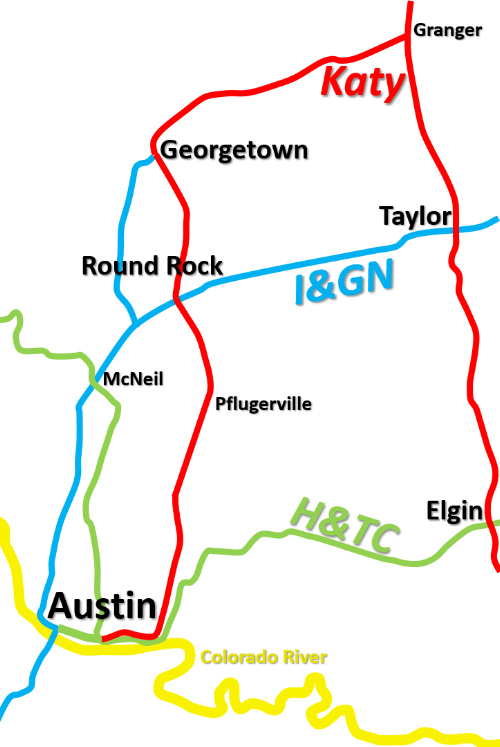 |
The Katy
had tracks from the Red River to San Antonio
via Smithville, but it did not serve Austin, the state capital. To do
so, it acquired two defunct railroads that had never laid tracks: the
Georgetown & Granger (G&G) Railroad and its owner, the Trinity, Cameron &
Western Railroad. The Katy did this to retire the G&G charter which had authorized
a line between Granger (on the Katy main north of Taylor) and Georgetown, the
county seat of Williamson County 25 miles north of Austin. Retiring the G&G
charter enabled a new railroad to be chartered, the Granger, Georgetown, Austin & San Antonio Railway,
which built 16 miles from Granger east to Georgetown in
1903. At Georgetown, the Katy connected with a 10-mile I&GN branch line, the
former Georgetown Railroad (GRR) from Round Rock which the I&GN had acquired out of foreclosure and merged in 1882. The Katy
laid the remaining tracks to
Austin in 1904 going south through Round Rock, Pflugerville and
eastern Travis County before curving west to approach downtown where it began
sharing SP's tracks. In July, 1905, the Katy negotiated rights to share the I&GN bridge over
the Colorado River along with 30 miles of I&GN track south to reach Katy rails
at San Marcos. This enabled the Katy to provide direct passenger service between Austin and San
Antonio. Three months later, the Austin Statesman
of October 4th reported on the I&GN's new Colorado River bridge under construction,
remarking that it was "...hardly possible that the new...railroad bridge will be
finished by the 1st of January, as was first expected. Work on the bridge,
however, is progressing very rapidly." Most likely this bridge replaced the
original structure built 25 years earlier.
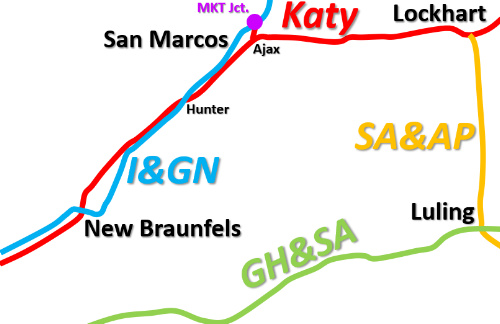
Left: The three main railroads in the Austin area
as of 1904 were the H&TC (owned by SP), the Katy, and the
I&GN. At Round Rock, the Katy crossing of the I&GN main line was
grade-separated, the Katy passing over the I&GN. The Katy crossings
at Taylor and Elgin were both at grade, and they became interlocked as
Tower 34
and Tower 100, respectively. The grade crossing of the I&GN and the H&TC at McNeil was
eventually interlocked as Tower 132. The Katy
intersected the H&TC east of downtown Austin at a switch
known as Pershing. From
there, the Katy used the H&TC tracks into downtown to connect with the
I&GN.
Right: MKT Junction was the branch point on the I&GN main line
for the half-mile run to Katy rails at Ajax, where a triangle track
arrangement permitted connecting movements in all three directions. South of San Marcos, the Katy crossed the I&GN twice. At
Hunter, the I&GN has had a bridge over the Katy since at least 1915, but
the pre-1915 track arrangement is undetermined. The second crossing is at
grade in New Braunfels, where Tower 92 was later built as a manned, 2-story
interlocking tower. |
While George Gould maintained control over the I&GN and helped guide it into a
much stronger railroad over the next 15 years, financial clouds began to appear.
Part of the problem was that RCT had begun issuing regulatory orders requiring
specific railroads to improve physical infrastructure, safety and service with
new railcars, upgraded roadbeds and new depots. Arguably, some of these investments may not have been economically
justifiable, but to the RCT, they were required for public safety. The
I&GN had a terrible safety record, particularly on its line
between Spring and Fort Worth that had opened in 1903. Wayne Cline explains...
"Commission records [in 1908] showed that 99 wrecks had occurred on the I&GN since the
summer of 1907, and 41 of them happened...on the Fort Worth Division. ... The
International & Great Northern had compiled a reasonably acceptable safety
record, but it rapidly went downhill after the Fort Worth Division was
constructed. In 1904, casualties suddenly soared when 139 workers and passengers
were injured -- almost twice the average for the previous ten years. ... After
increasing markedly in 1904, derailments steadily mounted until five times the
normal average occurred in 1907."
The poorly designed roadbed on the Fort Worth Division was not George Gould's only problem. An even larger issue was his
financially precarious situation resulting from the costs of major
rail expansions he had undertaken on the east and west coasts. When the
nation went into a sudden and deep depression caused by the
Panic of 1907, railroad revenues
fell
drastically. When the I&GN was unable to make payments on some of the
bonds issued during its reorganization in 1892, the I&GN went into voluntary receivership in
February, 1908. The receivership lasted three years during which the appointed
Receiver, Judge Thomas Freeman, a former T&P attorney, rehabilitated much of the
I&GN's roadbed and signaling systems using $11 million worth of short term
Receiver Certificates authorized for sale by the Court. In June, 1911, the Gould
family bought the I&GN out of bankruptcy and named Judge Freeman to be the new
President. Unfortunately, revenues were insufficient to retire the short term
notes he had issued as Receiver, hence the I&GN went back into receivership in
1914. And at that point, the Gould family connection to the I&GN ended forever.
It was not until July 28, 1922 that the reorganized railroad was bought out
of bankruptcy by a newly organized company, the International - Great Northern
Railroad (which explains why both I-GN and I&GN are
commonly used as abbreviations.) The new I-GN had more than 1,100 miles of
track, and it served many important cities across Texas including the Port of
Galveston. Its massive route structure through Texas made the I-GN an attractive
property. A major Midwest railroad, the St. Louis & San Francisco ("Frisco") Railway, tried to buy it
later in 1922 but the
Interstate Commerce Commission (ICC) refused to approve the sale.
The Frisco's attempt alarmed MP which had long cooperated with the I-GN on
access to St. Louis. MP had been reorganized in 1917 and the Gould family was no
longer involved. MP did not have any railroads in Texas and it wanted to acquire the
I-GN to re-enter the Texas market (having been evicted more than thirty years earlier
when its lease of the Katy was voided by Texas courts.) MP
tried to buy the I-GN in 1924, but again, the ICC nixed the sale.
Not to be deterred, MP executed its fallback strategy by helping to arrange
for the New Orleans, Texas & Mexico (NOT&M) Railway to buy the I-GN, simply to
keep it out of the hands of other competitors. The sale of the I-GN to the NOT&M
was approved by the ICC in June, 1924. MP was then allowed to buy the entire
NOT&M on January 1, 1925, thereby acquiring the target I-GN plus several other railroads
owned by the NOT&M. This instantly
gave MP a major presence in Texas including half ownership of the
primary switching railroad in Houston, the Houston Belt & Terminal Railway.
The
I-GN continued to operate under its own name within the MP family of railroads.
In 1933, MP and all of its subsidiaries went into a lengthy receivership largely
attributable to the Great Depression. The receivership did not end until 1956
when a new Missouri Pacific Railroad Company was formed with all of its
railroads merged into it, no longer carrying separate corporate identities. The
T&P, however, was not merged even though MP owned 75% of its stock. The T&P continued to operate cooperatively with MP until it was merged in 1976.
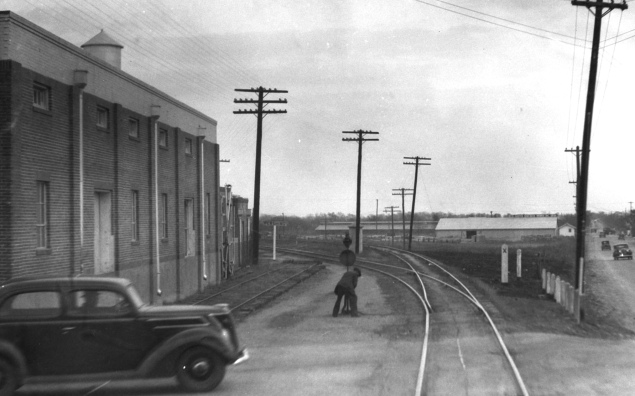
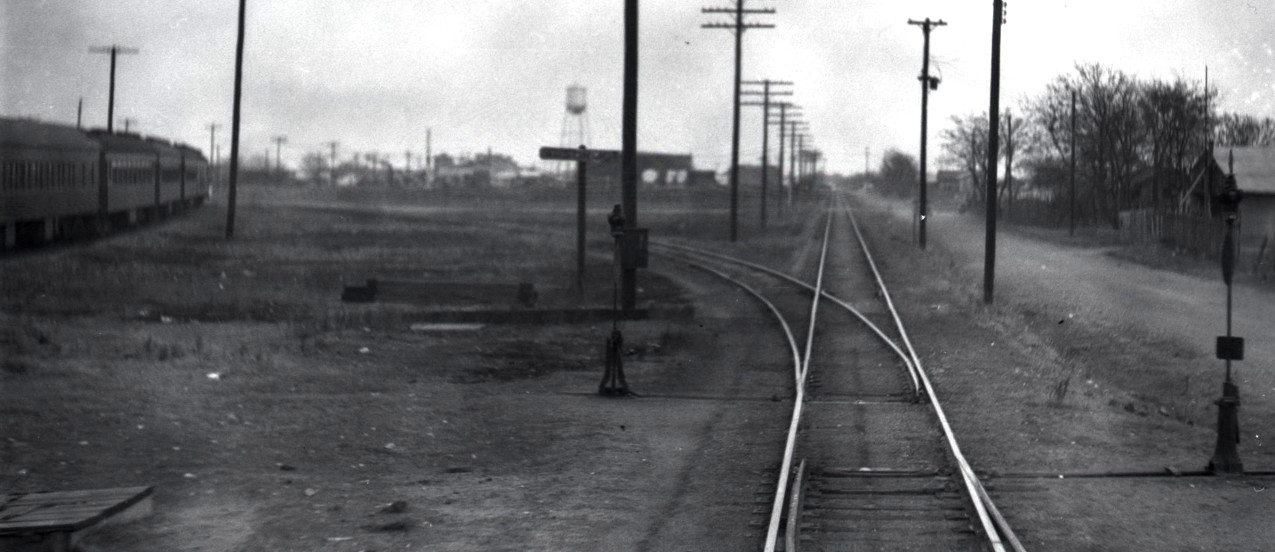
Above Left: Coming into Austin
on the Katy, Barriger took this photo facing east at Pedernales St. His business
car has just cleared the switch at Pershing where the Katy
merged onto SP's tracks for the trip west into downtown. A switchman, presumably an SP employee, has
begun to move the switch back to its normal position to allow straight-ahead
movements on SP's main track toward Houston. A barely visible horizontal sign atop the white pole
beyond the switchman (near the utility pole to the left) reads "PERSHING".
From Round Rock, the Katy came south through eastern
Travis County and then paralleled the H&TC for the last three miles into Pershing.
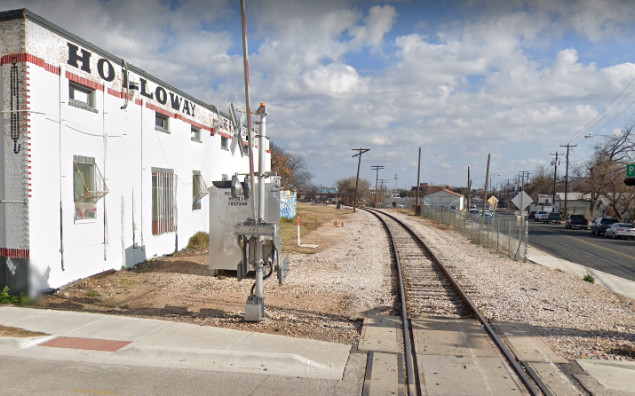
Above Right: This Google Street View image from 2021
shows that the Katy tracks are gone, but the adjacent building has
survived for 80+ years; perhaps some of the utility poles have as well. The
street to the right parallel to the tracks is East Fifth St.
Below: A quarter mile farther west (closer to downtown) Barriger's next photo is
facing east at Austin Jct. (as the horizontal sign reads.) This was the wye junction for SP trains to
go north to Burnet, Llano and Marble Falls on the former Austin & Northwestern line,
a right-of-way that is now used by Austin's
CapMetro commuter rail system. There were two tracks on the west side of the
wye going north, and Barriger's business car has just cleared the switch for the
inner track. The passenger cars sit on the outer track, which was removed
sometime in the 1940s; that real estate is now occupied by buildings. Barriger's
business car is about to cross Canadian St., now Robert T. Martinez Jr. St.
Continuing west into downtown, SP's track will migrate a block south to Fourth
St., and then transition again to Third St. to reach the passenger depot at the
corner of Third St. and Congress Ave. From there, the SP tracks proceed west to a wye at the I-GN's Colorado River
bridge.
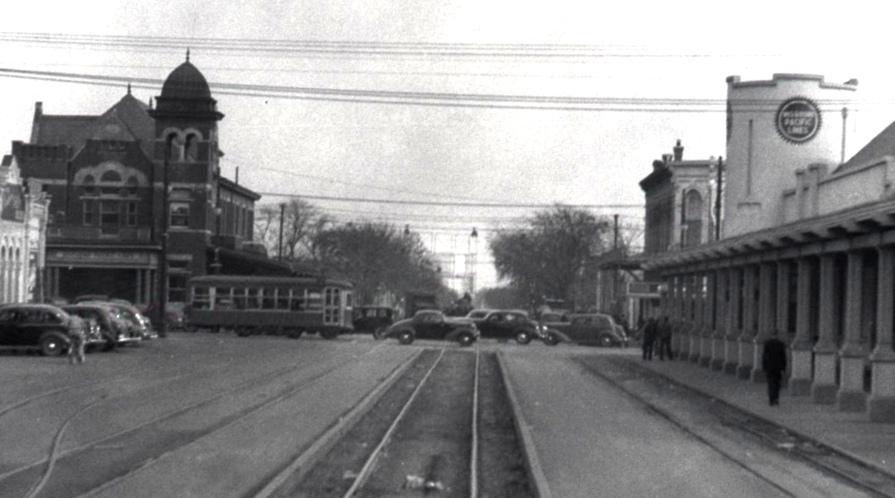
Above: In Barriger's next
photo taken about 1.5 miles farther west, his camera continues to face east as
his train is moving west on Third St. toward the river bridge. He has just
crossed Congress Avenue where the ornate SP depot (also used by the Katy) sat on
the northeast corner, and the MP depot (formerly the I-GN depot) sat on the southwest corner.
The I-GN was the only MP railroad serving Austin, but by this time, the I-GN's
separate identity had begun to be curtailed. It would disappear completely in 1956.
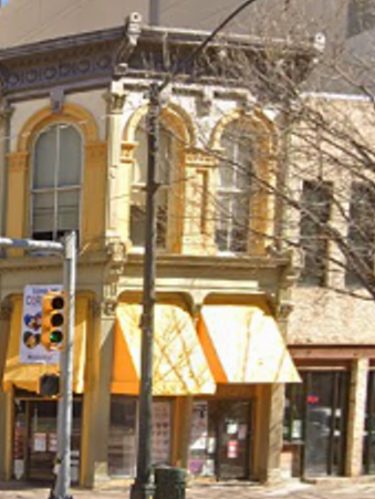
The MP and SP
depots are long gone, but on the southeast corner, the arch-windowed building
(visible beyond the circular tower on the MP depot) was still standing when Google Street View caught this image
(above right) in February, 2021.
Barriger's train will proceed another half mile west and then take the east leg
of the wye to turn south onto the Colorado River bridge.
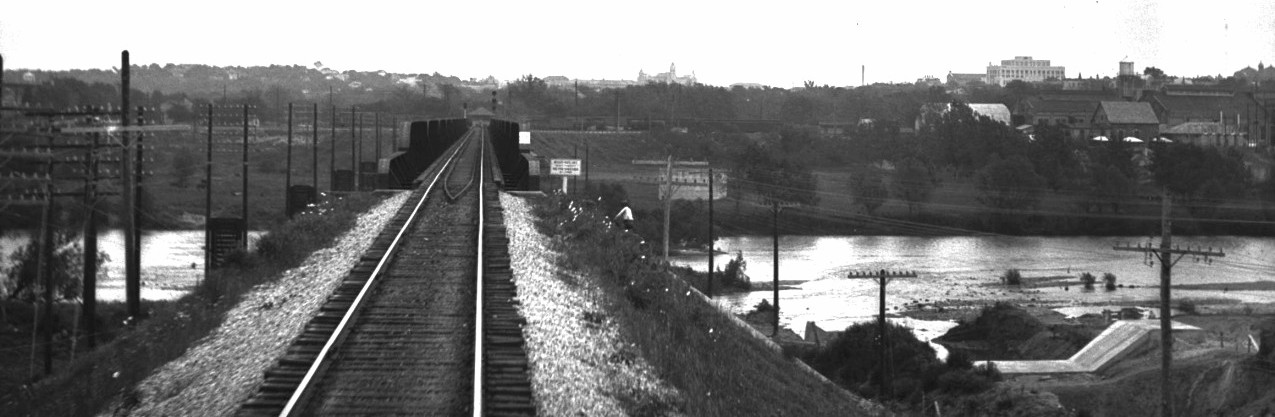
Below: This may have been Barriger's next photo, but its
sequence number in the Barriger Library suggests that it was from an earlier
trip southbound on the Katy. His view is from the south side of the Colorado
River looking north along the I-GN bridge. The bridge control tower is
barely visible sitting in
the middle of the wye at the north end of the bridge. Barriger's trip south to
San Marcos will be on tracks that had been upgraded with automatic block
signaling. The May, 1929 issue of Railway Signaling
reported that the I-GN had
ordered automatic block signals from General Railway Signal Co. for the 36 miles
between Austin and San Marcos yard.
Below:
At Austin on a northbound I-GN trip, Barriger's train has just exited
the Colorado River bridge on the west leg of the wye and cleared
its northwest switch to prepare for a backup move to the
MP depot on Third St. The depot is not visible to Barriger because it is
beyond the curve to the left in the distance.
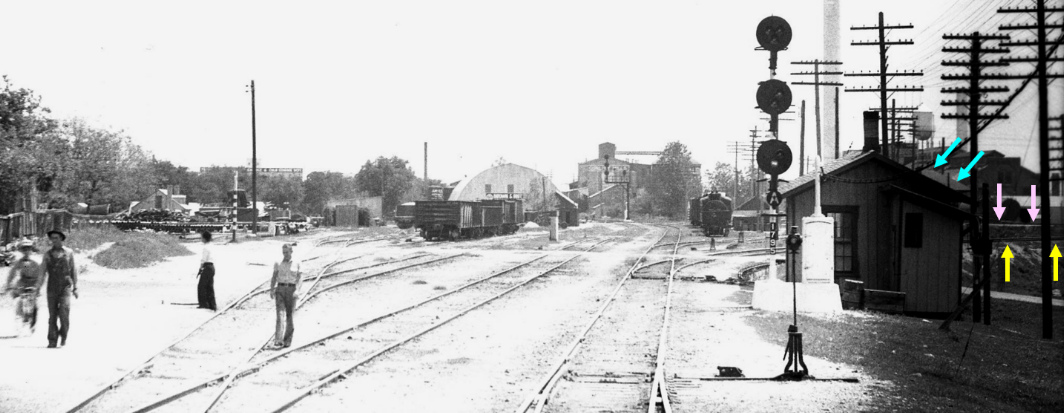 |
Barely visible to Barriger's
camera is a
portion of the control tower's roofline (blue arrows) and short stretches of the east leg (pink
arrows) and west leg (yellow arrows) of the wye at the bridge. |
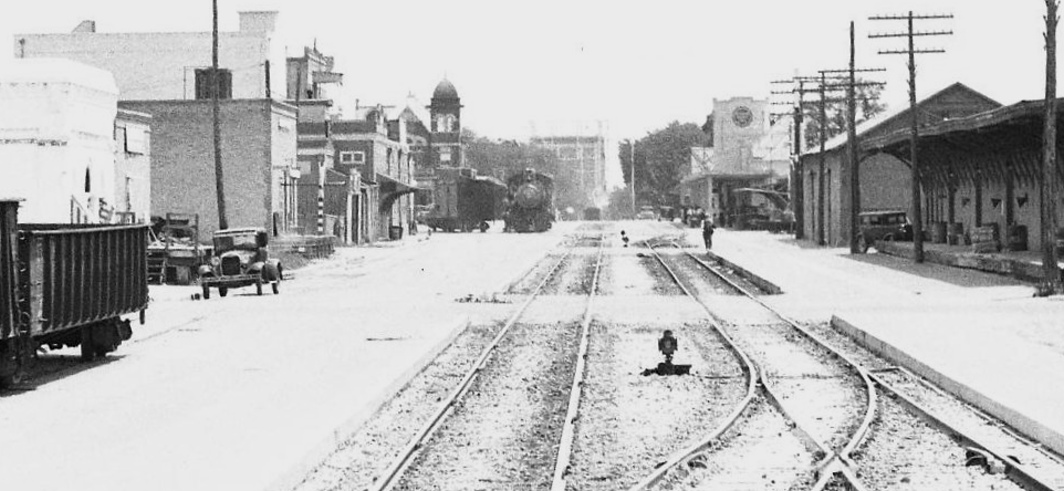
| Right:
The next photo in Barriger's sequence shows that he is approaching the
MP passenger station (white building
with circular MP herald) as his I-GN train
backs east along Third St. Judging by the position of the
switch rails and Barriger's photo not being centered on the rails, his train is
taking the crossover to move to the south track used for access to the depot. |
 |
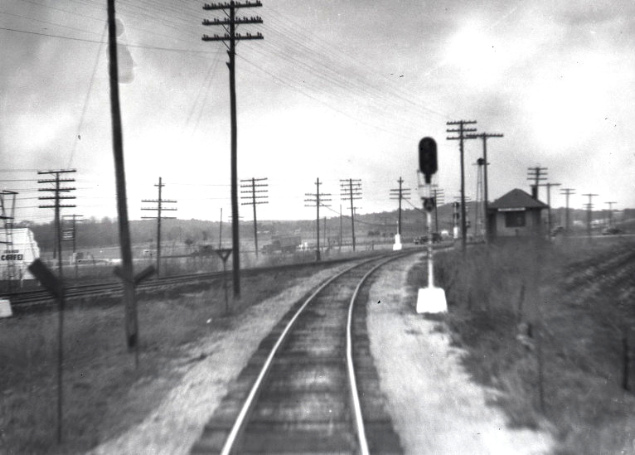
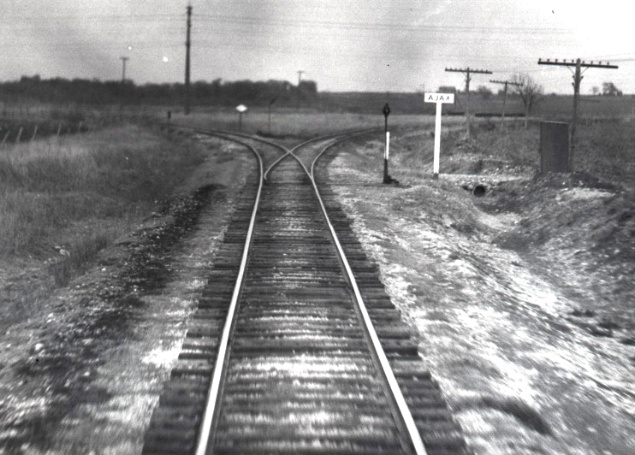
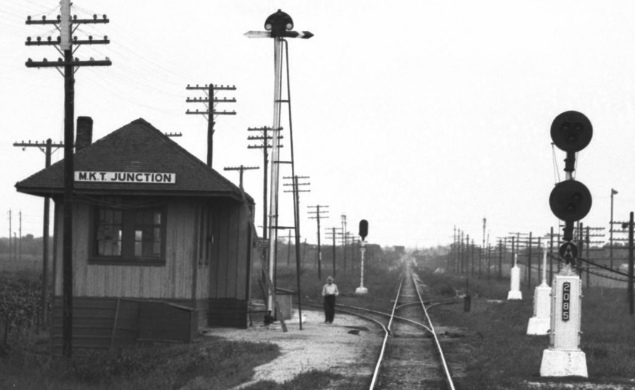
Above Left: Perhaps on the
same southbound Katy trip cited above, Barriger's train has taken the connector
off the I-GN at MKT Junction toward the Katy main line as he looks back at the
control cabin. In a half mile, Barriger's train will reach Ajax, most likely to
go south toward New Braunfels, but with the option to go east to Lockhart and
Smithville. Above Right: The
next photo in Barriger's sequence is looking back at the south lead of the wye
at Ajax. His train turned south at Ajax and is heading toward New Braunfels. The
position of the switch rails shows that his train came off the northeast lead
(left) from MKT Junction.
Below Left:
On a different trip, Barriger snapped this photo of MKT Junction from his
business car as his northbound Katy train has just come off the connector from
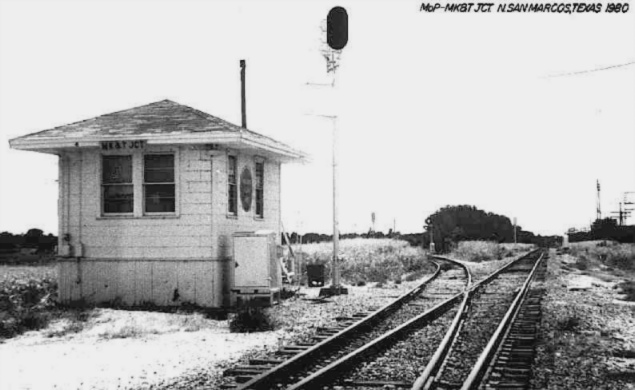
Ajax to head toward Austin on I-GN rails. Below Right: Taken in 1980, this photo shows a different cabin
sitting at "MK&T JCT" sporting a "Missouri Pacific Lines" circular herald
on the front. By this date, the junction was fully automated; the cabin housed
the interlocking plant but was normally
unoccupied. The cabinet at the near corner of the building may have held
override controls. (H. D. Connor Collection)
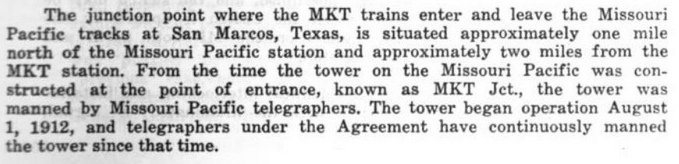
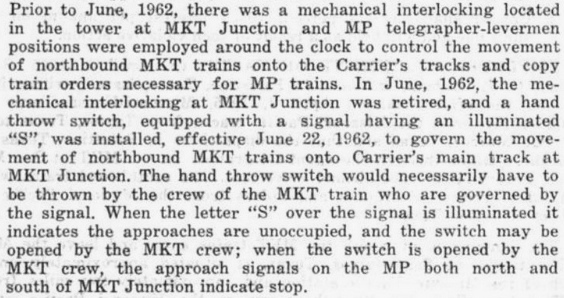
Above and Right: The
National Railroad Adjustment Board (NRAB) was a body created by Congress to
arbitrate labor
disputes in the railroad industry. These two excerpts are from an NRAB ruling
issued October 30, 1969 for a claim initially raised by MP telegraphers when
some of their jobs were eliminated at MKT Junction in June, 1962. The basic claim was that between 6:30 am and 3:00 pm, Katy
telegraphers at the depot in San Marcos had begun copying and delivering train
orders to northbound Katy trains to be executed after the trains arrived at MKT
Junction, whereas previously, such orders were handled by MP telegraphers at MKT
Junction. The MP employees asserted that this violated their union's agreement
with MP. Having failed to appeal MP's internal decision (on the 1962 claim) to
NRAB, their attempt to re-file the same claim in 1965 violated NRAB procedures
and was disallowed. The tower at MKT Junction had opened August 1, 1912
and had been staffed by MP personnel continuously since then, 24 hours daily. At
the time of the dispute "...there was a mechanical interlocking located in
the tower..." approved as Tower 206 by RCT at an unknown date. (Based on timeframes for
Tower 204 and Tower 207,
it is likely to have been in 1956.) The switch and interlocker controls had been
operated manually by the MP "telegrapher-levermen". Effective June 22,
1962, the cabin was not staffed during morning and early afternoon hours, so
Katy train crews would receive their train orders at the MKT depot in San
Marcos. Upon arrival at MKT Junction, they would stop and manually operate the
trackside switch. The switch was connected to the interlocker so that "...when the switch is
opened by the MKT crew, the approach signals on the MP both north and south of
MKT Junction indicate stop."
It is apparent from Barriger's photos
that there were home (and presumably distant) signals at MKT Junction long
before RCT approved the interlocker in 1956. The best guess is that since the
two railroads didn't actually cross at this junction, they had decided that RCT
approval of their switch and signaling system was not necessary. A nearly
identical situation existed with the control tower at the Colorado
River bridge. SP tracks (on which the Katy had rights) and MP tracks formed a
wye at the north end of the bridge but did not cross, hence the tower (which
presumably existed long before Barriger's visits) had never been incorporated
into RCT's numbering scheme. It officially became Tower 205 in the same 1956 timeframe
as Tower 206, suggesting that
MP (which managed both towers) had decided to comply with RCT interlocker
policies at these two junctions. Perhaps this was in response to
pressure (or a direct threat) from RCT, but it also seems reasonable to assume
that MP's exit from a lengthy receivership in 1956 (which dated back to the
1930s) played a role. The I-GN became fully integrated into MP when the
receivership ended, so that may also have been a factor.
It is interesting to note
that the focus of the labor dispute pertained solely to train order
communications for northbound Katy trains at San Marcos. Elsewhere, the ruling
mentions that southbound Katy trains (that would eventually take the switch at
MKT Junction) received their train orders from MP
telegraphers at Taylor, and that "...MKT's trackage rights were recently
extended to include...tracks between Austin and Taylor..." (approved by the
ICC on August 26, 1964.) Afterward, MKT trains
between Austin and
Temple began operating through Taylor instead of taking the Katy's route
through Georgetown (which meant that the Katy no longer served Georgetown and
Pflugerville.) The Katy tracks between Austin and Georgetown were formally
abandoned in 1976.
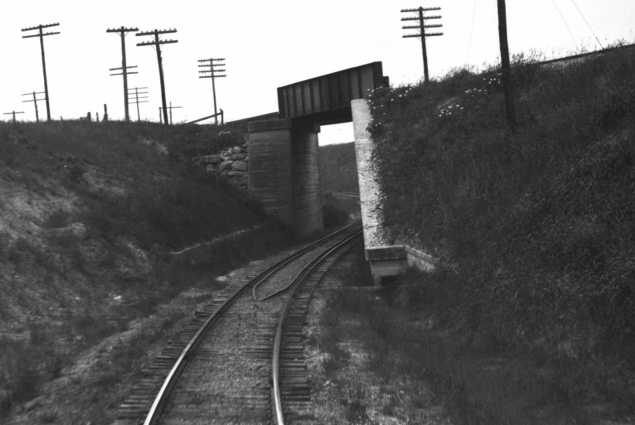
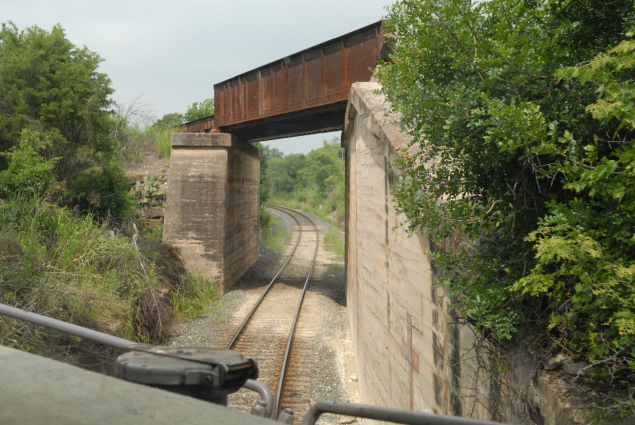
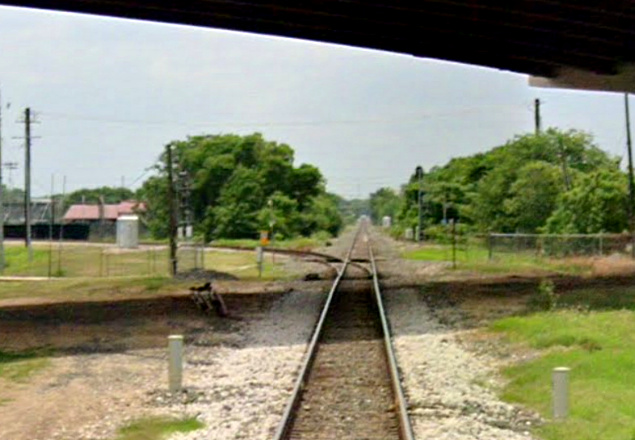
Above: About six miles south
of San Marcos, the Katy tracks crossed under the I-GN tracks near the community
of Hunter. On the other side, the lines resumed their parallel trek south
toward New Braunfels. As shown by these photographs taken approximately 70 years
apart by John W. Barriger III (left, c.1940, from the rear platform of his
business car on a northbound trip) and Bruce Blaylock (right, June 6, 2010, from
the cab of the Union Pacific locomotive he was piloting on a southbound trip), very little
has changed! Bruce describes this crossing:
"At Mile Post 215.58 on the MP
(upper) track is an 85-foot skewed girder bridge built in 1915. As you can see,
the clearances are very tight and I never held my arm out of the cab while
running through Hunter Cut. A shifted load would be a real problem here. Some
years ago, the bridge was raised a few inches to accommodate double-stack
trains."
Since there is apparently a local indication of the 1915 date
for the bridge installation, the obvious question is...was there always a bridge
here, i.e. was this the original track arrangement in 1901? The Katy tracks were
built 25 years after the I&GN tracks, and it's rare for the second railroad to
go under the first one. There's no indication (e.g. a creek bed or unusual
topography) that would convey the need for an I&GN bridge prior to the Katy's
construction. Since the Katy needed to move west of the I&GN tracks, the bridge
may have been added when the Katy was building south simply because there was no
less expensive way to do it. Rather than build a lengthy bridge, the Katy could
have paid the I&GN to raise their tracks (which are straight) onto a fill so the
Katy could cross beneath it. No evidence to the contrary has surfaced thus far, and
Hunter is not listed in any RCT documentation pertaining to crossings.
The positional swap of the rail lines (east for west) at Hunter did not disturb
their general southwest heading. So if the rail lines were near each other and
mostly parallel, how did they cross at nearly a right angle at Tower 92 in New
Braunfels? The culprit was the I&GN. The Katy tracks more or less maintain a
southwest heading on the entire route through New Braunfels, with short
adjustments at various places. The Katy crossed the Guadalupe River
geographically about where it would be expected, in the community of Gruene (less than a
half mile from the famous Gruene Hall dancehall which had already been hosting
live music for 23 years when the Katy showed up!) The Katy made one final
adjustment to a due south heading about three quarters of a mile north of the
crossing that became Tower 92's location and returned back to a southwest
heading just as it was crossing the I&GN at grade.
As can be discerned from the earlier map showing the rail lines between San
Marcos and New Braunfels, beginning northeast of New Braunfels the I&GN (the east line) takes a diverging path onto a
south-southwest heading,
gradually moving farther away from the Katy, continuing straight for nearly five
miles. This brings it to the Guadalupe River about a mile due east of downtown.
After crossing the river, the curve necessary to go back west into downtown
required a west-northwest heading because the river crossing had put the
latitude of the tracks a bit farther south than downtown. Continuing on this
heading, the I&GN crossed the Katy after passing through downtown and then
immediately began to curve back to the southwest to return to the original
heading toward San Antonio.
|
Right:
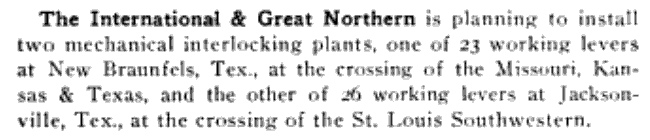
The January, 1913 issue of The Signal Engineer
carried this news item reporting the I&GN's plans to install interlocking plants
at New Braunfels and Jacksonville. The New
Braunfels plant was installed in Tower 92 and commissioned on
November 1, 1913. The Jacksonville plant was ... never bought? The first
appearance of Jacksonville in RCT interlocker records is dated eighteen years
later in 1931 when a 4-function interlocker was authorized to control the I&GN's
crossing of the St. Louis Southwestern ("Cotton Belt") with a swing gate tied to
an electric interlocker, similar to the later switch arrangement at San Marcos. |
 |
 |
 |
 |
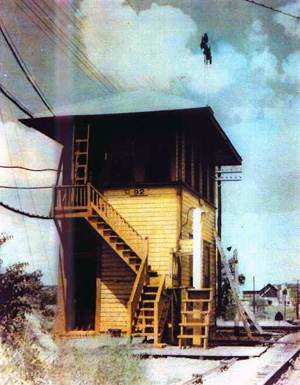
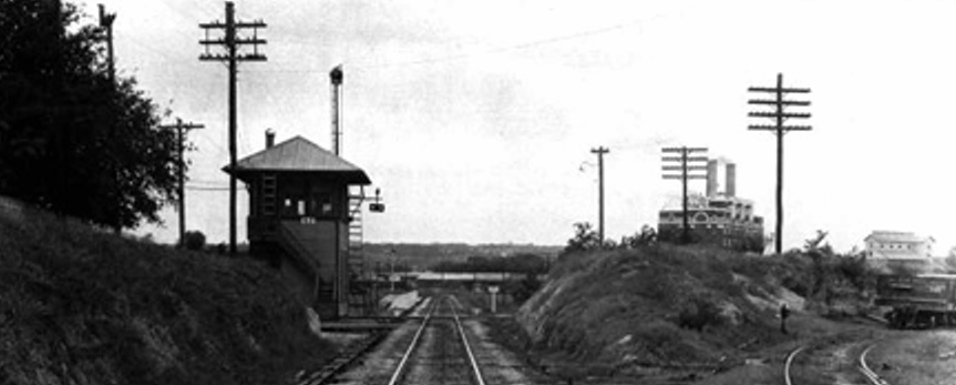
Above: Tower
92 controlling the Katy / I&GN crossing at New Braunfels was a manned,
2-story structure that housed a 23-function mechanical interlocker. These two
undated photos of Tower 92 face northwest although the tracks in view are
southbound to San Antonio. RCT records from 1916 show that the tower was
operated by I&GN personnel who likely had responsibility for
maintaining the tower and interlocking plant. In
1957, the ICC granted MP and the Katy permission to replace the Tower 92 manual
plant with an automatic interlocker. Presumably the tower was removed shortly
thereafter. (photos courtesy Jim Burns, New Braunfels Historic Railroad and
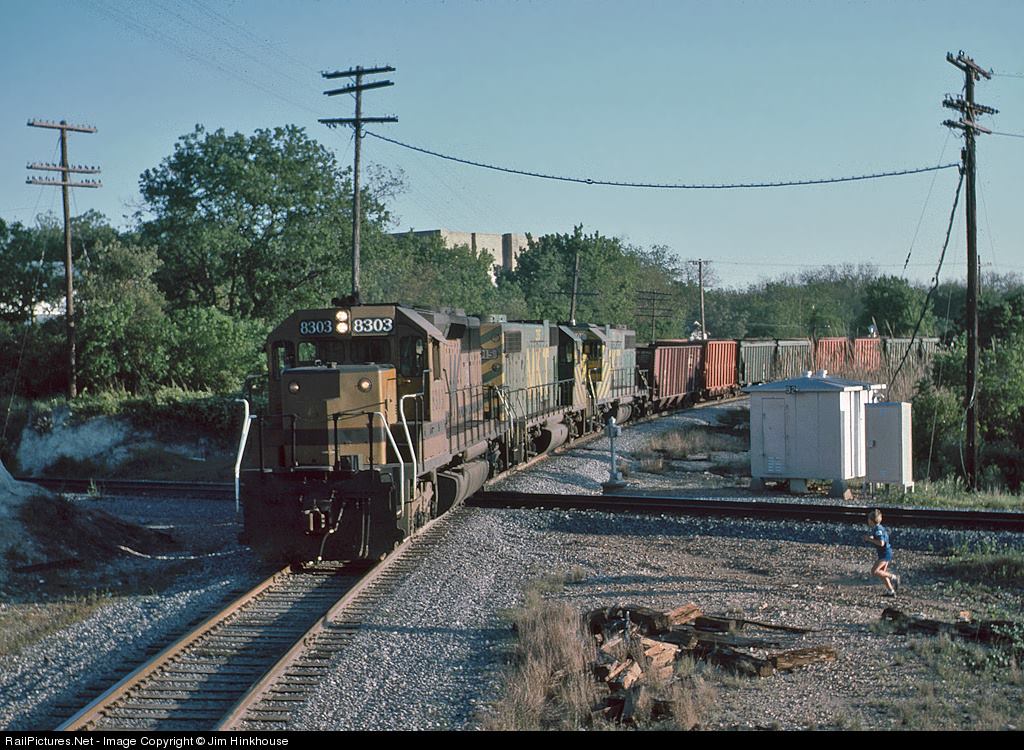
Modeler's Society collection) Left:
This June, 1983 photo by Jim Hinkhouse shows a young boy running toward a
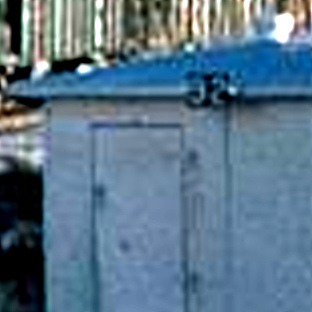
northbound Katy train as it crosses the Tower 92 diamond. The automatic
interlocker cabinet to his right has a "92" placard (magnification
below.) The control stand near the diamond allowed trainmen to override the
signals when necessary.
 |
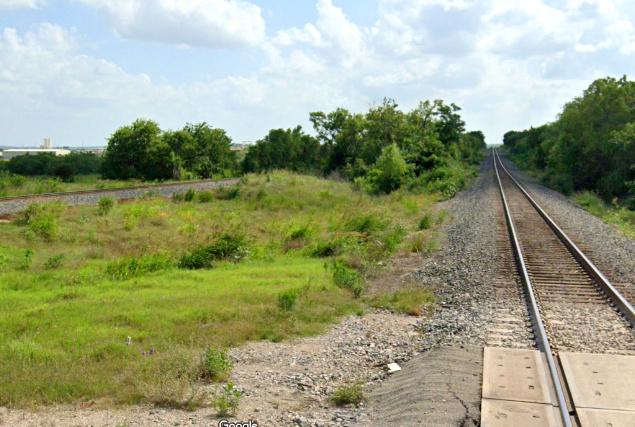
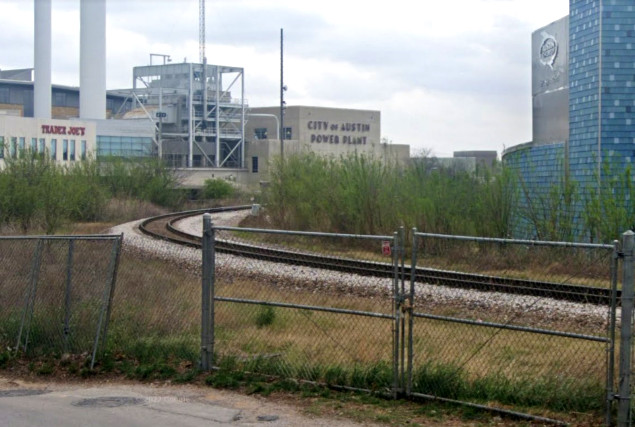
Above Left: This view looks
south from the County Rd. 235 grade crossing of the former I-GN tracks, with the
former Katy tracks to the left. The I-GN tracks are visibly rising to cross the
bridge at Hunter Cut while the Katy tracks remain level and gradually descend to
go through the cut. Above Right:
This view from Third St. in Austin shows the former MP tracks curving to cross
the Colorado River bridge. Previously, this would have been the west leg of the
wye with switches for a "straight ahead" track on Third St. Except for what is
now the main line, all of the tracks at the north end of the Colorado River bridge in Austin have
been removed, as have all of the other tracks on Third St. east
of the bridge.
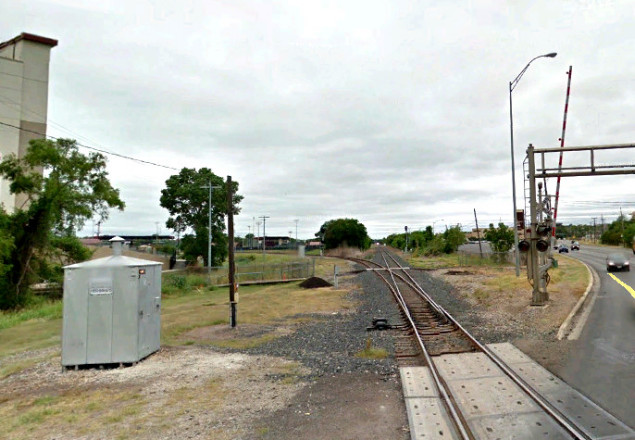
Below:
There is still a switch at San Marcos Jct., but the cabin is long gone. The
overpass visible in 2022 (left)
for Aquarena Springs Dr. opened in 2018, replacing the street grade crossing
that previously existed (right).
(Google Street View)
The Katy was able to stay independent but it was similarly affected by economic
downturns. The entire company entered receivership in 1915 and came out of it in
1923 under the name Missouri - Kansas - Texas Railroad, hence both MK&T and MKT
are used as abbreviations (but it was mostly just "the Katy".) Some of its routes were sold off or
abandoned, and some of its leases of other railroads were canceled. To
compete with the larger systems, the Katy began to consolidate management and
operations. The headquarters for the entire company was relocated to Dallas and
the Texas subsidiary corporation was dissolved (due to changes in law, it was no
longer necessary.) The railroad gradually abandoned
non-productive routes, but managed to remain in business into the 1980s. In
1988, it was purchased by MP, 100 years after MP had lost its lease on the Katy
due to the voluntary receivership undertaken by the new management when Jay
Gould was ousted. MP was no longer independent; it had
been acquired by Union Pacific (UP) in 1982. In 1989, the Katy was
merged into MP and ceased to exist as a separate corporation. Similarly, MP was
fully merged into UP in 1997.
