Texas Railroad History - Tower
132 - McNeil
A Crossing of the International - Great Northern Railroad
and the Houston & Texas Central Railway
 |
Left:
Northwest of Austin, two rail lines crossed at McNeil in an X-pattern with
slightly acute angles
north and south. An interlocking cabin, Tower 132, sat in
the eastern quadrant of the diamond. Viewed from this angle, a utility
pole blocks most of the white "132" placard facing the camera. An
identical placard is barely visible beneath the roof overhang on the
west wall facing the tracks.
The photo was taken in the mid 1960s
facing south-southeast along Southern Pacific (SP) tracks that dated back to
the Austin & North Western Rail Road in 1881-82. In
the distance, SP #6607, an Alco locomotive, is heading northwest. It
will cross Missouri Pacific (MP) tracks at the diamond and continue
to its final destination, perhaps Burnet or Llano. The MP line was built
by the International & Great Northern Railroad in late 1876. An exchange track behind
the cabin doubles as a straight siding using the short connector
opposite the bicyclist.
The mechanical interlocking plant at Tower 132 became operational in 1928. It was a
cabin interlocker, typically a small, walk-in hut (often
called a "shanty") that housed the plant and
its manual controls. It is undetermined whether this image shows the
original cabin.
(photos from the collection of Roger Shull, Crew Chief, Austin & Texas Central Railroad; thanks,
Roger!) |
The International & Great Northern (I&GN) Railroad
was created in 1873 by a
merger of the International Railroad and the Houston & Great Northern Railroad.
The merger was delayed in
getting approved by the Texas Legislature because of the International's dispute
with the State over construction subsidy bonds that the Texas Comptroller refused to sign. A
compromise was finally reached in 1875 and a year later, the I&GN built
sixty-one miles of track from
Rockdale to Austin,
passing through this area in the fall of 1876. The track segment was part of a larger plan to build from Longview to the Mexican
border at Laredo (hence, the International part of the name.) From Longview, there was a favorable connection on the
Texas &
Pacific (T&P) Railway to Texarkana where another
connection led onward to St. Louis.
The I&GN was acquired by rail baron
Jay Gould in 1881 using a swap for stock of the Missouri, Kansas & Texas
(MK&T, "Katy") Railway of which he was President. Gould had very little
personal ownership of Katy stock, and this eventually cost him his job. In
December, 1880, Gould leased the Katy to the Missouri Pacific
(MP) Railroad which he controlled with a substantial ownership position.
The lease terms were onerous, effectively allowing Gould to siphon Katy profits
into MP to the substantial detriment of Katy stockholders. When the stockholders
realized their predicament, they began attempts to summon a quorum to a special
meeting for the purpose of firing Gould. They finally succeeded in doing so at a
meeting held in May, 1888. The Katy's new management promptly sought bankruptcy
protection and a court order to void MP's lease, which was granted.
A
year earlier, Gould's expansion of MP (Katy) tracks in Texas during the 1880s
had come under legal attack by the Texas Attorney General because the Katy,
based in Kansas, lacked a Texas headquarters as required by an 1876 amendment to
the Texas Constitution. The Katy remained in receivership until the Legislature
could deal with the problem. A Texas railroad charter for the Katy was passed by
the Legislature and signed into law in October, 1891 establishing a Texas
subsidiary headquartered at Denison. The charter
did not allow the Katy subsidiary to own the I&GN, so the Katy had little choice
but to sell it back to Gould. The sale was delayed until July 11, 1892 waiting
for the completion of court proceedings for the Katy's receivership.
The
I&GN was Texas' largest railroad; it was the prize Gould had been seeking all
along. Gould had little time to enjoy
his victory -- he died less than five months later; his son George took over
the family rail empire. George's tenure as I&GN President had ups and downs as the I&GN went into receivership in 1908 and again in 1914. The 1914
receivership lasted until 1922 by which time the Gould family was no longer
involved. The reorganized railroad company took a new name, the International - Great Northern (I-GN)
Railroad. The I-GN was a large railroad
with 1,100 miles of track in Texas, but its recurring financial issues made it a
candidate for takeover by another railroad system. The St. Louis & San
Francisco ("Frisco") Railway, fresh out of its own receivership, tried to buy
the I-GN in 1922, but the Interstate Commerce Commission (ICC) rejected
the sale. MP, no longer controlled by the Goulds, tried to buy the I-GN in 1924 as a means of
regaining access to the Texas market which it had lost decades earlier when the
Katy lease was voided. Once again, the ICC nixed the sale. MP's fallback strategy involved the New Orleans, Texas & Mexico (NOT&M)
Railway. The NOT&M successfully purchased the I-GN and then MP was allowed
by the ICC to buy the entire NOT&M on January 1, 1925. This gave MP the I-GN
and several other NOT&M railroads that operated along the Gulf coast.
The I-GN continued to use its own name until 1956 when it was
fully consolidated into MP. MP was acquired
by Union Pacific (UP) in 1982 and became fully integrated into UP operations in
1997.
 |
Left: The SP tracks at
McNeil traced back to a lengthy rail line projected
into the Texas Panhandle by the
Houston & Texas Central (H&TC) Railway. The H&TC had already completed a
main line from Houston to
Denison (1873) with branch lines to Austin
(1871) and Waco (1872). A new line
northwest from Austin (blue circle)
was expected to reach Oldham County on the New Mexico border. A second
H&TC line out of Waco (red circle) was intended to reach the Canadian
River in Potter County. (Texas General Land Office map, 1876)
H&TC's investors expected
both branches eventually to connect to the Atlantic & Pacific (A&P) Railroad, a
company chartered by Congress to build a transcontinental route from
Springfield, Missouri to the Pacific Ocean along the 35th parallel. Eastern and western portions of the A&P were built but were never connected.
The
western tracks became part of the Atchison, Topeka & Santa Fe Railway;
the
eastern tracks became part of the Frisco.
The H&TC did not proceed with
construction northwest out of Austin in part due to the death of its
principal owner, Charles Morgan. When Morgan's estate was finally
settled, the H&TC had become controlled by SP in 1883. In
1882, an unrelated company, the Austin & North Western Rail Road, completed sixty miles of
narrow gauge track from Austin to Burnet, but went no further. The
railroad entered receivership the following year and was reorganized as the
Austin & Northwestern (A&NW) in 1888. It derived good business from granite quarries in the vicinity of Burnet and it carried all of
the granite used to build the State Capitol building in Austin. Tracks beyond
the quarries to Marble Falls were laid in 1889.
Under SP control,
the H&TC bought the A&NW in 1891 and converted it to standard gauge. The
tracks were extended to Llano in 1892. The original route out of Austin had crossed the I&GN at an unnamed rural location
where a settlement sprang up known as McNeil; George McNeil was an A&NW section foreman. The A&NW continued operating
under its own name until it was fully merged into the H&TC in 1901. |
That year, 1901, was a significant one for Texas
railroads. A new state law authorized the Railroad Commission of Texas (RCT) to
begin regulating railroad crossing safety. State law required all trains
to come to a complete stop before crossing another railroad's tracks at grade.
In addition to creating delay, the loss of physical momentum caused by the stop
increased a locomotive's fuel and water requirements as it accelerated after
proceeding over the crossing. This was recognized as wasteful of time and fuel
since a train approaching a crossing would find it unoccupied the vast majority of the time. The
new law anticipated implementing interlocking plants at crossings of two (or
more) railroads at grade to eliminate unnecessary stops,
saving time and fuel. The law also included authority to regulate
grade-separated crossings. This allowed RCT to intervene when two
railroads could not agree on a mode of crossing.
RCT began with a blanket order requiring swing gates to be installed immediately at all
crossings. This was somewhat odd; gates per se didn't qualify as the
kind of safety system that would permit a train to cross a diamond without
stopping. Thus, trains approaching a gate that was not positioned
against them nevertheless had to stop at the crossing
(whether they always did so is another question.) Much later, regulations were
enacted to allow trains to approach gated crossings at restricted speed, slow
enough to be able to stop comfortably short of the diamond if a gate was
positioned against them but otherwise allowed to cross the diamond without
stopping if the gate was open.
Interlocking plant technology had been developed and deployed in other
parts of the U.S. Such interlockers used electro-mechanical logic combined with home
signals, distant signals and derails to control how trains approached and
crossed a diamond. RCT began issuing orders periodically mandating that
railroads install interlockers at specific crossings within a defined timeframe. RCT's
order dated June 18, 1903 required the I&GN and the H&TC to interlock the
crossing at McNeil by the middle of 1904, but that did not happen. It
is likely that the railroads convinced RCT to rescind the interlocker requirement for McNeil.
At
crossings like McNeil, the relatively limited amount of SP traffic over the
diamond could not justify the capital, labor and material expense of
installing, operating and maintaining an interlocking plant and a structure to
house it. In some cases, interlockers
were deemed unnecessary because all trains stopped anyway at a nearby depot, close
enough to substitute for the required stop at the crossing. This could easily
have been the case for McNeil. How the McNeil crossing was
handled in the early days has not been determined, but it is likely that it was simply
gated until an interlocking was installed in 1928. None of the H&TC and I&GN
Employee Timetables dated between 1901 and 1927 that have been examined thus far
make any mention of swing gates, but this is not conclusive.
By 1928,
the H&TC had been leased (1927) to another SP subsidiary, the Texas & New Orleans
(T&NO) Railroad. RCT records
show that Tower 132 was commissioned at McNeil on July 13, 1928 with an 11-function mechanical cabin interlocker operated by H&TC. As 1928 was more than 25 years
after the first interlockers were installed in Texas in 1902, the technology had
evolved to address situations like McNeil where a busy line -- the I&GN --
crossed a line with limited traffic -- the H&TC. The expense of operating a
manned tower, particularly the labor costs, could not be justified at such
crossings. The tower operators would have very little work to do since the
signals would be set to allow virtually every approaching train on the busy line
to proceed across without stopping. Only rarely, when a train on the lightly
used track needed to cross, would the signals be set to warn an approaching
train on the busy line to prepare to stop. This condition would persist only
long enough for the crossing to complete, after which the signals would be
reset to allow continuous movements on the busy line.
Instead of
requiring the railroads to staff a tower with operators who would have little
actual work, RCT approved the use of cabin interlockers. Such cabins were
typically a small walk-in hut that would house the interlocking plant and its
manual controls. Trains on the lightly used track would always stop at the
crossing. A member of the train crew would disembark, enter the cabin and set
the signals to allow his train to cross. This would also set the signals to STOP on the busy line. When his train had
finished crossing, the crewmember would reset the signals to PROCEED allowing
uninterrupted movements by trains on the busy line. He would then return to his train,
now on the other side of the diamond. Thus, cabin interlockers were operated by
train crew employees of the less busy railroad. This was "free" labor since the
crews were already employed to operate the train.
Right: This excerpt
from a labor union's submittal to the National Railroad Adjustment Board
explains that there was an "employee covered by the agreement" that
operated the McNeil interlocker. The agreement specified this position
as an "agent-telegrapher-leverman" employed by MP (I-GN) to operate the
McNeil tower as a "joint agency" serving both railroads. The Union
disputed whether T&NO train crews could operate the interlocker on
Saturdays when, due to the new "40-hour work week", the tower was not
staffed. The response from I-GN (below)
states that train crews had always operated the interlocker when the
tower was not staffed.
 |
 |
The above labor dispute (in which NRAB ruled in favor
of the Union in 1953) provides valuable insight into the operations at Tower 132.
The Union's submittal explains that as of September 1, 1949, T&NO operated only
two trains daily through McNeil six days per week (no trains on Sunday.) This is
a classic example of a lightly used rail line that would motivate the
implementation of a cabin interlocker for the benefit of the busier line (I-GN).
Second, and more significant, I-GN's response states that T&NO train crew
operated the levers "...outside the assigned tour of duty of the Agent."
This passage isn't precisely worded, but it could be interpreted to assert that
there had been an Agent at the tower "...ever since the T&NO cabin
interlocking was placed in service..." in July, 1928. The fact that the
Agent had telegraph duties implies that the tower was being used to convey
orders to passing trains. Most likely, this was already being done by a
telegrapher at the I-GN depot across the diamond prior to the interlocker
installation, hence the telegrapher simply
relocated to the new facility and took on the additional duties of leverman, moving the interlocker
controls four times per day (twice for each passage of a T&NO
train.) The fact that the agent was an MP (I-GN) employee does not call into
question RCT officially listing the H&TC as the railroad that operated the
cabin. H&TC (T&NO) train crews were ultimately responsible for
operating the controls, but the duty was handled for them by the agent when he
was on duty. That the railroads chose to incorporate an "agent-telegrapher-leverman"
employed by I-GN was not an RCT requirement for the commissioning of Tower 132.
Many manned towers were not staffed 24/7/365. During unstaffed periods, the
signals were left positioned to grant PROCEED signals on the busier line. Train
crews on the other line encountering a STOP signal and an unstaffed tower would either summon the
tower operator by telephone to operate the controls (e.g.
Tower 33), or they would enter the tower and
operate the controls themselves (e.g. Tower 62,
where the railroads converted a manned tower into a cabin interlocker simply by
declaring it so and eliminating its staffing.) As a cabin interlocker, the default position of the signals at McNeil was to allow unrestricted movement
on the I-GN line. Unlike most cabin interlockers, Tower 132 was staffed
during the day six days per week (closed on Sundays.) The reason the Union
won its case at McNeil was because the railroads' agreement required
the use of a Union employee six days per week. The Federal law that lowered the
standard work week for "non-operating" railroad employees from 48 hours to 40
hours on September 1, 1949 did not affect the agreement since it could still be
honored by hiring additional employees.
 |
Left:
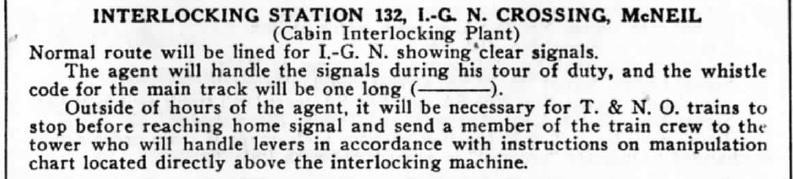
These instructions from a June, 1940 T&NO Employee Timetable explain to
train crews that they will need to operate the Tower 132 interlocker
when the agent is not on duty. Elsewhere, the timetable lists the duty
hours for the agent at Tower 132 as 8:00 am to 5:00 pm "Daily Except
Sundays and Holidays" and "8:00 am to 10:00 am" on Legal Holidays. These instructions remained unchanged in a
Special Instructions supplement issued by T&NO in December, 1959.
Historic aerial imagery shows both the cabin and the depot were removed
between 1967 and 1973. |


Above Left: Returning to the
scene in the photo at the top of page, SP #6607 has
almost reached the tower. Above Right:
SP #6607 crosses the diamond adjacent to the MP depot. The depot sat in the west
quadrant, diagonally across from the tower. (both photos, Roger Schull Collection)
Four mid 60s photos courtesy of the Roger Shull
Collection:
Above Left:
A southbound MP locomotive crosses the diamond while SP's train waits in the
siding. Above Right: a
northeast view along the MP tracks Below
Left: In this south view of the crossing, the Tower 132 cabin at
left is mostly obscured by electrical cabinets.
Below Right: Facing northwest along the SP tracks, a
northbound Texas Eagle passenger train speeds across the diamond past Tower 132.


Above:
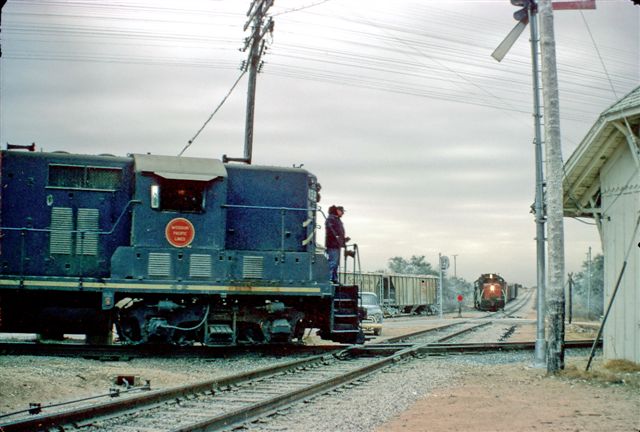
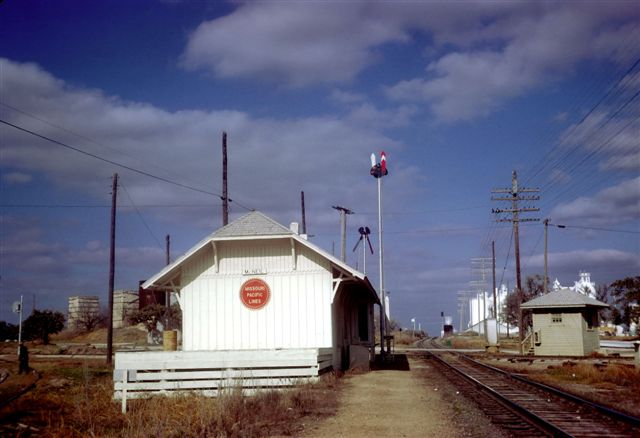
This photo, credited to Jim Hickey from the David M. Bernstein Collection,
appeared in the Summer 2019 edition of S P
Trainline. The caption was:
"Operating as Extra 162 West,
a train of empty cars for rock loading is crossing the Missouri Pacific diamond
at McNeil. The station was owned, maintained and operated by the MP. A joint
agency was maintained by the railroads by agreement effective November 1, 1911,
with each company paying 50% of the building maintenance and T&NO paying
one-third of the operating costs. The small building to the left is Interlocking
No. 132 which was owned, operated and maintained by the T&NO. This was a cabin
interlocking normally lined for Missouri Pacific movement. When on duty, the
agent handled the interlocking signals, otherwise T&NO trains were required to
stop before passing the interlocking signal and send a crewman ahead to operate
the interlocking for their route using a manipulation chart displayed above the
interlocking machine. After completing their move the T&NO crew would restore
the route for the Missouri Pacific."
The photo is undated, but it
certainly appears to have been taken in the mid 1960s. The view is similar to
the photo of SP #6607 crossing the diamond except that here, the camera is west
of the T&NO tracks instead of east. In both photos, the T&NO train is northbound out of Austin. That the
agreement between the railroads dated back to 1911 lends credence to the idea
that the joint agency telegrapher handling train orders at the station moved to
the new cabin when it was erected in 1928 and took on additional duties as the leverman.


Above: These two images from
1966 (left) and 1965 (right)
show operations at the McNeil crossing. In June, 1966, two crewmen on a
northbound MP freight are leaning out to catch train orders as they pass the
station. In August, 1965, this SP local freight is finally crossing the diamond
northbound after a lengthy delay during which MP's southbound Texas Eagle
passenger train was waiting in the distance. (both photos (c) J. Parker Lamb,
2016, Center for Railroad Photography and Art)
The H&TC was fully merged into the T&NO in 1934. The T&NO lasted
until 1961 when it was fully merged into SP. In 1986, SP sold the former A&NW route to the City of Austin which
wanted to preserve the right-of-way for potential commuter or light rail use.
The City
subsequently leased the line for freight operations to RailTex. Under RailTex,
a new Austin & Northwestern was created to be the operating railroad. In 1996,
the Longhorn Railroad took over operations on the line with freight service
beginning May 6th. Yet another operating change was made in April, 2000 when the
City leased the line to the Austin Area Terminal Railroad (AUAR reporting marks). Still owned by the
City, the line has been operated by the Austin &
Western Railroad (AWRR), a subsidiary of transportation services company
Watco
since October 1, 2007.
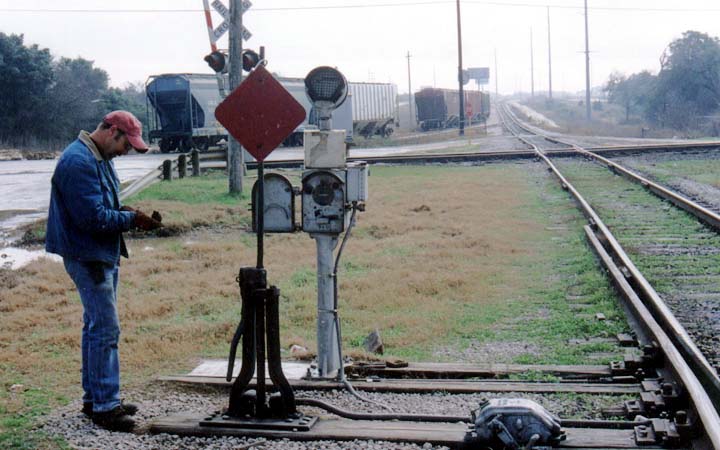 |
Left:
When the cabin was removed (late 60s or early 70s), the
interlocker controls were moved to a post-mounted box.
Brakeman Jon Pederson has opened the cover door and is preparing to
unlock the derail switch handle. The target in front indicates the
derail position (open). The silver interlock is linked to UP's traffic
dispatcher. When UP has a train in the block, a small semaphore
indicator on top of the control stand is in the 'up' position. After the AUAR train goes through,
the interlock is reset to pass UP traffic. The instruction board has
"Southern Pacific" scratched out in several locations, i.e. it was
most likely the same arrangement when the control box was installed. (John A. Pearce,
January 7, 2005)
Below:
This 1985 MP employee timetable shows the SP crossing at McNeil with a
circled M to indicate a mechanical interlocker. Compare with the Katy
crossing 0.4 miles east of Taylor, which shows a circled A indicating an
automatic interlocker.
 |
Control posts such as this one were commonly used
as replacements for cabin interlocker huts. With the box only able to be opened
by authorized train service personnel, huts could be eliminated, with the
controls moved to the post and the interlocking electronics moved to a trackside
cabinet. For other examples, see Tower 103,
Tower 70 and Tower 64.

Four photos taken January, 2005 by John A.
Pearce; thanks, John! Above Left:
Austin Area Terminal Railroad locomotive AUAR 190 is switching the UP
interchange track. Unit numbers 190 and 191 are a pair of GP-40s that had been
recently acquired by AUAR. The conductor on the rear of the locomotive is Eric
Hamilton. Above Right: Looking
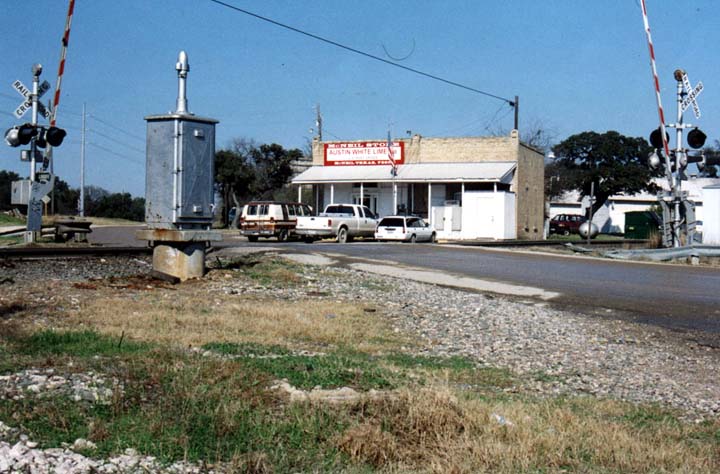
west, the grass covered cement rectangle is the old foundation for the Tower 132
cabin. The UP mainline is in the foreground, with north to the right, crossing
McNeil Store Rd. In the background sits the company store for the Austin White
Lime Co. Their limestone products plant has been located in the north quadrant
of the McNeil diamond since 1888, and may have had rail service from the very
beginning.
Below Left: A southbound UP
light engine hop passes Austin White Lime led by an old Cotton Belt engine.
Below Right:
Austin White Lime had a front loader with a railroad coupler attached to the rear,
known to all as "the McNeil Switcher". They routinely used it to push covered hoppers into place from
their UP interchange track.


Clifton Jones provides the following details about the interlocker at McNeil.
The interlocking device was
usually operated by an SP trainman (later A&NW, Longhorn, Austin Terminal, etc.)
There was a locked box, that once it was opened would set off a timer, and an
unlocking device for the derail, and also set the home and distant signals for
the MP (UP) approaching the interlocking. After a period of about 9 minutes, the
timer on the cabinet would unlock the derail and the trainman could throw the
split derail switch for the train on the SP to proceed. It set the home signal
for the SP to ‘lunar’ so the train could proceed at restricted speed. Once the
entire train had cleared the interlocking limits, the derail could be restored
to derail position and the lock box on interlocking device was closed and
locked.


Austin's plan to use the A&NW right-of-way for commuter transit evolved into Capital MetroRail,
a commuter rail system that began operating in 2010 between Leander and downtown
Austin, sharing the freight tracks along much of the route.
Above Left: At McNeil, commuter
trains pass over the
UP tracks on a bridge whereas AWRR freight trains continue to
cross UP at grade at the Tower 132 site. (photo by Rickey Green / CapMetro)
Above Right: Looking south from the McNeil Rd. grade
crossing, the right track elevates onto the bridge that carries Cap Metro
commuter trains over UP's tracks at McNeil. The left track is used by AWRR
freight operations to cross UP's tracks at grade.
In 1988, the
Austin Steam Train Association
(ASTA) was formed as a non-profit organization to rebuild SP #786, a
steam locomotive that had been donated to the City of Austin in 1956. The
rebuilt engine pulled its first excursion train northwest of
McNeil between Cedar Park and Burnet on July 25, 1992. Operating as
the Austin & Texas Central Railroad, the ASTA continues to offer
excursions to the public. While SP#786 is undergoing a complete rebuild,
diesel locomotives provide substitute power.
