Texas Railroad History - Tower 133 - Lancaster
A Crossing of the Missouri - Kansas - Texas Railroad and
the Houston & Texas Central Railway
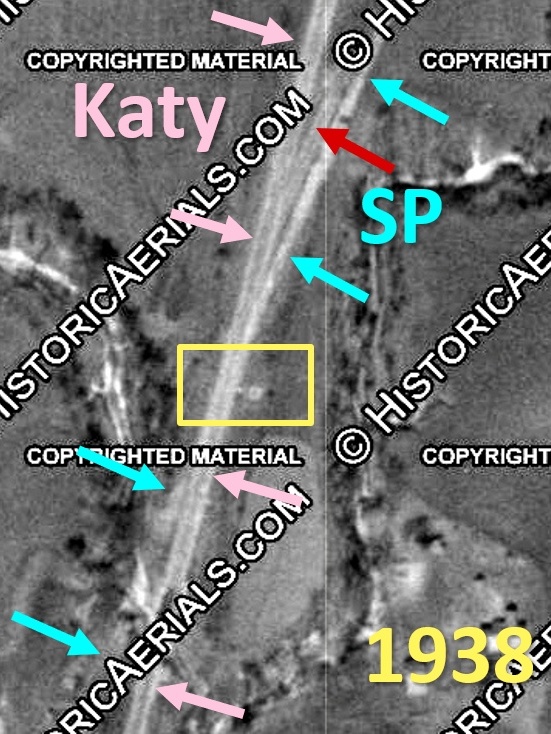 |
Left: This 1938 aerial image ((c) historicaerials.com)
has been annotated to show the crossing of the two steam railroads at
Lancaster. The image dates to approximately four years after the
Southern Pacific (SP) tracks were abandoned. Those tracks had been owned
by SP's subsidiary, the Houston & Texas Central (H&TC) Railway, and
later transferred to the Texas & New Orleans (T&NO) Railroad when
SP began consolidating its Texas and Louisiana lines in the
late 1920s. The tracks of the Missouri, Kansas & Texas (MK&T, "Katy") Railway had
been acquired by the Katy after completion by the Dallas & Waco
(D&W) Railway c.1890. The D&W was separately chartered to do the
construction, but it was a Katy operation all the way.
The
yellow rectangle shows the location of the highly acute-angled crossing diamond.
The white object inside the rectangle to the right of the tracks is very likely the Tower 133
interlocker cabin. It was common to leave interlocking cabins in place
after abandonment (sometimes for decades, e.g.
Shamrock, Plainview,
Richardson) even though they no longer
served a functional purpose. A white dot is visible between the cabin and the tracks.
This could
easily be the gatepost for a swing gate if one was reinstalled after the interlocker was
removed, particularly if the tracks remained in place. A swing gate was
used at the Lancaster diamond before the interlocking plant was
installed. A short exchange track (red arrow) existed north of
the diamond.
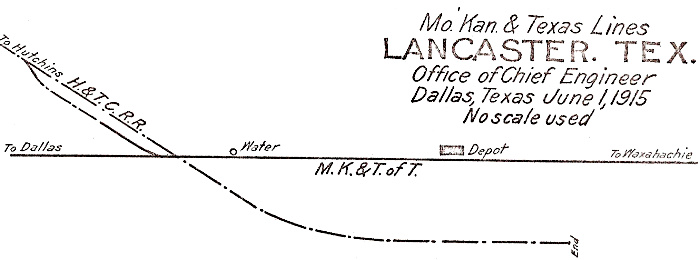
Above: This track
chart drawn in 1915 by the Katy's Chief Engineer's office in
Dallas confirms the existence of a connecting track near the diamond.
North is to the left, and the drawing is not to scale. The cartographer
took the liberty of increasing the angle of the crossing to simplify the
map. The main line is noted as belonging to the "M.K.&T.of T."
This was the Missouri, Kansas & Texas Railway of Texas, a Texas-based
subsidiary of the Katy railroad established in 1891 for compliance with
Texas' railroad ownership laws. |
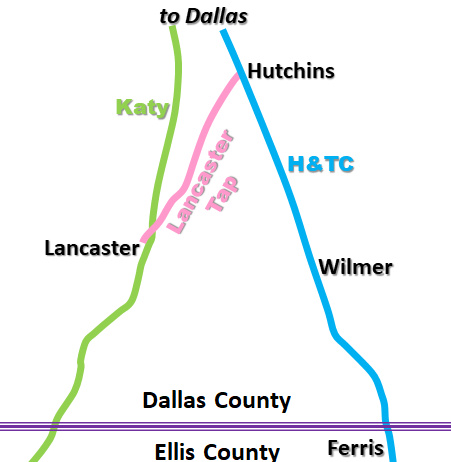
Right: Lancaster is
one corner of a triangle of railroad towns in southern Dallas County
along with Wilmer and Hutchins. As a surrogate for the Katy, the D&W passed through Lancaster in 1888 as it built from Dallas southwest toward
Hillsboro. The Katy
already had tracks at Hillsboro on its main line between
Fort Worth and
Waco, and this was to be a Dallas branch. The arrival of the D&W at
Lancaster gave the town its first rail service. This reduced the local
urgency for a line to "tap" the H&TC tracks to the east as had long been
considered. Yet, the Lancaster Tap was built anyway! ... in 1889-1890.
The town of Lancaster in southern Dallas County was founded in the 1850s and had a Post Office by 1860. In
1872, it appeared to be
geographically positioned to become a stop on the first railroad into Dallas County,
the Houston & Texas Central (H&TC) Railway. The H&TC had been chartered before the Civil War to start in
Houston and build north to the Red River.
After a pause during the Civil War near
Navasota, the H&TC had resumed construction north through
Bryan and Hearne,
eventually reaching Dallas. In southern
Dallas County, the H&TC chose to pass through the tiny community of
Prairie Valley (later renamed Wilmer) instead of the established town of
Lancaster. This was not unusual; railroads building new rail lines
sometimes bypassed small established towns in favor of tiny settlements
or open land where they could found their own towns. This strategy
enabled the railroad to own most or all of the valuable land near the
tracks, thus benefitting from land sales as the town grew. It was
virtually automatic for a railroad to bypass a
town if it refused to offer a bonus, mistakenly believing that the railroad had no alternative (as
Kingston found out the hard way.) Continuing beyond Dallas, the H&TC
arrived at the new town of Denison near the
Red River in early 1873.
At Denison, the H&TC connected with the
Missouri,
Kansas & Texas (MK&T, "Katy") Railway which had built south through Indian
Territory (Oklahoma) and bridged the Red River into Texas in late 1872. As traffic began to flow along the H&TC, it was Prairie Valley and the new town of Hutchins (named for an early
H&TC investor) four miles farther north that experienced the rail
traffic passing through southern Dallas County. The established town of
Lancaster had been bypassed, and its citizens were not happy! |
 |
The arrival and
immediate success of "the Central" (as the H&TC was known)
in southern Dallas County
motivated nearby towns to begin seeking rail connections to it. On December 27,
1875, citizens of Lancaster held an organizational meeting to discuss getting
access to the H&TC with a "tap line", an industry term with multiple meanings
that in this case described a
rail line
from a town without a railroad to the nearest main line that could be "tapped"
for service. The consensus was that a "Lancaster Tap Railroad" should be
built to connect Lancaster with the H&TC at Prairie Valley four
miles east, or perhaps at Hutchins five miles northeast. The meeting was reported to the
Dallas Daily Herald in a
Letter to the Editor dated January 15, 1876. The author of the letter self-identified as "J. H. S.", presumably Dr. James H. Swindells who is mentioned in
the letter as the appointed Secretary of the Lancaster committee.
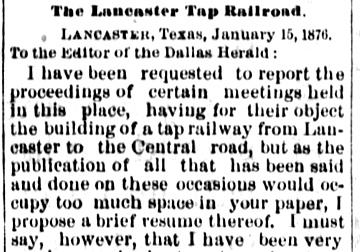
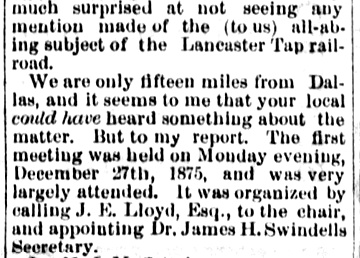
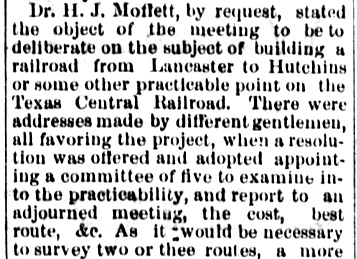
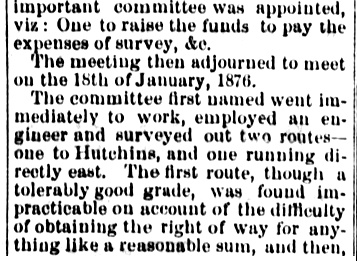
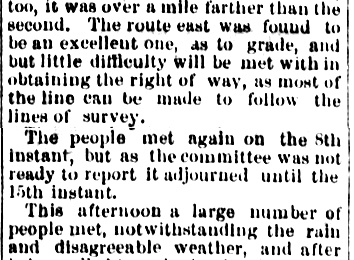
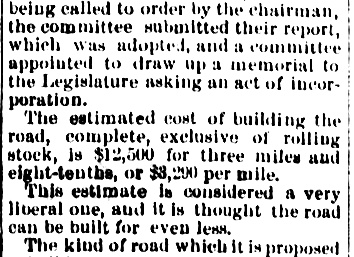
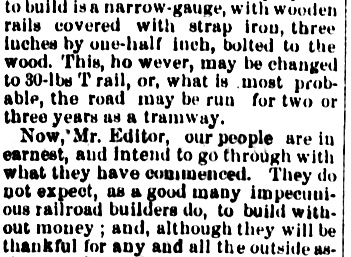
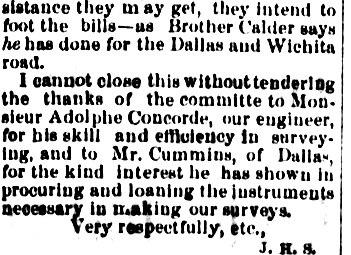
Above:
This lengthy Letter to the Editor of the Dallas Daily Herald
appeared in the January 21, 1876 edition, presumably written by
Dr. James H. Swindells ("J.H.S.") The letter
states the committee's conclusion
that the cost of obtaining all of the necessary right-of-way (ROW) to Hutchins would be unreasonable, in
addition to
the expense for an extra mile of construction. Instead, building a 3.8 mile
line due east to Wilmer using "wooden rails covered with strap iron ... bolted to the wood"
would be feasible for $12,500 and could be accomplished very quickly. The
line could be operated "for two or three years as a tramway."
Right: The tramway
never materialized. A decade later, the citizens of Lancaster were still
pursuing a way to "tap the Central." An article in the Dallas Weekly Herald
of August 13, 1885 described a recent meeting to discuss the proposed
Lancaster Tap Railway to be built by the H&TC. The article mentions that
Lancaster "fully guaranteed" the railroad's up front demand for $5,000,
plus land for a depot and a ROW into
town. Unfortunately for Lancaster, the H&TC's bankruptcy in 1885 delayed the project for
several years. |
 |
Despite the earnest intentions of the citizens of
Lancaster, neither the tramway to Wilmer nor any sort of tap line to Hutchins
materialized out of the initial meeting in 1875. It was more than a
decade later in 1888 that Lancaster finally obtained rail service, but it was not the
Lancaster Tap. The Dallas & Waco (D&W) Railway built south out of
Dallas,
passing through Lancaster and Waxahachie on its way to reaching
Hillsboro in
1891. [Note that this D&W was not the
Dallas & Wichita referenced in the above letter to the editor; it
went from Dallas to Denton. Both railroads
ultimately became part of the Katy, but they were not otherwise related.] The Dallas & Waco had been sponsored by the Katy and
it was formally merged into the
Katy in 1891 pursuant to a new railroad charter
issued by the Legislature. The tracks the D&W had built through Lancaster became substantially more valuable in 1907
when the Katy sold trackage rights between Waxahachie and Dallas to the Trinity
& Brazos Valley (T&BV) Railway. This helped to complete the T&BV's line between
Houston and Dallas, a route that remains in active use today by Burlington
Northern Santa Fe Railway.
If the arrival of the Katy in Lancaster spurred a
renewed interest in the idea of a "tap" railroad to the H&TC for
Lancaster, that interest appears to have been primarily on the part of
the H&TC which had entered receivership in 1885 despite coming under
Southern Pacific (SP) ownership two years earlier. Somehow, in late 1890, a railroad known as the Lancaster Tap
began operating the five miles between Lancaster and the H&TC main line
at Hutchins. The origins of this railroad
are a bit of a mystery, and the dean of Texas rail historians, S. G. Reed, has little to say about
it in his classic reference tome A
History of the Texas Railroads (St. Clair Publishing Co., 1941)
...
"During
the years 1889 and 1890 funds had been advanced by the H. & T. C. for the
building of a line 4.75 miles in length from Hutchins, ten miles south of Dallas,
to Lancaster, which was called the Lancaster Tap. No charter was
ever taken out for this road. It was purchased by the H. & T. C., on September
30, 1905, for the sum of $50,000 payable in ten years."
Right: The Lancaster Tap appears in
Valuation Reports, Vol. 36 published
by the Interstate Commerce Commission (ICC) in 1932. It must have been difficult
to perform a legitimate valuation when "there were no obtainable
accounting records..." |
 |
Three Receivers were named by the H&TC bankruptcy
court, but two of them departed the case at the outset; only Charles Dillingham
remained. From the ICC description, it appears Dillingham, on his own assessment
or more likely by recommendation of SP management, acquired ROW easements and construction rights between
Lancaster and Hutchins. This would correspond to Reed's
declaration that "funds had been advanced by the H&TC" (which
also implies that Dillingham was acting in an official capacity as H&TC
Receiver, not on his own as a private investor.)
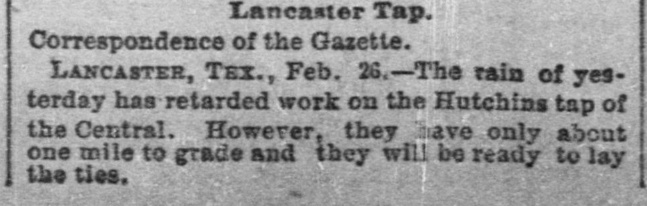  |
Far Left: Per the
Fort Worth Weekly Gazette of February 28,
1890, a mile of grading remained before tie
laying could commence. The construction probably began in late 1889.
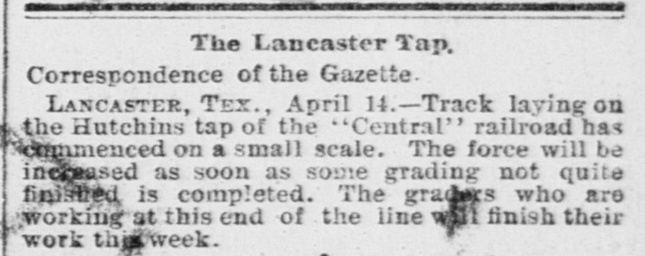
Left:
The Fort Worth Weekly Gazette of April
17, 1890 notes that track laying has begun while the final grading "at this end
of the line" (Lancaster) was to
conclude within the week. |
  |
Far Left:
The Galveston Daily News of May 26,
1890 reported a shortage of crossties temporarily stopped construction.
Left:
An article in the Galveston Daily News
of August 15, 1890 (datelined the day before) anticipates "regular
trains" (i.e. not "construction trains") would begin to serve Lancaster
from Hutchins the following day. The article attributes the "large force
at work" to
the H&TC. |
On September 6, 1890, Edward Pardee paid $2,000 for the
property rights acquired by Dillingham, and thus became the owner of the Lancaster
Tap. He remained so for more than a decade before selling it to George Thornton in 1903 for "$1 and other valuable consideration". In 1905, Thornton sold the
property to the H&TC for "$50,000, payable in ten years." While details are lacking, the financial arrangements certainly appear unusual. From
the ICC description confirmed by newspaper articles, it is clear that when Pardee
acquired the deed and other assets from Dillingham, construction of the Lancaster Tap had
recently been completed. But how did
a railroad in bankruptcy acquire the capital to build five miles of track, and
why would it then sell the new line for $2,000? Most likely (but speculation
nonetheless) Pardee had provided the cash flow to build the line, and there's evidence that he did so by
using H&TC's
construction forces (essentially hiring the H&TC to build itself!) The transaction with Dillingham was simply the final step,
i.e. Dillingham had acquired the track easements and construction rights as
security for the line's completion and then sold them to Pardee, almost certainly in exchange for
a period of exclusive rights for the H&TC to operate the Lancaster Tap
(during which Pardee likely received lease payments.)
The whole
financing arrangement was probably orchestrated by Dillingham as a means of
avoiding the involvement of the bankruptcy judge. A capital project like this
one normally would have
required selling Receiver bonds (to raise construction capital) but such bonds
would need the approval of the bankruptcy judge. By getting Pardee involved, the H&TC would incur
negligible cash
outlay (for construction rights and track easements) while the funding for labor, materials
and construction management was provided by Pardee. The low final price paid by Pardee
(surely an element of his agreement with Dillingham) would then reflect the
substantial construction expense he had incurred. Pardee was willing to fund the
bulk of the project knowing that eventually he could derive income from lease
payments and ultimately sell the Lancaster Tap to the H&TC at a tidy profit
The theory that Pardee funded the construction while
Dillingham held title to the ROW easements and other assets is
compatible with the fact that the Lancaster Tap was never chartered. The H&TC
was in receivership, certainly in no position to pursue a charter from the Legislature,
especially for a line it would not immediately own when completed. Pardee, either out of
ignorance or daring, did not seek a charter, knowing the entire enterprise was
ultimately to be operated as part of the H&TC. Thus, despite the fact that the
Lancaster Tap had no legal right to exist under Texas law, it was built and
provided a valuable service to Lancaster. The State of Texas had little impetus
to file a lawsuit to shut it down and they did not do so.
Newspaper articles for
the next decade show the H&TC paying taxes for the Lancaster Tap while operating
it
and incorporating it into reports submitted to the Railroad Commission of Texas
(RCT). The H&TC nonetheless recognized
the need for a charter amendment from the Legislature to allow it to merge the
Lancaster Tap and several other railroads. Early in the new legislative session
that convened in January, 1899, a bill amending the H&TC's charter was passed to
allow it to acquire the Lancaster Tap and several other railroads. Texas Governor
Joseph Sayers vetoed the legislation, citing interference with an on-going
court case against SP's ownership of the Austin & Northwestern (A&NW.)
The state's contention was that the acquisition had not been authorized by the
Legislature and was thus unlawful. The bill would, in fact, have ended that
lawsuit by legalizing SP's ownership of the A&NW.
 |
Left:
The Galveston Daily News of
Nov. 28, 1895 reported H&TC's quarterly passenger revenue taxes, of
which the Lancaster Tap was listed first among the several railroads the
H&TC was operating. The tax was levied on passenger earnings, hence
the operator, H&TC, paid the tax.
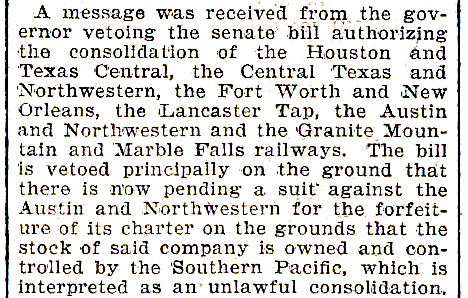
Right: This paragraph is from an article in
the Galveston Tribune of March
16, 1899 discussing various activities in progress at the current
legislative session in Austin. Among them was the
recent veto by Gov. Sayers of the bill authorizing the H&TC to acquire ownership of
several railroads. |
 |
Rejected by the Governor, SP tried again when the
Legislature was in session two years later. Governor Sayers had been reelected
in 1900, and SP realized it needed to negotiate with him. It promised to build a
spacious new first class depot in Austin and it committed to extending the
H&TC's line at Burnet north to Lampasas, both improvements being incorporated
into the new law. But the situation had also changed for Gov. Sayers. Massive
central Texas floods around Temple,
Hearne and Palestine
that occurred in June, 1899 had wiped out bridges and motivated new thinking on
hardening the state's infrastructure to survive severe weather events. Sayers
became interested in settling various lawsuits against the railroads in exchange
for infrastructure improvements. Sayers was lauded for his personal involvement
in managing emergency response funding in the aftermath of the floods. His mettle would be severely tested
again a year later when a massive hurricane leveled Galveston in 1900. A bridge
owned by the Gulf, Colorado & Santa Fe Railway survived the storm and
thus became the critical transportation corridor for getting supplies and
medical aid onto Galveston Island.
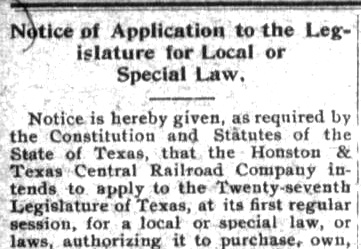


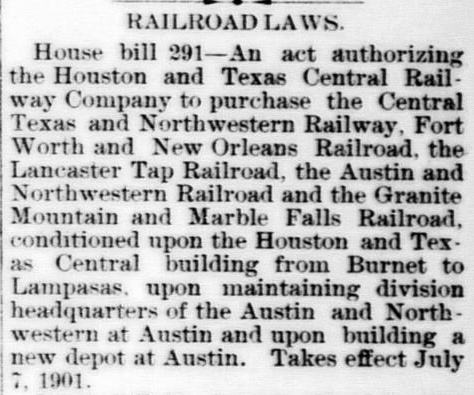
Above Left-to-Right:
La Grange Journal, January 3, 1901: notices
were published statewide by the H&TC to announce its intention to apply for a
special law (a charter revision) to be allowed to consolidate its ownership of
several railroads including the Lancaster Tap;
Galveston Tribune, February 8, 1901: noting that H&TC's bill had been
introduced in the Texas Senate; The Bastrop
Advertiser, March 2, 1901: noting that the bill was referred
favorably out of committee to the full Texas House;
McKinney Democrat, May 2, 1901: reporting the new law to take
effect July 7, 1901.
By the summer of 1901, the H&TC had the necessary legal
authorization to purchase and consolidate the railroads it was operating, but
its acquisition of the Lancaster Tap did not occur until four years later,
September 30, 1905. Meanwhile, Edward Pardee sold the Tap to George Thornton on
July 15, 1903. The ICC was unable to uncover details of the "valuable
consideration" that Pardee received in making the sale to Thornton for $1.
Building southwest from Hutchins, the Lancaster Tap tracks had crossed the
Katy roughly a quarter mile north of the H&TC's Lancaster depot. The depot was a
short distance west of the Katy tracks, just enough space for a lead track in front of the depot
and another track behind it. Whether the depot had been
built on land
promised by the Lancaster committee in 1885 is unknown, but it seems likely.
Otherwise, SP could have bought land for a depot east of the Katy which would
have eliminated the need for a crossing. Whatever the case, the crossing was
uncontrolled for nearly forty years. This meant that all trains on both lines had to come to
a complete stop at the diamond before proceeding across.
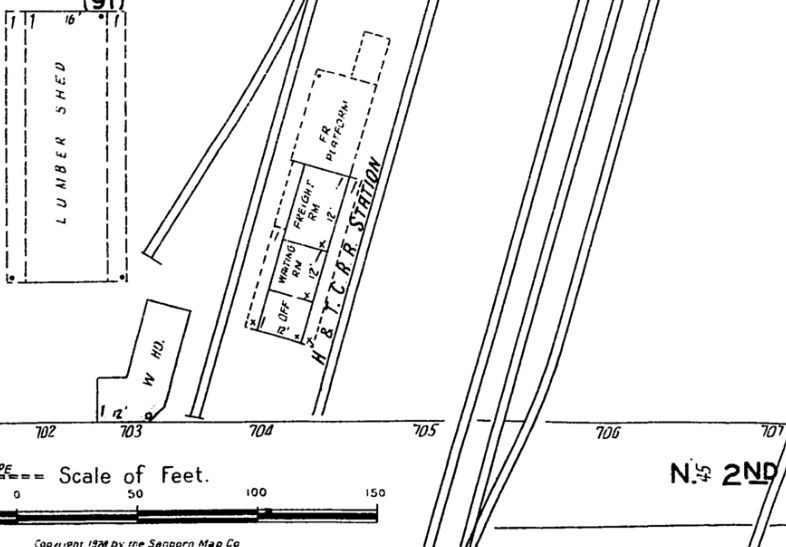
Right: The 1928 Sanborn Fire Insurance map of
Lancaster showed the H&TC station on N. 2nd St. near the street crossing of the Katy's triple tracks.
The H&TC had a passenger lead track in "front" (the side closest to the Katy
tracks) and a freight lead behind the station that split into a track for
a lumber shed and a track to a warehouse ("W. HO.") that abutted
N. 2nd. St. The map does not show a turntable or wye,
implying that trains ran backwards five miles to or from Hutchins (they
could potentially have used the exchange track to reposition locomotives.) The 1939 Sanborn map of Lancaster shows the entire
station removed.
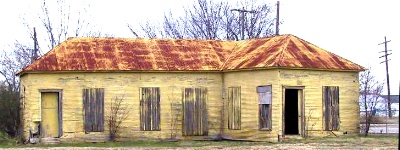
Above: The warehouse
("W. HO.") in the lower left corner of the Sanborn map remained standing
at its original location seven decades after the H&TC station was removed. There was a small "Freight Rm."
inside the station for package items, but larger freight
was presumably warehoused in this building. It was razed not long after this photo
was taken. (Jim King photo, 2005) |
 |
The Lancaster Tap was never a
major branch for the H&TC, but the line carried sufficient traffic to pay its operating and
maintenance expenses into the 1920s. By 1923 and probably much earlier, the H&TC
was operating only one mixed train daily (no trains on Sunday) from Hutchins to Lancaster
and back each morning. A mechanical cabin interlocker with eleven
functions designated Tower
133 was authorized for operation by RCT on February 8, 1928 to manage the
H&TC / Katy crossing at Lancaster. The interlocker
improved efficiency for Katy and T&BV trains; they only had to stop at
the Lancaster crossing if the diamond was actually occupied.
A cabin interlocker was typically a small hut, usually adjacent to the
tracks but sometimes another nearby structure was used, e.g. a yard office or
depot. The hut housed the
interlocking plant and its controls for the signals that managed access to the
crossing. The signals would normally be set to give a PROCEED indication on the
busier route, in this case the Katy tracks, so that Katy and T&BV trains would
not need to stop for the crossing. When an H&TC train needed to cross, it would
stop short of the diamond and a member of the train crew would enter the hut. He
would set the controls to give his train the PROCEED signal while giving a STOP indication on the Katy tracks. Once the train had crossed, the crewmember would return the
controls to the normal position, allowing unrestricted movement on the Katy
tracks.
The minimum standard interlocker for a crossing of two railroads
had twelve functions: a home signal, distant signal and derails in each of the
four directions. The interlocker was designed so that a locomotive would derail
if it neared the diamond without a PROCEED signal. The distant
signals gave indications to trains arriving into Lancaster whether they
needed to begin slowing to stop short of the diamond. The home signals near the
diamond gave the same indication and were used by trains that were stopped
waiting for a PROCEED signal. The Tower 133 interlocker had only eleven
functions. A distant signal was not needed for northbound movements
on the H&TC tracks as there were no
H&TC tracks south of the station. Northbound H&TC trains moved a short
distance from the station and waited for the PROCEED indication on the home signal
that would result (after a built-in delay) from a crewmember setting the
controls in the interlocker cabin.
Deciding to consolidate its Texas and
Louisiana lines, SP selected its Texas & New Orleans (T&NO) Railroad
subsidiary to be its regional operating company. SP leased the H&TC to
the T&NO in 1927 and then merged it in 1934. T&NO abandoned the Lancaster branch
that same year. It was simply too short to provide value to T&NO. The passenger
station at Hutchins was less than five miles from Lancaster, and there were much
better roads and faster conveyences for making the trip than there had been
forty-four years
earlier when the line opened. Locally,
businesses surely had better service from the Katy
with its busier line and lengthier tracks through town providing more real
estate for trackside businesses. Lancaster was also served by an interurban
railroad which reduced the ability of steam railroads to capture passenger
traffic for short trips to Dallas or Waxahachie. The utility of the Lancaster
Tap had probably expired at least a decade earlier.
 |
Left: An H&TC
Employee Timetable (ETT) dated February 6, 1927 carried this note
regarding the crossing gate at the diamond.
Below: The T&NO ETT dated June 17, 1928 provided
the new procedure for train crews at Lancaster. |

It is apparent from the ETTs that the crossing was
still gated in 1927; it probably had been for twenty-five years. The normal
position of the gate was against the H&TC which is no surprise. The H&TC
generally had two crossings of the diamond daily -- a train from Hutchins and
back -- while the Katy and T&BV probably had ten times as many crossings.
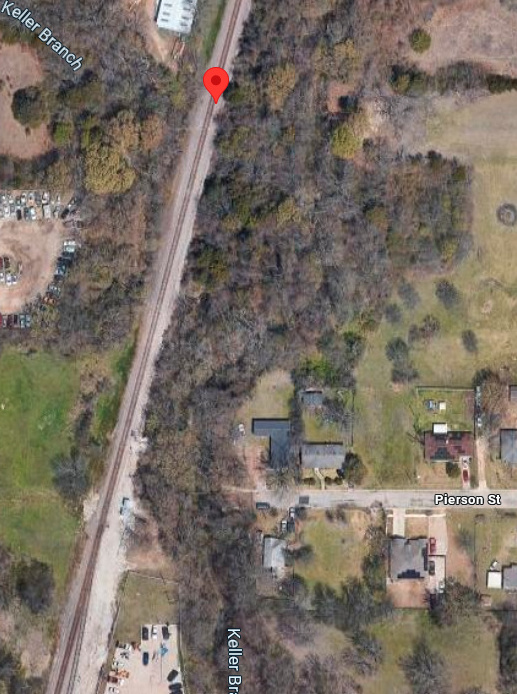 |
Left:
With Pierson St. as a landmark, the red dot is a mapping
of the former Tower 133 crossing diamond using coordinates derived from
the 1938 aerial imagery. The dot is about 565 ft. north of a projected
intersection of Pierson St. and the Katy tracks, and 1,315 ft. north of the N. 2nd St.
grade crossing where the H&TC station was located. (2026 Google Maps)
An H&TC ETT from
1923 lists the diamond with a "Distance from Hutchins" of 4.44 and it
lists Lancaster's H&TC station with a "Distance from Hutchins" of 4.74
miles. This places the diamond more or less 0.3 miles north of the H&TC
station, about 1,584 ft. But the milepost markers weren't precise and
the location assignment of the milepost for the Lancaster depot could be
anywhere along the building. The difference between 1,315 ft. and 1,584
ft. is 0.05 miles.
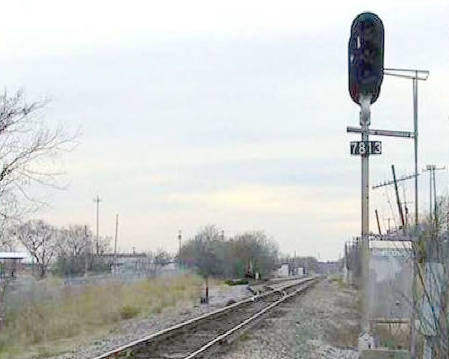 Left: RCT documentation
archived at DeGolyer Library,
Southern Methodist University, states that the diamond was between
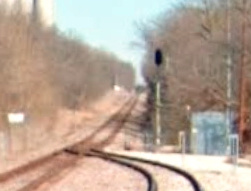
milepost 781 and 782. This photo was taken in 2005 looking south along
the Katy tracks at the siding switch signal at milepost 781.3. The
equipment cabinet visible beyond the signal is labeled "West Lancaster".
Based on what is now known about the crossing from the 1938 aerial
imagery, the diamond was farther north, perhaps 500 ft. behind the
camera. Left: RCT documentation
archived at DeGolyer Library,
Southern Methodist University, states that the diamond was between
milepost 781 and 782. This photo was taken in 2005 looking south along
the Katy tracks at the siding switch signal at milepost 781.3. The
equipment cabinet visible beyond the signal is labeled "West Lancaster".
Based on what is now known about the crossing from the 1938 aerial
imagery, the diamond was farther north, perhaps 500 ft. behind the
camera.
 Left:
Sometime after 2019, the cabinets and signal for the siding were relocated to the opposite side of the
tracks. This view looks north toward the crossing site. (Google Street
View, 2026) Left:
Sometime after 2019, the cabinets and signal for the siding were relocated to the opposite side of the
tracks. This view looks north toward the crossing site. (Google Street
View, 2026) |
Historic aerial imagery shows that the abandoned H&TC
ROW north of Lancaster soon became the roadbed for Lancaster - Hutchins Rd. This
starts at E. Pleasant Run Rd. near Lancaster and continues north all the way to
the intersection with W. Hickman St. at Hutchins. There, the ROW switches onto
W. Hickman St. and runs west toward the former SP main line. Just shy of
Interurban St., the H&TC curved north, crossed the interurban tracks and merged
into the H&TC main line north of the Wilmer passenger station.
In 1931,
the end of the T&BV receivership resulted in the creation of the
Burlington - Rock Island (B-RI) Railroad to own and
operate the T&BV's routes. It was effectively a paper railroad, owned equally by
Burlington Northern (BN) and the Chicago, Rock Island & Gulf
(CRI&G), a Texas subsidiary of the Chicago, Rock Island & Pacific. B-RI inherited T&BV's trackage
rights on the Katy from Waxahachie through Lancaster to Dallas and was able to
sustain a viable business on this lengthy route to Houston.
By the 1960s, the administrative expense of maintaining the B-RI corporate
entity could no longer be justified. In 1964, the B-RI was put into foreclosure
by its two owners as a simple means to dissolve the corporation. Its assets were
taken over by the two railroads who agreed to share maintenance expenses and
unlimited rights to operate over the B-RI tracks. Rock Island's bankruptcy in
1980 left BN as the sole operator of the Waxahachie - Houston line. In 1996, BN
merged with the Atchison, Topeka & Santa Fe Railway to form
Burlington Northern Santa Fe (BNSF), which continues to operate the line.
In 1988, the Katy was merged into
Missouri Pacific (MP) which
had earlier become a subsidiary of Union Pacific (UP) in 1982. In 1990, MP abandoned a ten-mile
stretch of the Katy tracks north of Italy, leaving
a short stretch of track south of Waxahachie in place to serve a business. Effectively,
Waxahachie became the southern terminus of the former Katy line. BN was
providing the bulk of the traffic through Waxahachie on the former B-RI, merging
into the Katy for the trip to Dallas. In 1996, UP acquired SP, which also had tracks through Waxahachie on a route from
Fort Worth to the SP main
line near Ennis. Those tracks had become SP property by being included in the "special law"
in 1901 that allowed the H&TC's acquisition of the Lancaster Tap. The UP / SP and BN / AT&SF mergers required legal
agreements to gain Federal approval, and one of the agreed provisions was that
UP would sell the line between Waxahachie and Dallas to BNSF. Hence, BNSF now
owns the former Katy tracks from Waxahachie through Lancaster to Dallas.

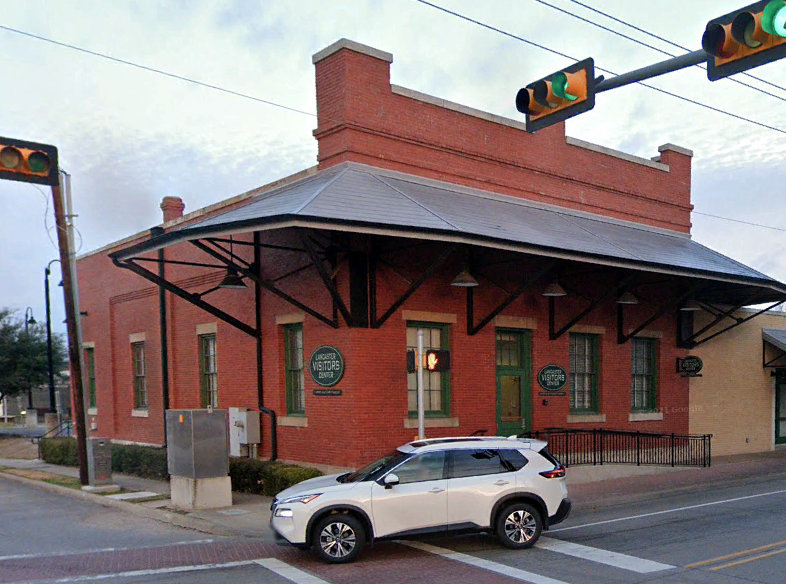
Above Left: The Katy
depot still stands trackside in Lancaster on the northwest corner of Pecan St.,
but it is located about 400 ft. farther south than it originally was. The
Lancaster Historical Society conducts meetings in the depot and appears to have
some responsibility for managing it. (Google Street View 2021)
Above Right: Around 1912, the Southern Traction interurban
railway built south from Dallas through Lancaster on its way to Waxahachie and
beyond. In 1916, it merged with other interurban railways in the Dallas area to
create the Texas Electric Railway. The former interurban ROW through
Lancaster is now Dallas Ave., and its former Lancaster station remains standing
on the northwest corner of Dallas Ave. and Main St. (Google Street View 2021)
