Texas Railroad History - Tower 73 - Texas City Junction
A Crossing of the Texas City Terminal, the Galveston,
Harrisburg & San Antonio, and the Galveston, Houston & Henderson railroads
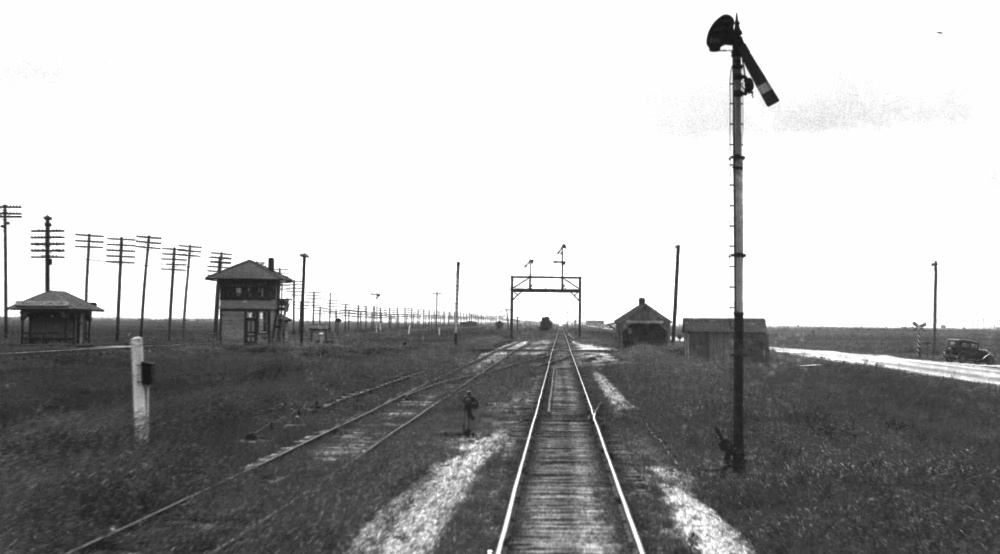
Above: John W Barriger III took this photo facing
southeast from the rear platform of his business car as his train sped north
from Galveston toward
Houston sometime in the late 1930's or early 1940s. His shutter finger was triggered
by the sight of Tower 73 at left, an interlocking tower located at Texas City
Junction on the west
outskirts of Texas City. Even from this distance, the tower architecture clearly
reflects its Southern Pacific (SP) heritage, resembling many other SP towers in
Texas (e.g. Tower 13,
Tower 26 and Tower 81, etc.) Barriger is
heading northwest on a train belonging to the Missouri, Kansas &
Texas (MK&T, "Katy") Railway operating over tracks of the
Galveston, Houston & Henderson (GH&H) Railway. His train has just crossed the tracks of the Texas City Terminal (TCT) Railway which
intersected
the GH&H at a right angle (note the crossbuck for the TCT on the roadway
at far right, a predecessor of today's State Highway 3.) In front of Tower 73 at this angle, the TCT crossed
the tracks of the Texas & New Orleans (T&NO) Railroad, a subsidiary of SP, with
Tower 73 sitting in the southwest quadrant of the diamond. The
T&NO tracks parallel the GH&H four miles south to Virginia Point, and
from there, the
railroads share a causeway onto Galveston Island.
 |
One of the early railroads in Texas
was the
Galveston, Houston & Henderson (GH&H) Railroad, chartered in 1853
to build between Galveston and Houston. Construction began in November,
1853.
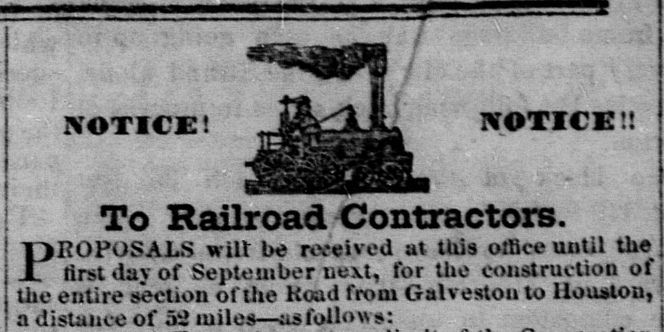
Left: GH&H ad
soliciting contractor proposals (Galveston
Journal, July 15, 1853)
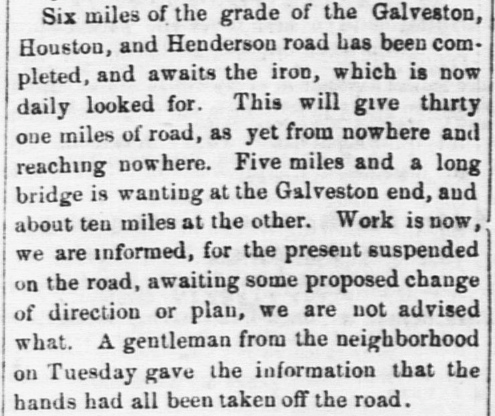
Right: Things did not go smoothly for the GH&H.
More than three years in, it was a railroad "from nowhere and reaching
nowhere" with 25 miles of track completed, still lacking a bridge onto
Galveston Island. (Houston Weekly
Telegraph, July 22, 1857) |
 |
The GH&H bridge over Galveston Bay opened on
February 6, 1860 and service began between Galveston and Houston. The
GH&H became insolvent during the Civil War and went into receivership in 1867.
It was acquired out of bankruptcy in 1871, and a decade later, it was purchased
by rail baron Jay Gould in August, 1882. Almost immediately Gould sold it to the Missouri, Kansas & Texas (MK&T, "Katy") Railway
of which he was President. A year later, Gould directed the Katy to lease the GH&H to the International & Great Northern
(I&GN) Railroad, Texas' largest, which Gould had acquired in 1881. The
I&GN had a presence in Houston whereas the Katy did not. In 1895, three years
after Gould's death, Katy tracks finally reached Houston and connected with the
GH&H. The Katy tried to cancel the I&GN's lease of the GH&H, but Gould's son
George, the new I&GN President, countered with a lawsuit. The dispute was
eventually settled by splitting the GH&H between the Katy and the I&GN,
both railroads having half-ownership and unlimited use of GH&H tracks and facilities.
SP's tracks at Texas City were acquired through a railroad that began as the Galveston, La Porte and Houston
(GL&H) Railway. It had been
founded in the mid 1890s to consolidate three smaller railroads and build tracks to connect
them, thereby establishing a complete rail line between
Houston and Virginia Point. The GL&H also planned to build a bridge from
Virginia Point onto
Galveston Island, paralleling two others owned by the GH&H and the Gulf, Colorado & Santa Fe (GC&SF) Railway,
respectively. Like the GH&H, the GL&H's rail line also passed through Texas City
Junction and Harrisburg. Unlike the GH&H which was almost perfectly
straight between Virginia Point and Harrisburg, the GL&H had a more circuitous
route to the east. It ran directly beside
the GH&H four miles northwest from Virginia Point and then turned to a
more northerly heading that sent it through towns (e.g. Seabrook, La Porte) along the shore of Galveston Bay. It turned west at La Porte
and continued into Harrisburg where it again paralleled the GH&H northward for a
short distance through the Tower 30 interlocking.
The GL&H's proximity to Galveston Bay motivated it to
adopt the moniker The Bayshore Line. Compared to the GH&H, the GL&H served
a larger
population but it was longer and slower.
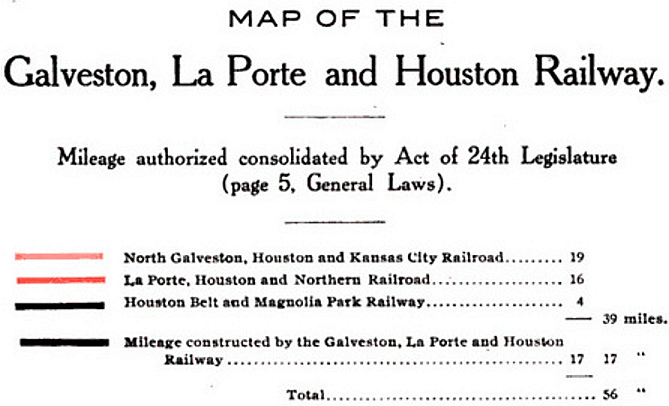
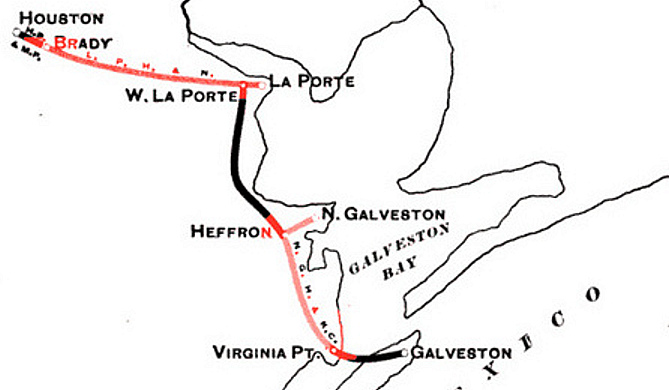
Above: This map appears in
the book Railroad Consolidations in Texas 1891 -
1903 by Joseph Draper Sayers published in 1903. It illustrates how
the GL&H was formed as a consolidation of three railroads. The GL&H right-of-way through Texas City was established by the North Galveston, Houston &
Kansas City Railroad in 1893.
In addition to the Galveston Bay bridge,
the GL&H planned to build a bridge over Buffalo Bayou
at Magnolia
Park several miles east of downtown Houston. The bridge was a critical
element of the
railroad's plan to attract SP business and investment by facilitating a rail line directly to
Galveston from the north side of Buffalo Bayou. SP owned several railroads
serving a variety of industries north of the bayou, and its new
Englewood Yard had opened there in 1895. The GL&H's funding did not match its plan, and it went
into receivership in early 1896 before it had finished the Galveston Bay bridge. The bankruptcy court allowed the Receiver to
sell $250,000 in Receiver Certificates to pay the GL&H contractor to complete
both bridges and additional tracks, which was accomplished by mid 1896.
L. J. Smith had been the GL&H construction contractor and he held extensive debt
against the railroad for unpaid bills. In October, 1898, Smith won a
court-ordered auction, enabling him to buy the GL&H out of foreclosure for
$425,000 (much of which came back to him in disbursements from the creditor's
committee established by the bankruptcy judge.) Smith sold the GL&H in
April, 1899 to the newly chartered
Galveston, Houston & Northern (GH&N) Railway of which he was a
Director. In less than a year, the GH&N sold
out to SP. Among many assets, this gave SP ownership of the GH&N (GL&H) bridge onto Galveston Island
which was
wiped out eight months later by the massive hurricane that struck on September
8, 1900. Only the GC&SF bridge survived and it became an essential link in
rebuilding the island. In the aftermath, the decision was made to build a
single concrete causeway across Galveston Bay to be
shared by vehicular traffic, steam railroads and an electric interurban.
Construction commenced in 1909 and the causeway opened in 1912.
SP planned for the GH&N to be merged
into the Galveston, Harrisburg & San Antonio (GH&SA)
Railway, a subsidiary acquired in the 1880s, but the merger was delayed to
1905 because it required approval by the Texas Legislature. The GH&SA had a
long history of involvement with shipping along Buffalo Bayou. It had been
chartered originally as the Buffalo Bayou, Brazos and
Colorado (BBB&C) Railway with a
main line going west from the riverport at
Harrisburg. The name was changed to GH&SA when the BBB&C was acquired out
of bankruptcy in 1870. After the GH&SA reached San
Antonio in 1877, an extension to El Paso was
funded by SP. It opened in 1883, and SP acquired the GH&SA soon thereafter. In
the 1920s, SP decided to consolidate its Texas and Louisiana railroads into a
single subsidiary, the
Texas & New Orleans (T&NO) Railroad,
which SP had owned since the 1880s. The GH&SA
became integrated into the T&NO, first by lease
(1927) and then by formal merger (1934.)
The
rail bridges over Galveston Bay all came ashore on the mainland at
Virginia Point. About five miles north of there, investors from Duluth,
Minnesota saw the potential for a deep water
port, so they created the Texas City Improvement Company to acquire land and
develop the area. In 1893 they built a
4-mile railroad, the Texas City Terminal (TCT) Railway, to connect the port
with the GH&H. At the time, the North Galveston,
Houston and Kansas City (NGH&KC) Railroad was building north from
Virginia Point, laying a track parallel to the GH&H a hundred feet to
the east. There was a TCT / NGH&KC crossing, but which track arrived
there first is undetermined. The TCT had connecting tracks with the GH&H but
did not cross it. This changed in 1907 when the TCT built farther west
to connect with the GC&SF; its tracks ran west-northwest from
Virginia Point toward Richmond instead of
going north toward Houston.
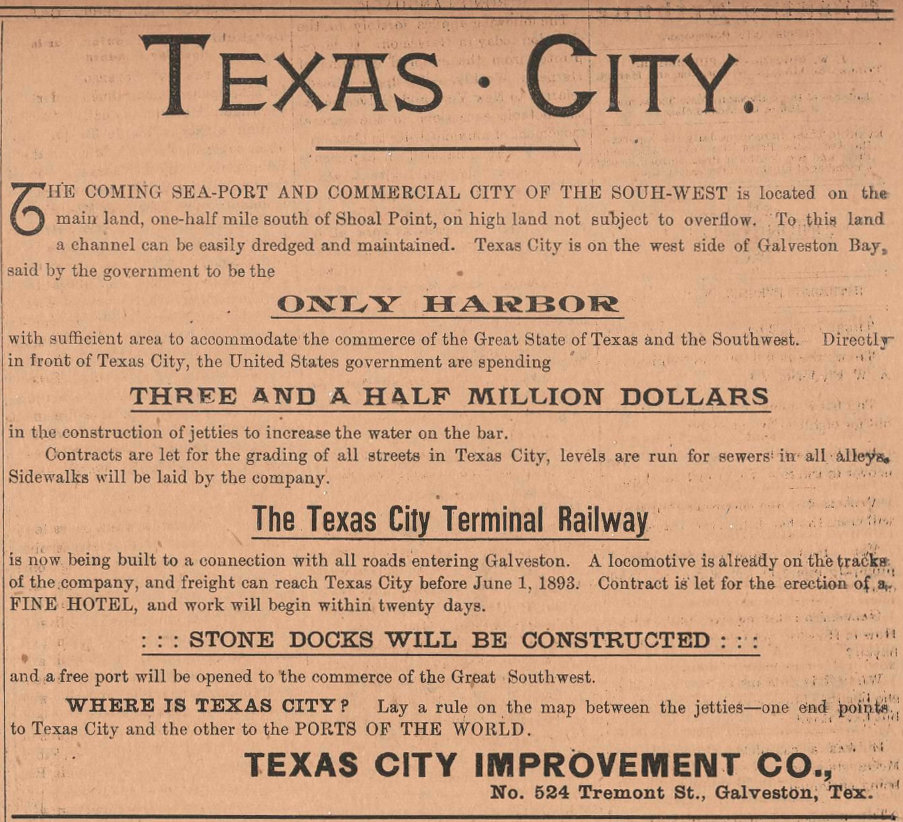
Right: Texas City
advertisement,
Galveston Evening Tribune, May 6,
1893
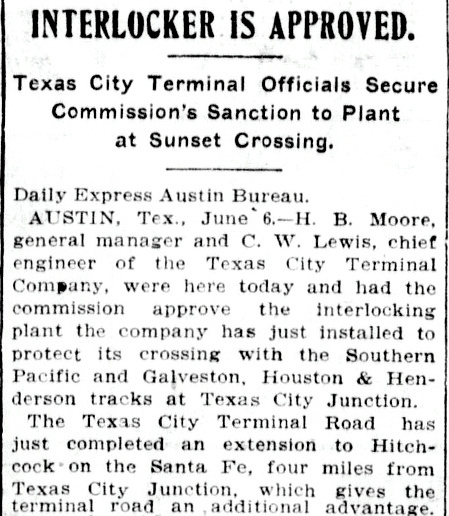
Left:
The San Antonio Daily Express
of June 7, 1907 reported that the Railroad Commission of Texas (RCT) had
approved an interlocker installation at the TCT crossings of the GH&H
and SP at Texas City. The headline writer mistakenly referenced the
location as
"Sunset Crossing", a San Antonio site. The story properly called it
Texas City Junction.
|
 |
The TCT's westward
extension across the busy GH&H main line created the need for an interlocker
that would control the entire junction including the TCT / GH&SA crossing which
heretofore was uncontrolled. A mechanical plant was
installed, commissioned as Tower 73 by RCT on February 18, 1908 ... or at least
that was the first commissioning date RCT reported. In a table dated December 31,
1923 published by RCT, the Tower 73 commissioning
date was revised to be precisely a year
earlier, February 18, 1907. Neither date corresponds to the
newspaper report of June 7, 1907.
The Tower 73
interlocking function count (24) indicates that it handled the main
crossings plus the signals, derails and switches for various connecting tracks,
one of which created a third diamond by crossing the GH&SA to reach the
GH&H. Because the two TCT main line diamonds were only 110 ft. apart,
the TCT would have had home and distant signals east of the GH&SA and west of
the GH&H covering both diamonds, i.e. there
was no need for TCT signals between the diamonds.
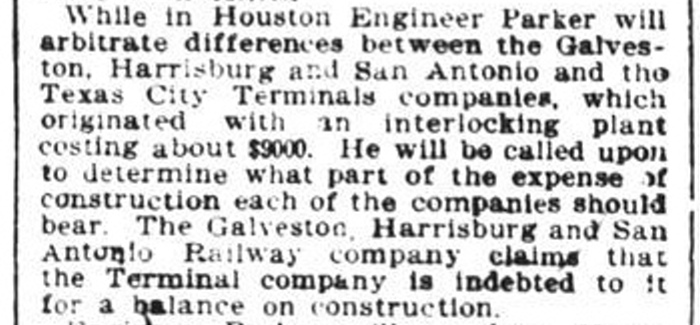
Right:
The Houston Post of September
23, 1910 noted that RCT engineer R. D. Parker was in Houston for various
purposes including to arbitrate a dispute between the GH&SA and the TCT
regarding the capital expense of the Tower 73 interlocking plant. The
diamond existed prior to 1901 hence RCT rules required all three railroads
to
share the capital expense for the tower equally. SP had the most
experience in building and operating interlocking towers so it took the
project lead. RCT documentation confirms that the GH&SA was also given
operational responsibility. Recurring operations and maintenance costs
were shared by the ratio of each railroad's allocated interlocking
functions to the total function count for the plant. |
 |
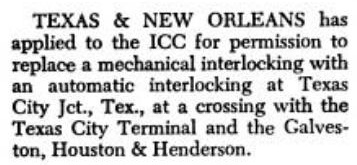 |
Tower 73 survived into the late 1950s. It is visible on 1958 aerial
imagery but not on 1961 aerial imagery. Its disappearance is
attributable to replacement by an automatic interlocker. The fate of the
tower building is undetermined.
Left: The November, 1958 edition of
Railway Signaling and Communications
carried this item regarding T&NO's application to the Interstate
Commerce Commission (ICC) for permission to replace Tower 73 with an
automatic interlocking. The Federal Transportation Act of 1920 had
expanded the ICC's jurisdiction to regulate railroad operations
nationwide, and by the mid 1930s, it had effectively displaced RCT as
the agency managing interlocking plants in Texas. RCT nominally
continued its traditional role, but with no ability to override ICC
decisions, RCT found the railroads eventually stopped soliciting its
authority. RCT provided
one final tower number assignment for Tower 215
c.1966 and then ceased to be involved with interlocking plants,
concentrating its focus on regulating oil and gas production
in Texas. |
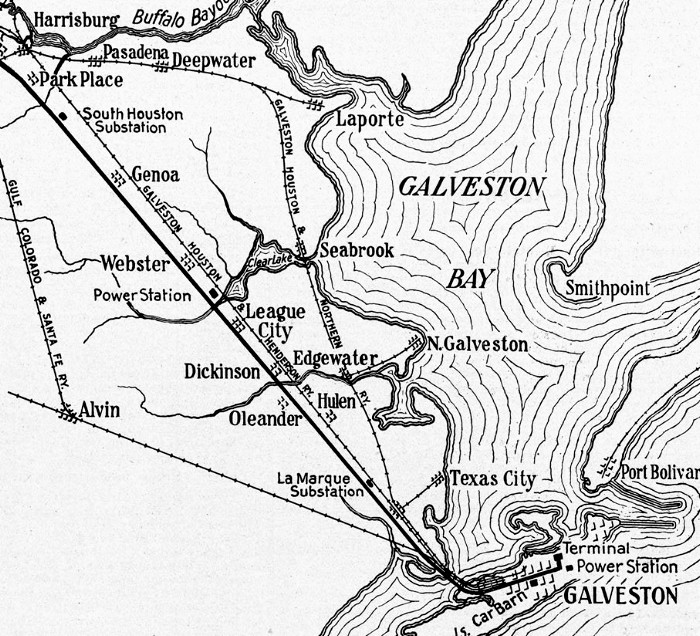 |
Left:
In 1911, the Galveston-Houston Electric (GHE) Railway opened interurban
service between Houston and Galveston. The GHE tracks were generally
parallel to the GH&H tracks, and they appear as a solid line on this
snippet from a 1913 GHE map. [Unfortunately, the map does not label two
key locations -- Texas City Junction and Virginia Point.] Near Texas
City Junction, the GHE
crossed the TCT's 1907 westward
extension (which was somehow omitted from the map) about 500
yards west of the TCT / GH&H diamond. Although both the GH&H and GHE had
straight tracks, a slight difference in their headings caused the GHE to
be over a thousand yards west of the GH&H at League City, and more than
1,800 yards west at Park Place.
The map provides an excellent
overview of the three steam railroad lines coming out of Galveston over
the Galveston Island Causeway. From Virginia Point, the GC&SF main line continued
west-northwest through
Alvin where a branch went north to Houston. The GH&N and GH&H were
parallel from Virginia Point to Texas City Junction. North of there, the
GH&N changed heading to pass through Edgewater, Seabrook and La Porte
before turning west into Harrisburg.
The map also
shows tracks for a steam railroad serving Port Bolivar. This was the
Gulf & Inter-State Railway line out of Beaumont
that opened in 1896, including service to Galveston by barge. In 1914 it
became owned by Santa Fe and continued operating to Port Bolivar
until it was abandoned back to High Island in 1942.
Today, the tracks remain intact southwest of Beaumont as far as Fannett,
presently owned by Santa Fe's successor,
Burlington Northern Santa Fe (BNSF.) BNSF was established by the 1996
merger of Burlington Northern with the Atchison, Topeka & Santa Fe
(AT&SF) Railway. The GC&SF had been acquired by AT&SF in 1887, but
it had continued to operate under the GC&SF name until 1965 when it was
fully merged. |
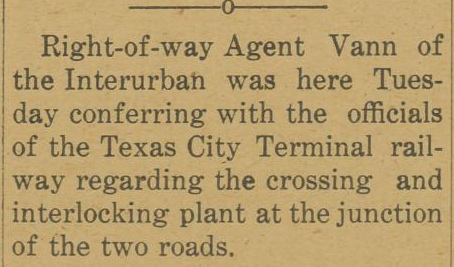 Above:
Discussions were held to consider the GHE crossing of the
TCT and the potential need for an interlocker. In later years, RCT approved plants for
steam / interurban
crossings at
Corsicana, Italy,
Plano and
Hillsboro, but RCT never listed GHE as a participant in Tower 73.
Thus far, no evidence has surfaced for a GHE interlocker near Texas City
Junction. More likely, interurban trains simply stopped before crossing the TCT.
There was a GHE station nearby, so the delays would have been negligible
since GHE trains were coming to a stop anyway. (Texas City Times,
September 16, 1910) Above:
Discussions were held to consider the GHE crossing of the
TCT and the potential need for an interlocker. In later years, RCT approved plants for
steam / interurban
crossings at
Corsicana, Italy,
Plano and
Hillsboro, but RCT never listed GHE as a participant in Tower 73.
Thus far, no evidence has surfaced for a GHE interlocker near Texas City
Junction. More likely, interurban trains simply stopped before crossing the TCT.
There was a GHE station nearby, so the delays would have been negligible
since GHE trains were coming to a stop anyway. (Texas City Times,
September 16, 1910) |
Right:
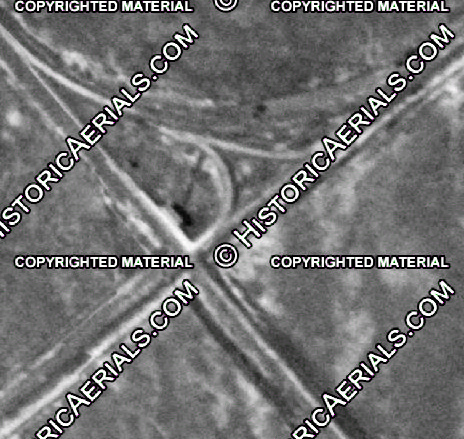
This image from 1930 ((c) historicaerials.com) shows that the GHE / TCT
crossing was more complex than might be expected. The interurban station
was located along the GHE tracks immediately northwest of the diamond.
Behind it, a connecting track facilitated freight car exchanges between
the two rail lines. This was not uncommon; interurbans offered limited
freight service that often involved exchanging cars with steam
railroads. Other examples of this can be found at
Tower 166, Tower
167 and near Tower 35. The GHE
is long gone, having closed in 1936.
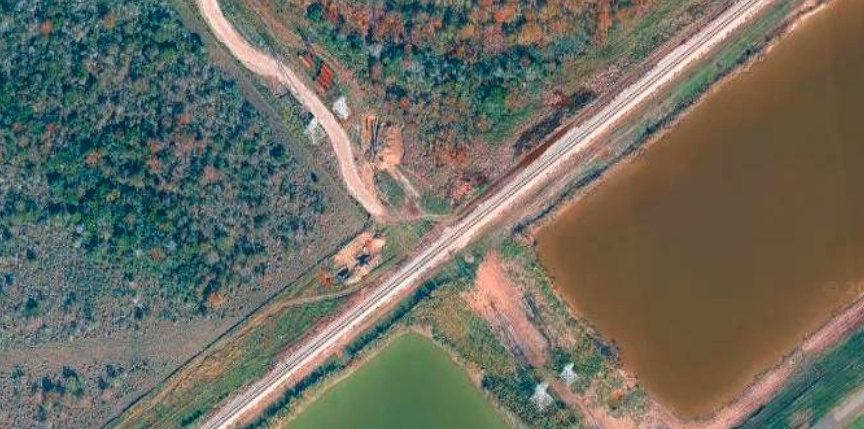
Below: This Google Maps
view of the GHE right-of-way at the TCT crossing shows it now
carries power lines (and pipelines.) The TCT remains operational, owned jointly by Union Pacific (UP) and BNSF.
 |
 |
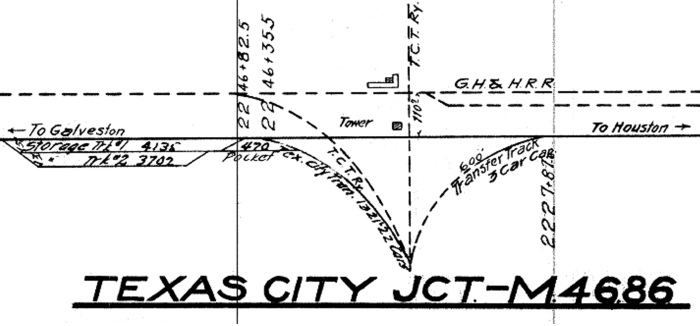 |
Left: This
1926 SP track chart of Texas City Junction (Carl Codney collection) from
the T&NO's archives is oriented with north to the right. It shows Tower 73
in the southwest quadrant of the TCT / GH&SA crossing. A depot is
depicted in the southwest quadrant of the GH&H / TCT crossing,
presumably the building visible in Barriger's photo at top of page.
Diagonally across from the tower, Barriger's photo shows a small
structure that has signage suggestive of a depot, but
it does not appear on this chart -- perhaps it was built after 1926. The
image does not show the GHE
tracks; they would be off the top of the
track chart at this scale. |
In 1922, the I&GN emerged from receivership with a new
name, the International - Great Northern (I-GN) Railroad. In 1925 it was acquired
by Missouri Pacific (MP) a major Midwestern railroad seeking a foothold
in Texas. The I-GN became fully merged into MP in 1956 and ceased to exist,
hence MP became the legal owner of I-GN's 50% share of the GH&H. MP was acquired by UP
in 1982 but continued to operate separately. In 1988, the Katy
was acquired by UP and merged into MP. Since MP and the Katy each held 50%
ownership of the GH&H, the merger put all of the GH&H under MP
ownership. The GH&H was dissolved as a separate legal entity in 1989, ending
130 years of operation under a single name and charter, the
lengthiest period for any railroad in Texas history.
UP continued its efforts to
consolidate railroads in the western U.S. by acquiring and merging SP in 1996.
Soon thereafter, SP and MP became fully
integrated into UP, with all operations conducted under UP's name. Thus, the
SP and GH&H tracks through Texas City are now owned by UP. The former GH&H
constitutes UP's main line between Virginia Point and Houston. The former SP
tracks still exist from Virginia Point through Texas City Junction, and they
continue north and diverge slightly east into Texas City on the original
NGH&KC alignment used by the GL&H. The tracks continue north across the bridge over Moses Bayou where UP serves an Ashland Co.
chemical plant. The rails terminate at the plant adjacent to the intersection of State Highway 146
and Attwater Ave.
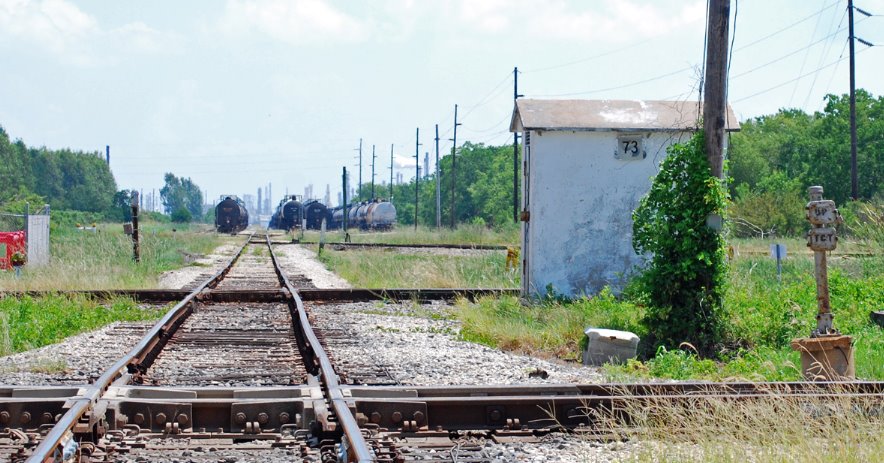
Right:
In this undated photo courtesy of Stephen Hesse, the camera is facing east-northeast along the TCT tracks toward the port
of Texas City. The near diamond was for the GH&H; the far
diamond was for the GH&SA. In the late 1950s, Tower 73's building was
removed and replaced by this cabin interlocker. Note the stand for manual override controls, with "UP"
and "TCT" labels on separate hinged boxes. The controls inside allow
train crews to override the automatic interlocker when necessary.
The two diamonds are 110 ft. apart, hence there were no signals between
them. The
gap appears to be much smaller because the compressed depth of field distorts distances vertically but not horizontally.
The cabin is 35 feet
from the track that appears to be just on the other side of it, and it
is eleven feet from the TCT rails. |
 |
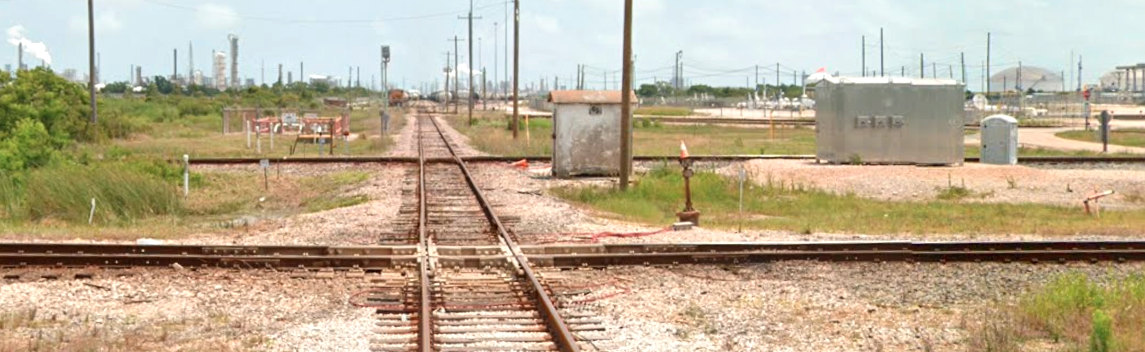
Above: This May, 2025 Google Street View shows that much
has changed since Stephen Hesse's photo was taken. In the distance to the right,
a large oil storage facility operated by Seaway Crude Pipeline LLC is visible.
It dates back to at least 1985, so it may simply have been obscured by the trees
in Stephen's photo. Sometime after May, 2023, the large silver cabin and the
smaller hut beside it were installed by UP, presumably replacing the active
electronics from the original cabin, which still stands, as does the interlocker
override post. Construction cones and orange cable suggest that work was
underway or recently completed. The cable extends beneath the former GH&H tracks
into the foreground and encircles several railroad ties beneath the TCT tracks,
perhaps some kind of detection circuit.
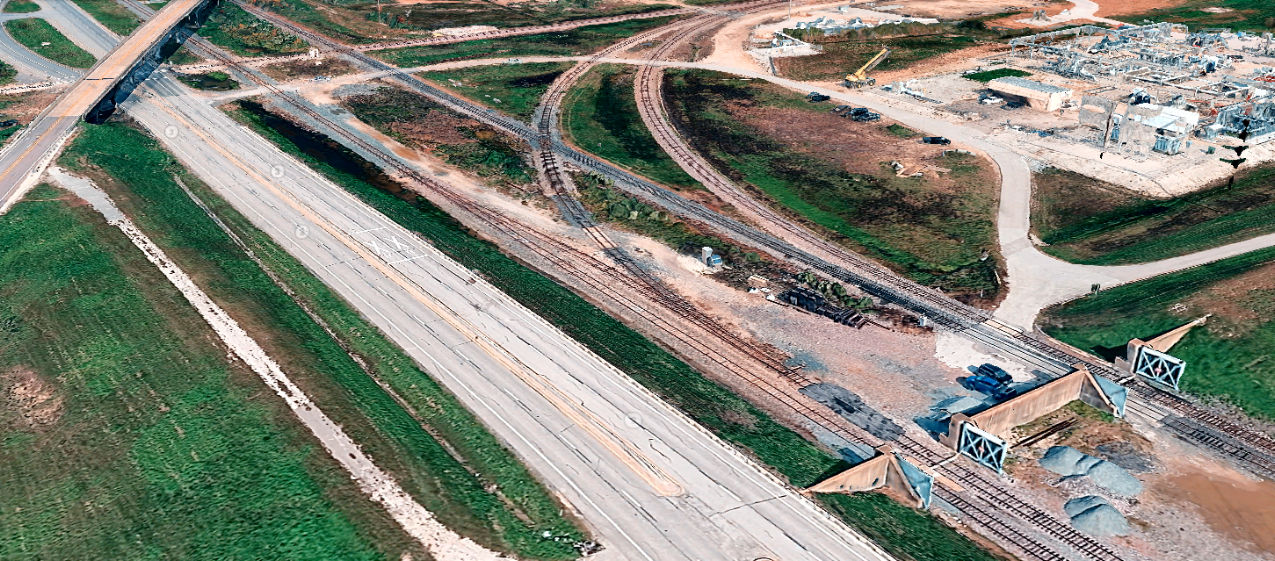
Above: Facing north at
Texas City Junction, parallel tracks of the former GH&SA and GH&H at lower right
come in from Virginia Point, passing through giant concrete gates installed by
UP to mitigate storm surge in the narrow channel where the tracks sit.
Immediately north of the gates, connecting tracks to the TCT curve off to the
north past the Seaway facility. The TCT crosses both lines at right angles
adjacent to the Tower 73 cabin interlocker which shows a door from this angle. This Google Maps 3D imagery is dated May, 2023 hence
the large silver cabin has not yet been installed. The Highway 146 overpass at
left offers a good view of the junction.
